Strong writing is not only about ideas; it is also about the words used to communicate those ideas. One of the most common issues in essays, blogs, research papers, and professional reports is word repetition.
When the same word appears too frequently, writing can feel monotonous and less sophisticated.
Using synonyms effectively allows writers to maintain clarity while improving vocabulary variety, tone precision, and reader engagement.
For students preparing academic essays or language exams, synonym diversity can significantly improve writing scores and lexical resource evaluation.
Bloggers benefit from it because varied vocabulary improves readability and SEO performance, while professionals use synonyms to maintain formal tone and conceptual accuracy in reports, research papers, and presentations.
The word “exploration” is widely used in fields such as science, geography, research, education, business, and creative writing.
However, repeating the same term repeatedly may weaken the impact of writing. Knowing alternative expressions helps writers communicate ideas with greater nuance and precision.
This guide introduces 14 powerful synonyms for “exploration”, explains when to use each one, and demonstrates how they function in different contexts.
By understanding these variations, writers can improve their academic clarity, professional tone, and linguistic sophistication.
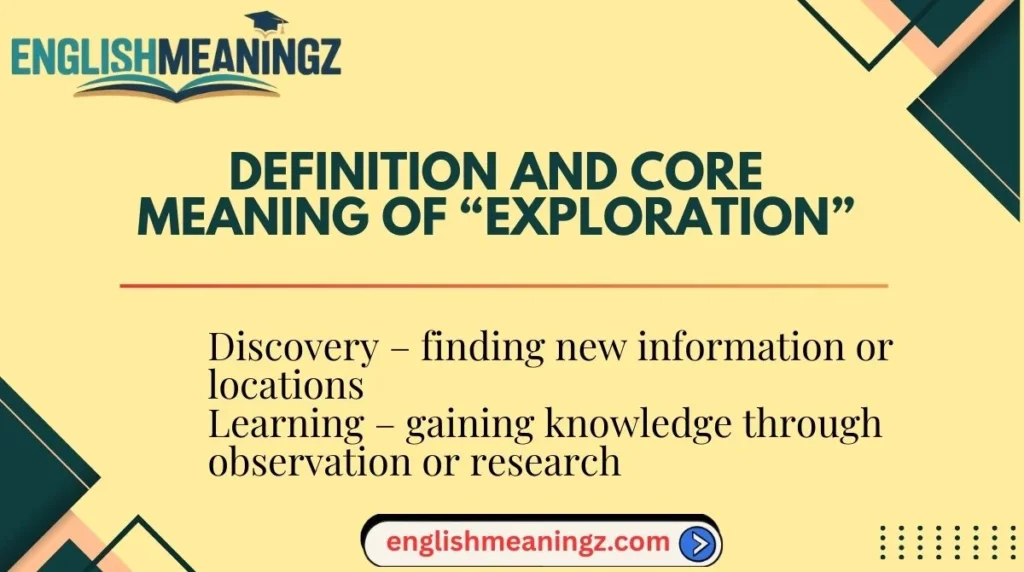
Definition and Core Meaning of “Exploration”
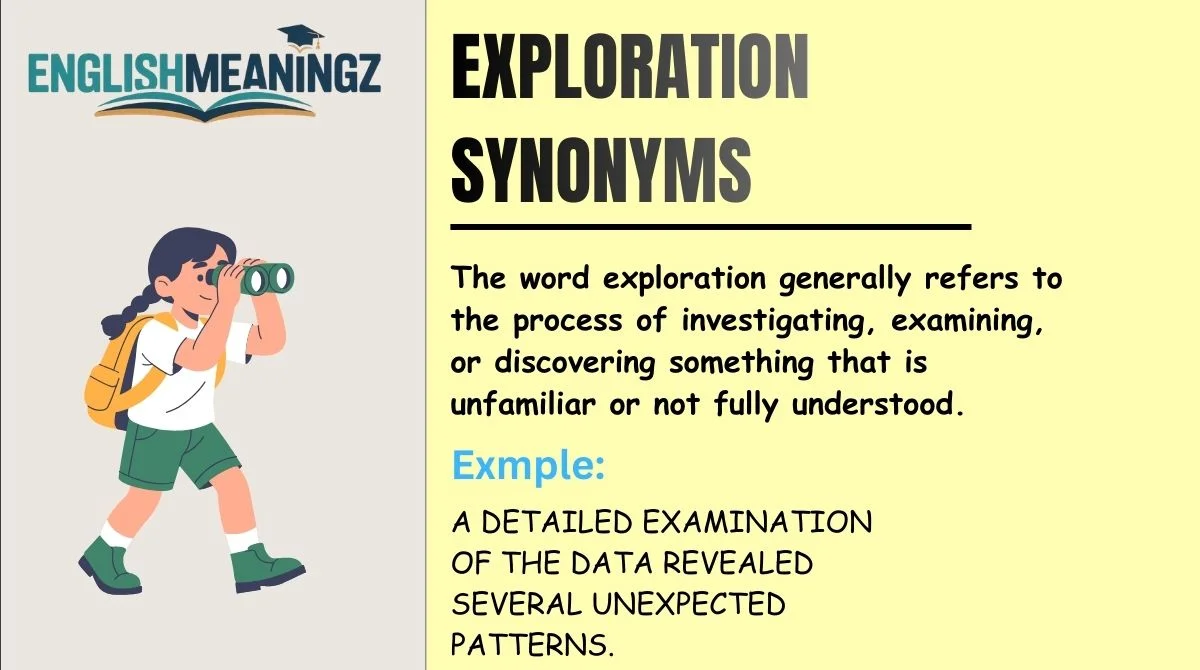
The word exploration generally refers to the process of investigating, examining, or discovering something that is unfamiliar or not fully understood.
At its core, exploration involves three main ideas:
- Investigation – examining something carefully
- Discovery – finding new information or locations
- Learning – gaining knowledge through observation or research
In academic contexts, exploration often refers to systematic study or research conducted to understand a topic more deeply. For example, scientists conduct exploration when studying unknown ecosystems, and scholars explore ideas when analyzing historical documents.
In everyday language, exploration can also refer to physical discovery, such as traveling to new places, or intellectual curiosity, such as learning about a new concept.
Because the word carries such a broad meaning, different synonyms are used depending on the context, tone, and level of formality.
14 Synonyms Grouped by Context
General Use Synonyms
These synonyms can be used in everyday writing and general communication.
Discovery
Meaning: The act of finding something previously unknown.
Context Explanation: Discovery emphasizes the moment when new knowledge or information becomes known.
Example Sentence:
The scientist’s discovery of a rare microorganism changed the direction of the entire research project.
Investigation
Meaning: A detailed and systematic examination of a subject.
Context Explanation: Investigation is commonly used when careful analysis or inquiry is involved.
Example Sentence:
The committee launched an investigation into the environmental impact of the construction project.
Search
Meaning: The act of looking for something carefully.
Context Explanation: Search focuses on the effort made to locate something specific.
Example Sentence:
The researchers began their search for historical records related to the ancient civilization.
Examination
Meaning: Careful observation or analysis of a subject.
Context Explanation: Examination often appears in academic or analytical contexts where close attention is required.
Example Sentence:
A detailed examination of the data revealed several unexpected patterns.
Formal & Academic Writing Synonyms
These words are particularly useful in essays, research papers, and academic writing.
Inquiry
Meaning: A formal investigation aimed at discovering truth or information.
Context Explanation: Inquiry is widely used in academic discussions, philosophy, and research studies.
Example Sentence:
The professor encouraged students to approach the topic through critical inquiry.
Analysis
Meaning: The process of studying something by examining its parts.
Context Explanation: Analysis is common in academic disciplines such as literature, science, and economics.
Example Sentence:
The analysis of survey results provided valuable insights into consumer behavior.
Research
Meaning: Systematic study conducted to establish facts or reach conclusions.
Context Explanation: Research is one of the most widely used academic synonyms for exploration.
Example Sentence:
Extensive research was conducted to understand the long-term effects of climate change.
Study
Meaning: Detailed learning or investigation of a subject.
Context Explanation: Study is often used in academic contexts when discussing scholarly examination.
Example Sentence:
The study explored the relationship between education and economic growth.
Evaluation
Meaning: The process of assessing the value or significance of something.
Context Explanation: Evaluation is used when exploration leads to judgment or assessment.
Example Sentence:
The evaluation of the new policy highlighted both its strengths and limitations.
Informal Usage Synonyms
These alternatives are suitable for casual writing, storytelling, or general discussion.
Adventure
Meaning: An exciting or unusual experience involving discovery.
Context Explanation: Adventure highlights the excitement of exploration.
Example Sentence:
Traveling through the rainforest became an unforgettable adventure for the young explorers.
Roaming
Meaning: Moving around freely without a fixed destination.
Context Explanation: Roaming suggests casual or spontaneous exploration.
Example Sentence:
They spent the afternoon roaming through the historic streets of the old city.
Wandering
Meaning: Moving aimlessly while observing surroundings.
Context Explanation: Wandering often appears in creative writing and narratives.
Example Sentence:
Her wandering through the museum led to a fascination with ancient art.
Technical or Subject-Specific Synonyms
These words appear frequently in scientific, academic, or professional contexts.
Survey
Meaning: A methodical inspection or data collection process.
Context Explanation: Survey is commonly used in research and environmental studies.
Example Sentence:
The environmental survey examined the biodiversity of the coastal region.
Reconnaissance
Meaning: Preliminary observation conducted to gather information.
Context Explanation: Reconnaissance is used in military, scientific, and strategic fields.
Example Sentence:
The team conducted reconnaissance before beginning the archaeological excavation.
Word Intensity & Tone Comparison Table
| Word | Formal Level | Emotional Strength | Common Context |
|---|---|---|---|
| Exploration | Neutral | Moderate | General writing |
| Discovery | Neutral | High | Science, innovation |
| Investigation | Formal | Moderate | Law, research |
| Inquiry | Highly formal | Low | Academic writing |
| Analysis | Highly formal | Low | Academic research |
| Adventure | Informal | High | Storytelling |
| Survey | Formal | Low | Data collection |
| Study | Formal | Low | Academic writing |
| Search | Neutral | Moderate | Everyday use |
| Reconnaissance | Technical | Moderate | Military, strategy |
This comparison shows that some synonyms emphasize emotion and excitement, while others focus on methodical analysis and scholarly investigation.
Common Mistakes When Using These Synonyms
Even strong vocabulary can create confusion if used incorrectly. Understanding the differences between similar words helps avoid common mistakes.
Mistake 1: Using “Adventure” in Formal Writing
Incorrect:
The scientist began an adventure of the new chemical compound.
Correct:
The scientist began an investigation of the new chemical compound.
Explanation:
“Adventure” is informal and unsuitable for academic contexts.
Mistake 2: Confusing “Research” and “Search”
Incorrect:
The professor conducted a search on climate change patterns.
Correct:
The professor conducted research on climate change patterns.
Explanation:
Research involves systematic study, while search simply means looking for something.
Mistake 3: Overusing “Analysis”
Incorrect:
The report included an analysis of the topic, followed by another analysis of the issue.
Correct:
The report included an analysis, followed by further evaluation of the issue.
Explanation:
Using synonyms helps maintain readability and stylistic variety.
Synonyms in Academic Writing
Example Paragraph 1
Modern scientific progress depends heavily on systematic research and continuous inquiry. Scholars frequently conduct detailed analysis to identify patterns and relationships within complex data sets. Through careful investigation, researchers can develop new theories that expand human knowledge.
Example Paragraph 2
Environmental scientists often begin their work with a regional survey to collect data on biodiversity. This initial study helps researchers identify ecological patterns and determine areas requiring deeper examination. Such structured exploration enables policymakers to design effective conservation strategies.
IELTS & Exam Writing Tips
Students preparing for language proficiency exams often lose marks because of repetitive vocabulary. Strategic synonym usage helps improve lexical variety, which is an important scoring criterion.
How to Avoid Repetition
Instead of writing:
The exploration of space has increased knowledge. Exploration allows scientists to learn more about planets.
Use variation:
The exploration of space has expanded scientific understanding. This research allows scientists to learn more about distant planets.
When NOT to Replace the Word
Sometimes replacing a word with a synonym may reduce clarity.
For example, in technical discussions about space exploration, replacing the term with adventure or wandering would be inaccurate.
Therefore, writers should ensure that synonyms maintain the original meaning and tone of the sentence.
Similar Words vs True Synonyms
Many words appear similar to “exploration,” but they are not always exact substitutes.
Exploration vs Investigation
Exploration is broader and may involve discovery or learning.
Investigation usually refers to a formal and systematic inquiry, often related to legal or scientific analysis.
Exploration vs Research
Exploration may involve curiosity-driven discovery.
Research refers to organized academic study with defined methodology.
Exploration vs Adventure
Adventure highlights excitement and personal experience, while exploration focuses on learning or discovery.
Understanding these subtle differences helps writers choose the most accurate and effective word.
Practice Sentences
Choose the most suitable synonym for each sentence.
- The archaeologists conducted a detailed ______ of the ancient ruins.
- Her lifelong ______ of art history led to several published books.
- The environmental ______ collected data from multiple ecosystems.
- Scientists began an extensive ______ into renewable energy sources.
- The travelers enjoyed their ______ through the remote mountain region.
Suggested Answers:
- investigation
- study
- survey
- research
- adventure
Practicing with these examples helps reinforce vocabulary usage and improves writing flexibility.
Frequently Asked Questions
What is the best synonym for exploration in academic writing?
The most suitable academic alternatives include research, investigation, inquiry, analysis, and study because they convey structured examination and scholarly analysis.
Can “discovery” replace exploration?
Yes, but only when the emphasis is on finding something new rather than the entire investigative process.
Which synonym is best for storytelling?
Words such as adventure, wandering, and roaming are better suited for narratives because they emphasize experience and movement.
Why should writers learn synonyms?
Synonyms help improve vocabulary diversity, readability, and clarity, which are essential for academic writing, blogging, and professional communication.
Are all synonyms interchangeable?
No. Each synonym carries different levels of formality, emotional tone, and contextual meaning, so writers should choose words carefully.
Conclusion
Mastering synonyms is one of the most effective ways to strengthen writing skills.
While the word exploration is useful and widely applicable, relying on it too frequently can make writing repetitive and less engaging.
Learning alternatives such as investigation, inquiry, research, discovery, survey, and analysis allows writers to express ideas with greater precision and stylistic sophistication.
For students, this skill can improve essay quality and exam performance. Bloggers benefit from improved readability and SEO optimization, while professionals gain the ability to communicate ideas more clearly in reports and research papers.
Ultimately, vocabulary development is a continuous process. By expanding your understanding of synonyms and practicing their use in different contexts, you can produce writing that is clearer, more dynamic, and more persuasive.