Strong vocabulary plays a critical role in effective academic and professional writing. One of the most common problems students, bloggers, and professionals face is excessive repetition of technical terms.
When the same word appears too frequently, the writing can feel monotonous and less engaging. Using appropriate synonyms helps improve clarity, readability, and overall writing quality.
Vocabulary variation is especially important in essays, research papers, and online content.
Many academic scoring systems—including university grading rubrics and international exams—reward writers who demonstrate lexical diversity.
By replacing repeated terms with suitable alternatives, writers can present their ideas more precisely while maintaining reader interest.
The term algorithm appears frequently in fields such as computer science, mathematics, data science, and artificial intelligence.
However, depending on the context, other words may express similar concepts more effectively.
Learning the right synonyms for algorithm allows students to communicate technical ideas more clearly and avoid repetitive phrasing.
This article explores 14 useful synonyms for “algorithm”, explains when each should be used, and provides examples that help writers apply them accurately in both academic and professional contexts.
Definition and Core Meaning of “Algorithm”
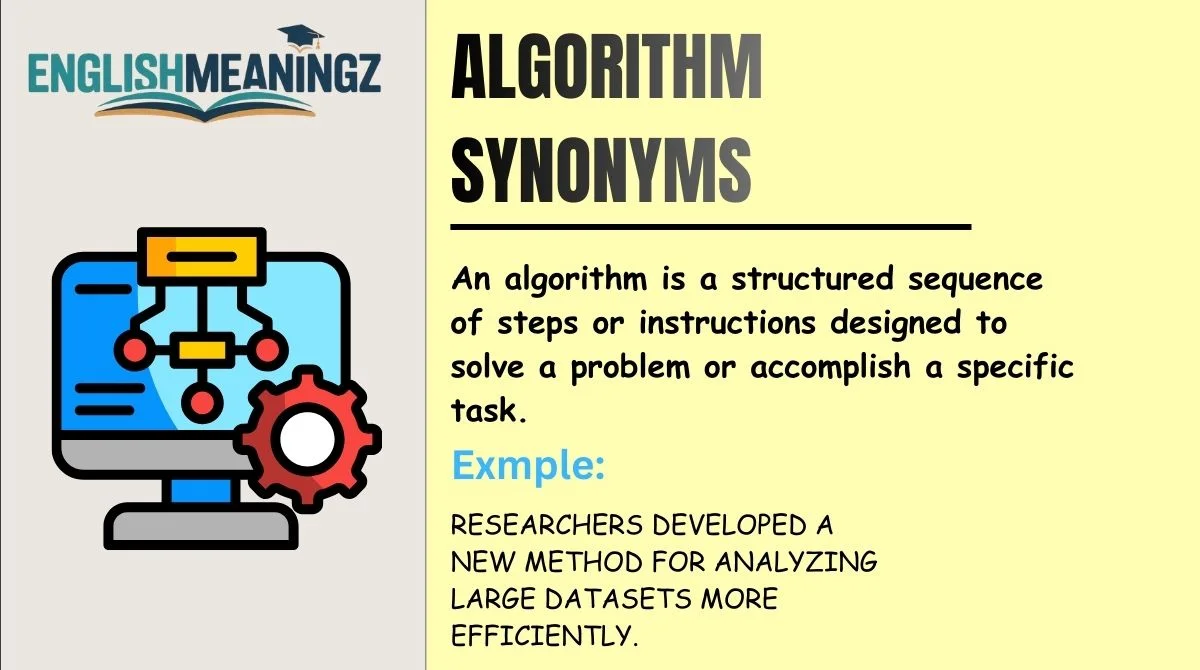
An algorithm is a structured sequence of steps or instructions designed to solve a problem or accomplish a specific task. Algorithms are fundamental to computer programming, mathematics, and data processing.
In computer science, an algorithm describes how a computer should perform calculations, process data, or make decisions. For example, sorting numbers in ascending order, searching for information in a database, or recommending videos on a streaming platform all rely on algorithms.
In broader terms, an algorithm can also refer to any logical procedure used to solve a problem step by step. Even everyday activities—such as following a cooking recipe or assembling furniture—can be viewed as simple algorithms because they involve a defined sequence of actions leading to a result.
The key characteristics of an algorithm include:
- A clear starting point
- Well-defined steps
- A logical sequence
- A predictable outcome
Because of its structured nature, the concept of an algorithm overlaps with several related terms such as method, procedure, process, formula, and technique. However, each synonym carries subtle differences in meaning and usage.
14 Synonyms Grouped by Context
General Use
Method
Meaning: A systematic way of doing something or achieving a result.
Context: Often used in both academic and everyday contexts to describe an organized approach.
Example sentence:
Researchers developed a new method for analyzing large datasets more efficiently.
Procedure
Meaning: A series of actions carried out in a specific order.
Context: Common in technical, laboratory, and administrative instructions.
Example sentence:
The software follows a precise procedure to verify user authentication.
Process
Meaning: A sequence of operations or steps that lead to a particular outcome.
Context: Frequently used in business, science, and computing.
Example sentence:
The image compression process reduces file size while preserving quality.
System
Meaning: A structured set of rules or methods working together.
Context: Used when referring to a complete organized structure rather than a single sequence.
Example sentence:
The recommendation system analyzes user preferences to suggest relevant products.
Formal & Academic Writing
Framework
Meaning: A structured model that guides problem solving or analysis.
Context: Widely used in research papers and academic discussions.
Example sentence:
The study proposes a computational framework for predicting climate patterns.
Model
Meaning: A representation or structured approach used to explain or simulate processes.
Context: Common in scientific research, data science, and machine learning.
Example sentence:
The predictive model estimates consumer behavior based on historical data.
Mechanism
Meaning: An underlying process or system that explains how something works.
Context: Often used in scientific or theoretical discussions.
Example sentence:
The algorithm relies on a ranking mechanism that prioritizes relevant results.
Protocol
Meaning: A predefined set of rules or procedures.
Context: Common in computing, networking, and research methodologies.
Example sentence:
The encryption protocol ensures secure communication between devices.
Informal Usage
Strategy
Meaning: A plan designed to achieve a specific objective.
Context: Frequently used in business, marketing, and general discussions.
Example sentence:
The search engine uses a ranking strategy to deliver the most relevant results.
Approach
Meaning: A particular way of dealing with a problem.
Context: Often used in both casual and academic writing.
Example sentence:
The researchers proposed a new approach to reduce computational complexity.
Technique
Meaning: A specific skill or method used to perform a task.
Context: Common in educational and technical discussions.
Example sentence:
This sorting technique improves processing speed in large databases.
Technical or Subject-Specific Use
Formula
Meaning: A mathematical expression used to perform calculations.
Context: Most appropriate in mathematics and quantitative analysis.
Example sentence:
The algorithm calculates probabilities using a statistical formula.
Routine
Meaning: A small program or repeated sequence of instructions.
Context: Frequently used in programming.
Example sentence:
The sorting routine organizes numbers in ascending order.
Workflow
Meaning: A structured sequence of tasks within a system.
Context: Common in software development and business automation.
Example sentence:
The automation workflow processes customer requests in real time.
Word Intensity & Tone Comparison Table
| Word | Formal Level | Technical Strength | Typical Context |
|---|---|---|---|
| Method | Medium | Moderate | Research, education |
| Procedure | High | Moderate | Laboratories, technical manuals |
| Process | Medium | Low | General explanations |
| Framework | Very High | High | Academic research |
| Model | High | High | Data science, statistics |
| Strategy | Medium | Low | Business and planning |
| Approach | Medium | Moderate | Academic writing |
| Technique | Medium | Moderate | Skill-based discussions |
| Routine | Technical | High | Programming |
| Workflow | Medium | Moderate | Automation systems |
This comparison highlights that not all synonyms can replace algorithm directly. The choice depends on context, level of formality, and subject matter.
Common Mistakes When Using These Synonyms
Even though many words are related to algorithm, they cannot always replace it accurately. Misusing synonyms can lead to unclear or incorrect writing.
Mistake 1: Replacing Algorithm with Strategy in Technical Context
Incorrect:
The encryption strategy sorts numbers using a quick-sort logic.
Correct:
The encryption algorithm sorts numbers using a quick-sort logic.
Explanation:
Sorting logic refers to a computational process, not a general plan.
Mistake 2: Using Formula When Steps Are Not Mathematical
Incorrect:
The login formula verifies the user’s identity.
Correct:
The login procedure verifies the user’s identity.
Explanation:
A formula refers specifically to mathematical expressions.
Mistake 3: Using Process When Precision Is Required
Incorrect:
The search process calculates ranking scores.
Correct:
The search algorithm calculates ranking scores.
Explanation:
“Process” is broader and less precise than “algorithm.”
Synonyms in Academic Writing
Example Paragraph 1
Modern data science relies heavily on computational methods that allow researchers to analyze large datasets efficiently. Machine learning models can identify patterns that would otherwise remain undetected. By developing improved analytical frameworks, scientists can enhance prediction accuracy and optimize decision-making processes.
Example Paragraph 2
In computer science, sorting techniques play an essential role in data organization. Efficient procedures reduce processing time and improve system performance. Researchers continually design new computational approaches to address the growing complexity of modern datasets.
IELTS & Exam Writing Tips
1. Avoid Repetition Strategically
When writing essays, repeating the same word many times reduces lexical variety. Instead of repeating algorithm, you can alternate between words like method, approach, or technique where appropriate.
Example:
Weak:
The algorithm improves efficiency. The algorithm also reduces errors.
Improved:
The algorithm improves efficiency. This computational method also reduces errors.
2. Maintain Meaning Accuracy
Do not replace a technical term if the synonym changes the meaning. In scientific writing, accuracy is more important than vocabulary variation.
Example:
Correct:
The algorithm calculates the shortest path.
Incorrect:
The strategy calculates the shortest path.
3. Use Synonyms in Supporting Sentences
Keep the main term when introducing a concept, and use synonyms later to maintain variety.
Example:
First sentence:
The algorithm sorts data efficiently.
Later sentence:
This computational approach reduces processing time.
Similar Words vs True Synonyms
Some words appear similar to algorithm but are not true synonyms.
Algorithm vs Program
An algorithm is the logical design or plan for solving a problem, while a program is the actual coded implementation of that algorithm.
Algorithm vs Formula
A formula is a mathematical expression, whereas an algorithm is a sequence of steps that may include multiple formulas.
Algorithm vs Process
A process describes a general sequence of actions, but an algorithm refers specifically to a well-defined computational procedure.
Understanding these distinctions helps writers choose the most accurate term.
Practice Sentences
Fill in the blank with the most appropriate synonym.
- The new sorting ______ significantly improves database performance.
- Researchers proposed a computational ______ for analyzing medical data.
- The authentication ______ verifies user identity before granting access.
- The data analysis ______ uses statistical modeling techniques.
- The automation ______ processes customer orders automatically.
Suggested answers:
- algorithm / technique
- framework
- procedure
- method
- workflow
Practicing with contextual examples helps reinforce correct vocabulary usage.
FAQs
What is the closest synonym for algorithm?
The closest synonym is method, because both describe a systematic way of solving a problem.
Can “process” replace “algorithm”?
Sometimes, but not always. Process is broader and less precise, so it may not be suitable in technical writing.
Is “formula” the same as algorithm?
No. A formula is a mathematical expression, while an algorithm is a sequence of logical steps that may include formulas.
Why are algorithm synonyms important in writing?
They improve vocabulary variety, enhance readability, and help avoid repetitive wording in essays and professional content.
Which synonym is best for academic writing?
Words such as method, framework, model, and approach are commonly used in academic papers.
Conclusion
Developing a strong vocabulary is essential for effective communication in both academic and professional environments.
The word algorithm is central to many technical discussions, particularly in computer science, mathematics, and data analysis.
However, relying on the same term repeatedly can weaken the clarity and engagement of your writing.
By learning appropriate alternatives such as method, procedure, framework, technique, model, and approach, writers can express ideas more precisely while maintaining lexical diversity.
Understanding the subtle differences between these words is equally important, as each carries its own contextual meaning.
Students preparing for exams, bloggers producing technical content, and professionals writing research papers can all benefit from mastering these synonyms.
With careful practice and thoughtful word choice, vocabulary development becomes a powerful tool for clearer and more effective communication.