Understanding opposites is one of the fastest ways to elevate your writing from average to precise and persuasive. When you know not only what a word means—but also what it does not mean—you gain control over tone, clarity, and emotional impact.
This is especially important with nuanced words like conciliatory, which carry subtle implications of peace, diplomacy, and compromise.
In academic and professional communication, word choice is never accidental. A single antonym can completely shift the intent of a sentence—from cooperative to hostile, from respectful to dismissive.
Whether you’re writing essays, reports, emails, or speeches, mastering opposites helps you communicate with authority and intention.
This guide explores 16 strong antonyms of “conciliatory”, with clear meanings, tone analysis, and real examples—so you can use them effectively in any context.
What Does “Conciliatory” Mean?
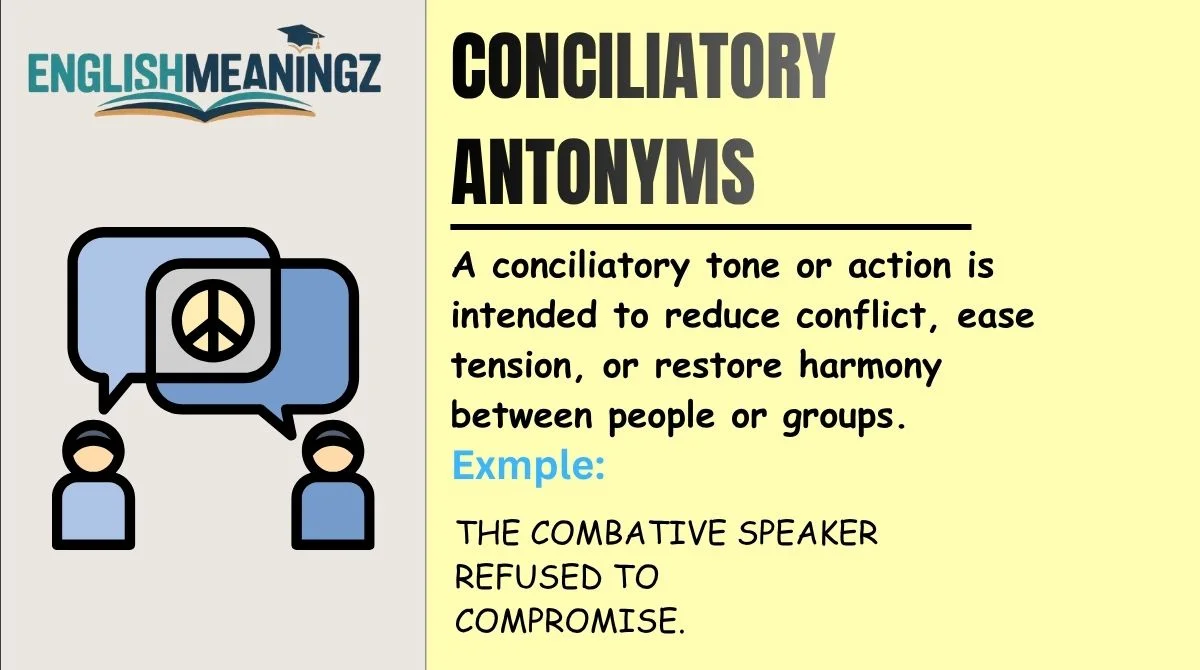
A conciliatory tone or action is intended to reduce conflict, ease tension, or restore harmony between people or groups.
Clear Definition
Conciliatory means showing willingness to settle disputes, calm disagreements, or make peace.
Tone Explanation
It carries a calm, diplomatic, and cooperative tone. It avoids aggression and instead emphasizes understanding and compromise.
Emotional / Action Intensity
Conciliatory behavior is low in hostility and high in empathy. It seeks resolution rather than escalation.
Example:
“Her conciliatory message helped resolve the argument before it worsened.”
16 Best Antonyms for “Conciliatory”
1. Hostile
Meaning: Showing strong opposition or aggression
Tone: Emotional / Formal
Example: His hostile response escalated the disagreement.
Why Opposite: Hostility increases conflict, while conciliatory behavior reduces it.
2. Aggressive
Meaning: Forceful, confrontational, or attacking
Tone: Informal / Emotional
Example: The aggressive tone of the debate shocked the audience.
Why Opposite: Aggression pushes conflict forward instead of calming it.
3. Confrontational
Meaning: Tending to provoke or challenge directly
Tone: Academic / Formal
Example: Her confrontational questions made the meeting tense.
Why Opposite: It invites conflict rather than resolving it.
4. Belligerent
Meaning: Inclined to fight or argue
Tone: Formal
Example: His belligerent attitude made negotiation impossible.
Why Opposite: Belligerence resists peace and promotes dispute.
5. Combative
Meaning: Ready or eager to fight
Tone: Informal / Emotional
Example: The combative speaker refused to compromise.
Why Opposite: It reflects conflict-seeking behavior, not harmony.
6. Argumentative
Meaning: Likely to engage in disagreements
Tone: Informal
Example: She became argumentative over minor issues.
Why Opposite: It sustains disputes instead of ending them.
7. Unyielding
Meaning: Not willing to compromise
Tone: Formal / Academic
Example: His unyielding stance blocked any agreement.
Why Opposite: Conciliatory behavior requires flexibility.
8. Stubborn
Meaning: Refusing to change opinion
Tone: Informal
Example: His stubborn refusal prolonged the conflict.
Why Opposite: Stubbornness prevents reconciliation.
9. Defiant
Meaning: Openly resisting authority or agreement
Tone: Emotional
Example: The defiant response worsened the situation.
Why Opposite: Defiance rejects cooperation.
10. Provocative
Meaning: Intended to trigger reaction or conflict
Tone: Formal
Example: His provocative remarks angered the group.
Why Opposite: It deliberately creates tension.
11. Antagonistic
Meaning: Actively opposing or hostile
Tone: Academic
Example: Their antagonistic relationship made teamwork difficult.
Why Opposite: It embodies opposition instead of harmony.
12. Harsh
Meaning: Severe, strict, or unkind
Tone: Informal / Emotional
Example: The harsh criticism discouraged cooperation.
Why Opposite: Harshness intensifies conflict.
13. Insulting
Meaning: Disrespectful or offensive
Tone: Emotional
Example: His insulting comment ended the discussion abruptly.
Why Opposite: Insults damage relationships instead of repairing them.
14. Abrasive
Meaning: Harsh and unfriendly in manner
Tone: Formal
Example: Her abrasive tone offended her colleagues.
Why Opposite: Abrasiveness creates friction, not peace.
15. Disputatious
Meaning: Fond of arguing
Tone: Academic
Example: The disputatious student challenged every point.
Why Opposite: It thrives on disagreement rather than resolution.
16. Inflexible
Meaning: Unwilling to change or adapt
Tone: Formal
Example: His inflexible approach prevented compromise.
Why Opposite: Conciliatory actions require adaptability.
Strong vs Mild Opposites
Not all antonyms carry the same intensity. Understanding this helps you choose the right word for the situation.
Strong Opposites
Words like hostile, belligerent, and antagonistic represent extreme conflict and aggression. Use these when describing intense disagreements or serious disputes.
Mild Opposites
Words like stubborn, inflexible, or argumentative indicate resistance without full aggression. These are suitable for everyday disagreements.
Key Insight
Conciliatory sits at the low-conflict end, so its strongest antonyms lie at the high-conflict extreme.
Context-Based Opposites
The best antonym often depends on the situation.
- Workplace conflict:
Use uncooperative, inflexible, or argumentative - Political or diplomatic context:
Use hostile, antagonistic, or belligerent - Casual conversation:
Use stubborn, abrasive, or harsh - Debates or discussions:
Use confrontational or provocative
Insight
Choosing context-appropriate antonyms improves clarity and avoids exaggeration.
Common Mistakes When Using Opposites
1. Confusing Strength Levels
Incorrect: “He was slightly hostile” (too strong for mild context)
Correct: “He was somewhat argumentative”
2. Using the Wrong Tone
Incorrect: “Her academic paper was aggressive”
Correct: “Her argument was confrontational”
3. Overusing Harsh Words
Writers often default to extreme words like hostile when milder terms would be more accurate.
4. Ignoring Context
Incorrect: Using belligerent in casual conversation
Better: Use stubborn or argumentative
5. Misinterpreting Conciliatory
Some assume it means “weak,” but it actually reflects strategic calmness and diplomacy.
Sentence Transformation Examples
Original Sentence 1
He gave a conciliatory response to ease tension.
Rewritten: He gave a hostile response that escalated tension.
Original Sentence 2
Her conciliatory tone helped resolve the issue.
Rewritten: Her confrontational tone worsened the issue.
Original Sentence 3
They adopted a conciliatory approach in negotiations.
Rewritten: They adopted an inflexible approach in negotiations.
Original Sentence 4
The manager remained conciliatory during the conflict.
Rewritten: The manager remained abrasive during the conflict.
Original Sentence 5
His conciliatory attitude restored harmony.
Rewritten: His antagonistic attitude destroyed harmony.
FAQs
What is the simplest antonym of conciliatory?
The simplest antonym is hostile, as it directly represents opposition and aggression.
Are all antonyms of conciliatory negative?
Most are negative because they reflect conflict, resistance, or aggression.
Can “assertive” be an antonym of conciliatory?
Not always. Assertive can be neutral or positive, unlike truly opposing terms like antagonistic.
Which antonym is best for formal writing?
Words like antagonistic, confrontational, and inflexible are more suitable for formal contexts.
What is a mild opposite of conciliatory?
Stubborn or argumentative are milder opposites.
Is “aggressive” always the best opposite?
No. It depends on context. Sometimes inflexible or abrasive fits better.
Why is learning antonyms important?
It improves vocabulary precision, strengthens arguments, and enhances communication clarity.
Conclusion
Mastering antonyms of conciliatory gives you a powerful advantage in both writing and communication. These opposites allow you to express conflict, resistance, and tension with accuracy and nuance.
From mild disagreement to full hostility, each word carries a unique tone and intensity.
By understanding when and how to use these antonyms, you gain the ability to shape meaning, control emotional impact, and communicate more effectively in academic, professional, and everyday situations.