Understanding opposites is one of the fastest ways to sharpen your writing. When you know both a word and its antonyms, you gain control over tone, clarity, and precision.
Instead of repeating the same descriptive language, you can switch perspectives and express stronger or subtler meanings with confidence.
In academic and professional communication, this skill becomes even more valuable. Whether you are crafting essays, reports, or persuasive content, choosing the right opposite word can transform weak sentences into compelling statements.
It helps you contrast ideas, emphasize arguments, and communicate nuanced emotions effectively.
This guide focuses on “docile antonyms”—powerful alternatives that express resistance, boldness, and intensity. By mastering them, you’ll instantly upgrade your vocabulary and writing style.
What Does “Docile” Mean?
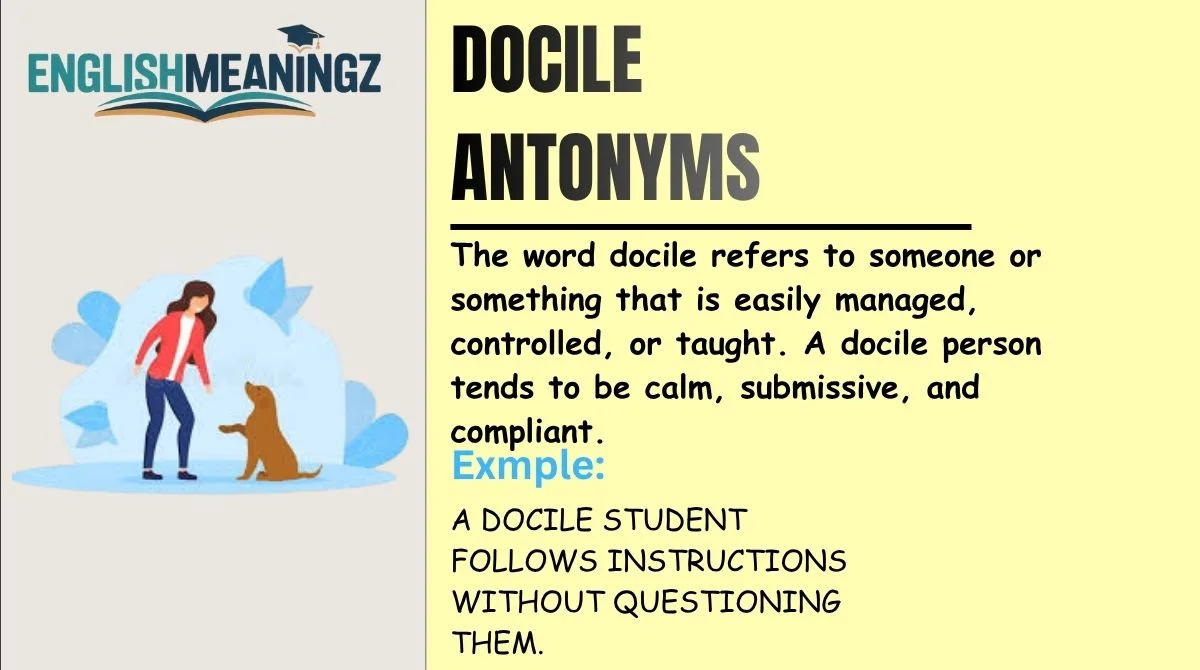
The word docile refers to someone or something that is easily managed, controlled, or taught. A docile person tends to be calm, submissive, and compliant.
Tone Explanation
“Docile” carries a neutral-to-positive tone depending on context. It can suggest politeness and cooperation, but it may also imply weakness or lack of independence.
Emotional or Action Intensity
- Low intensity behavior
- Passive, yielding, and non-resistant
- Often associated with obedience or gentleness
For example:
A docile student follows instructions without questioning them.
Understanding this baseline helps us explore its opposites—words that express strength, defiance, and assertiveness.
16 Best Antonyms for “Docile”
Defiant
Meaning: Boldly resisting authority or opposition
Tone: Emotional
Example: The child remained defiant despite repeated warnings.
Why it’s an opposite: A docile person obeys; a defiant person resists openly.
Rebellious
Meaning: Actively resisting rules or control
Tone: Emotional
Example: Teenagers often go through a rebellious phase.
Why it’s an opposite: Rebellion directly contradicts docility’s compliance.
Aggressive
Meaning: Ready to attack or confront
Tone: Formal / Emotional
Example: His aggressive tone made the discussion uncomfortable.
Why it’s an opposite: Docility is calm; aggression is forceful and confrontational.
Assertive
Meaning: Confidently expressing opinions
Tone: Professional
Example: She is assertive in meetings and voices her ideas clearly.
Why it’s an opposite: Assertiveness involves control and confidence, not submission.
Stubborn
Meaning: Refusing to change one’s opinion
Tone: Informal
Example: He was too stubborn to admit his mistake.
Why it’s an opposite: A docile person yields; a stubborn one refuses.
Unruly
Meaning: Difficult to control or discipline
Tone: Informal
Example: The unruly crowd disrupted the event.
Why it’s an opposite: Docility implies order; unruliness suggests chaos.
Fierce
Meaning: Intense, strong, and aggressive
Tone: Emotional
Example: She gave a fierce response to criticism.
Why it’s an opposite: Fierceness shows strength instead of submission.
Belligerent
Meaning: Hostile and eager to fight
Tone: Academic
Example: His belligerent attitude escalated the conflict.
Why it’s an opposite: Belligerence directly opposes docile calmness.
Resistant
Meaning: Opposing or withstanding force
Tone: Formal
Example: The material is resistant to damage.
Why it’s an opposite: Resistance replaces compliance.
Dominant
Meaning: Exercising control or influence
Tone: Professional
Example: She has a dominant presence in negotiations.
Why it’s an opposite: Dominance contrasts with submissive docility.
Independent
Meaning: Self-reliant and not controlled by others
Tone: Academic
Example: He prefers to remain independent in decision-making.
Why it’s an opposite: Independence rejects the idea of being easily controlled.
Headstrong
Meaning: Determined to do as one pleases
Tone: Informal
Example: The headstrong athlete refused to follow advice.
Why it’s an opposite: Docility follows guidance; headstrong behavior ignores it.
Forceful
Meaning: Strong and assertive in action
Tone: Formal
Example: Her forceful argument convinced the audience.
Why it’s an opposite: Forcefulness replaces gentleness with intensity.
Combative
Meaning: Ready to argue or fight
Tone: Academic
Example: His combative nature created tension in the team.
Why it’s an opposite: Combative personalities oppose docile cooperation.
Wild
Meaning: Untamed or uncontrolled
Tone: Informal
Example: The wild horse resisted being trained.
Why it’s an opposite: Wildness is the absence of docile control.
Insolent
Meaning: Showing disrespect or arrogance
Tone: Formal
Example: The student gave an insolent reply to the teacher.
Why it’s an opposite: Insolence challenges authority instead of obeying it.
Strong vs Mild Opposites
Not all antonyms carry the same intensity. Understanding this helps you choose the right word for the right context.
Mild Opposites
These suggest independence without aggression:
- Assertive
- Independent
- Resistant
Moderate Opposites
These reflect noticeable opposition:
- Stubborn
- Headstrong
- Unruly
Strong Opposites
These indicate extreme behavior:
- Aggressive
- Belligerent
- Combative
- Fierce
Using the wrong intensity can distort your message. For example, calling someone “belligerent” instead of “assertive” may sound unnecessarily harsh.
Context-Based Opposites
Antonyms change depending on the situation. “Docile” can describe behavior, personality, or even animals.
In Personality Context
- Docile → Assertive / Independent
In Behavior Context
- Docile → Defiant / Rebellious
In Animal Context
- Docile → Wild / Aggressive
In Professional Settings
- Docile → Dominant / Forceful
Choosing the correct antonym depends on what aspect of docility you are contrasting.
Common Mistakes When Using Opposites
Confusing Strength with Negativity
Not all opposites are negative.
Incorrect: She is aggressive in meetings
Better: She is assertive in meetings
Using Extreme Words Unnecessarily
Overusing strong antonyms can sound exaggerated.
Incorrect: He was belligerent about a minor issue
Better: He was stubborn about a minor issue
Ignoring Context
Some antonyms only fit specific situations.
Incorrect: The wild employee refused instructions
Better: The rebellious employee refused instructions
Misjudging Tone
Words like “insolent” carry a negative tone and should be used carefully.
Sentence Transformation Examples
Original Sentence 1
The student was docile in class.
Rewritten: The student was assertive in class.
Original Sentence 2
The dog remained docile during training.
Rewritten: The dog became wild during training.
Original Sentence 3
She gave a docile response to criticism.
Rewritten: She gave a defiant response to criticism.
Original Sentence 4
The employee appeared docile in meetings.
Rewritten: The employee appeared dominant in meetings.
Original Sentence 5
The child was docile despite pressure.
Rewritten: The child was stubborn despite pressure.
FAQs
What is the simplest antonym of “docile”?
The simplest antonym is defiant, as it directly contrasts obedience with resistance.
Is “assertive” a negative opposite of docile?
No, “assertive” is generally positive and reflects confidence rather than aggression.
Can “wild” always replace “docile”?
No, “wild” is mainly used for animals or uncontrolled situations, not formal human behavior.
Which antonym is best for professional writing?
“Assertive,” “independent,” and “dominant” are suitable for professional contexts.
Are all antonyms of docile aggressive?
No, some are neutral or positive, such as “independent” or “assertive.”
What is the strongest antonym of docile?
“Belligerent” and “combative” are among the strongest opposites.
Why is it important to learn antonyms?
Antonyms improve vocabulary range, clarity, and the ability to express contrast effectively.
Conclusion
Mastering docile antonyms gives you a powerful advantage in communication. Instead of relying on basic vocabulary, you can precisely express resistance, confidence, or intensity depending on your needs.
From mild opposites like “assertive” to strong ones like “belligerent,” each word adds a new dimension to your writing.
The key is not just knowing these words, but understanding their tone, context, and intensity. When used correctly, they can transform ordinary sentences into impactful, professional, and engaging communication.