Understanding opposites is one of the fastest ways to sharpen your writing clarity, precision, and emotional impact. When you know not just what a word means—but also what it is not—you gain control over nuance, tone, and intention.
This is especially critical in persuasive writing, academic essays, and professional communication where word choice directly shapes meaning.
Antonyms act like directional tools. They help you contrast ideas, refine arguments, and avoid ambiguity. In academic contexts, they allow you to demonstrate critical thinking by presenting opposing viewpoints.
In professional environments, they prevent miscommunication by ensuring your message is exact and intentional.
This article explores 16 custom antonyms, offering deep insight into how opposites function, when to use them, and how to apply them effectively in real-world writing.
What Does “Custom” Mean?
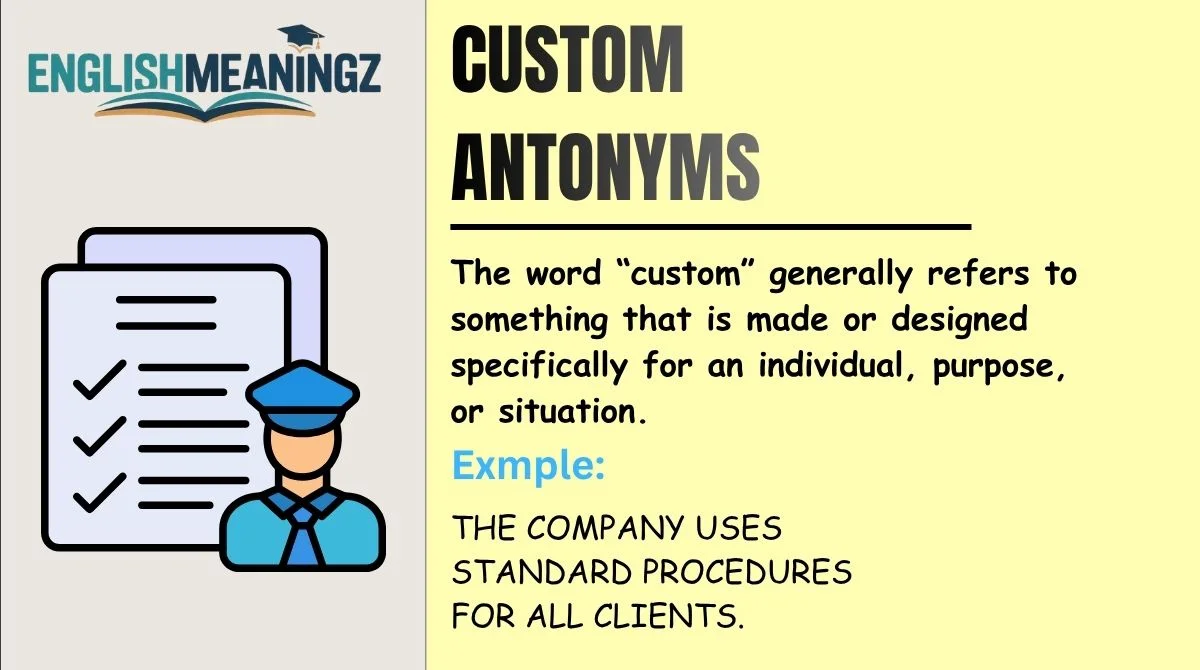
The word “custom” generally refers to something that is made or designed specifically for an individual, purpose, or situation. It emphasizes personalization, uniqueness, and tailored characteristics.
Tone Explanation:
“Custom” carries a neutral to positive tone. It often suggests care, exclusivity, and intentional design.
Emotional or Action Intensity:
Moderate intensity. It is not emotionally charged but implies thoughtful adaptation or personalization rather than randomness or uniformity.
16 Best Antonyms for “Custom”
Standard
Meaning: Conforming to a fixed or common norm
Tone: Formal / Academic
Example: The company uses standard procedures for all clients.
Why Opposite: “Custom” is tailored; “standard” is uniform and unmodified.
Generic
Meaning: Lacking uniqueness; widely common
Tone: Neutral
Example: The product felt generic and uninspired.
Why Opposite: Custom implies uniqueness; generic suggests sameness.
Mass-produced
Meaning: Manufactured in large quantities without variation
Tone: Industrial / Neutral
Example: These shoes are mass-produced in factories.
Why Opposite: Custom items are individualized; mass-produced items are identical.
Uniform
Meaning: Consistent and unchanging across all instances
Tone: Formal
Example: The design remains uniform across all platforms.
Why Opposite: Custom varies by need; uniform eliminates variation.
Conventional
Meaning: Based on traditional or widely accepted standards
Tone: Formal
Example: He followed a conventional approach to problem-solving.
Why Opposite: Custom breaks away from norms; conventional follows them.
Ready-made
Meaning: Already prepared and not tailored
Tone: Neutral
Example: She bought a ready-made dress instead of tailoring one.
Why Opposite: Custom involves creation for a specific need; ready-made does not.
Template-based
Meaning: Built from a pre-designed format
Tone: Technical
Example: The website uses a template-based layout.
Why Opposite: Custom design is original; templates repeat structure.
Common
Meaning: Frequently found; not special
Tone: Neutral
Example: This issue is quite common in new systems.
Why Opposite: Custom is distinctive; common is ordinary.
Ordinary
Meaning: Not special or unusual
Tone: Neutral
Example: It was an ordinary solution with no innovation.
Why Opposite: Custom adds uniqueness; ordinary lacks it.
Typical
Meaning: Representative of a general pattern
Tone: Neutral
Example: This is a typical response to stress.
Why Opposite: Custom is exceptional; typical is expected.
Fixed
Meaning: Not changeable or adaptable
Tone: Formal
Example: The system operates on a fixed schedule.
Why Opposite: Custom is flexible; fixed is rigid.
Preset
Meaning: Pre-established and not adjustable
Tone: Technical
Example: The camera settings are preset for beginners.
Why Opposite: Custom allows adjustments; preset restricts them.
Standardized
Meaning: Made consistent according to rules
Tone: Academic
Example: The test is standardized across all schools.
Why Opposite: Custom adapts; standardized enforces uniformity.
Off-the-shelf
Meaning: Available without modification
Tone: Informal / Business
Example: They chose an off-the-shelf software solution.
Why Opposite: Custom is built from scratch; off-the-shelf is pre-built.
Universal
Meaning: Applicable to all cases
Tone: Formal
Example: There is no universal solution to this issue.
Why Opposite: Custom is specific; universal is broad.
Predefined
Meaning: Determined in advance
Tone: Technical
Example: The options are predefined in the system.
Why Opposite: Custom evolves based on need; predefined is fixed beforehand.
Strong vs Mild Opposites
Not all antonyms carry the same intensity. Some create a sharp contrast, while others only slightly shift meaning.
Strong Opposites:
Mass-produced, standardized, uniform
These directly contradict the essence of customization by eliminating variation entirely.
Moderate Opposites:
Generic, typical, ordinary
These suggest lack of uniqueness but don’t fully remove the possibility of minor variation.
Mild Opposites:
Conventional, common, ready-made
These contrast with custom subtly, often depending on context.
Understanding this intensity scale helps you choose the right level of contrast instead of over- or under-expressing your idea.
Context-Based Opposites
Antonyms are not always fixed. Context determines the most appropriate opposite.
- In fashion: Custom vs Ready-made
- In software: Custom vs Template-based
- In manufacturing: Custom vs Mass-produced
- In communication: Custom vs Standardized
For example, saying “custom software” contrasts best with “off-the-shelf software,” not necessarily “generic.”
Choosing the right antonym depends on the domain, audience, and intent.
Common Mistakes When Using Opposites
1. Using weak opposites
Incorrect: Custom vs Different
Correct: Custom vs Standard
2. Ignoring context
Incorrect: Custom vs Universal (in fashion context)
Correct: Custom vs Ready-made
3. Confusing tone levels
Mixing formal and informal opposites can weaken writing clarity.
4. Overgeneralization
Not every non-custom item is generic. Some may still have partial customization.
5. Misinterpreting meaning
“Preset” doesn’t always oppose custom—it depends on whether modification is possible.
Sentence Transformation Examples
Original: The company offers custom solutions.
Rewritten: The company offers standardized solutions.
Original: She prefers custom clothing.
Rewritten: She prefers ready-made clothing.
Original: This is a custom-built system.
Rewritten: This is a template-based system.
Original: The design is fully custom.
Rewritten: The design is generic.
Original: We created a custom strategy.
Rewritten: We followed a conventional strategy.
FAQs
What is the simplest antonym for “custom”?
The simplest and most widely applicable antonym is “standard.”
Are all antonyms exact opposites?
No. Many antonyms are context-based and vary in intensity.
Can “generic” always replace “standard”?
Not always. “Generic” implies lack of uniqueness, while “standard” implies conformity.
Is “ready-made” informal?
It is generally neutral but more commonly used in everyday language.
Why are multiple antonyms needed for one word?
Because meaning changes across contexts, requiring different opposites.
Is “mass-produced” a strong antonym?
Yes, it strongly contrasts with customization by removing individuality.
How do I choose the right antonym?
Consider context, tone, and the degree of contrast you want to express.
Conclusion
Mastering antonyms like those for “custom” is more than a vocabulary exercise—it’s a strategic skill. Whether you are writing academically, professionally, or creatively, understanding opposites allows you to communicate with precision, contrast ideas effectively, and enhance readability.
By learning these 16 antonyms and their contextual applications, you gain flexibility in expression and avoid common language pitfalls.
The key is not just knowing opposites, but knowing which opposite fits best in a given situation.