Understanding opposites is one of the fastest ways to sharpen your writing. When you know not just what a word means—but also what it doesn’t mean—you gain control over tone, clarity, and precision.
This is especially true for a word like hiatus, which carries subtle implications of pause, interruption, and temporary absence.
In academic and professional communication, choosing the right opposite can dramatically change meaning. Whether you’re writing essays, business reports, or creative content, replacing vague phrasing with precise antonyms elevates your authority and readability.
Instead of simply saying something “resumed,” you might choose “continued,” “sustained,” or “maintained,” depending on the nuance you want to convey.
This guide gives you 19 powerful antonyms for hiatus, each explained with tone, usage, and real examples—so you can apply them confidently in any context.
What Does “Hiatus” Mean?
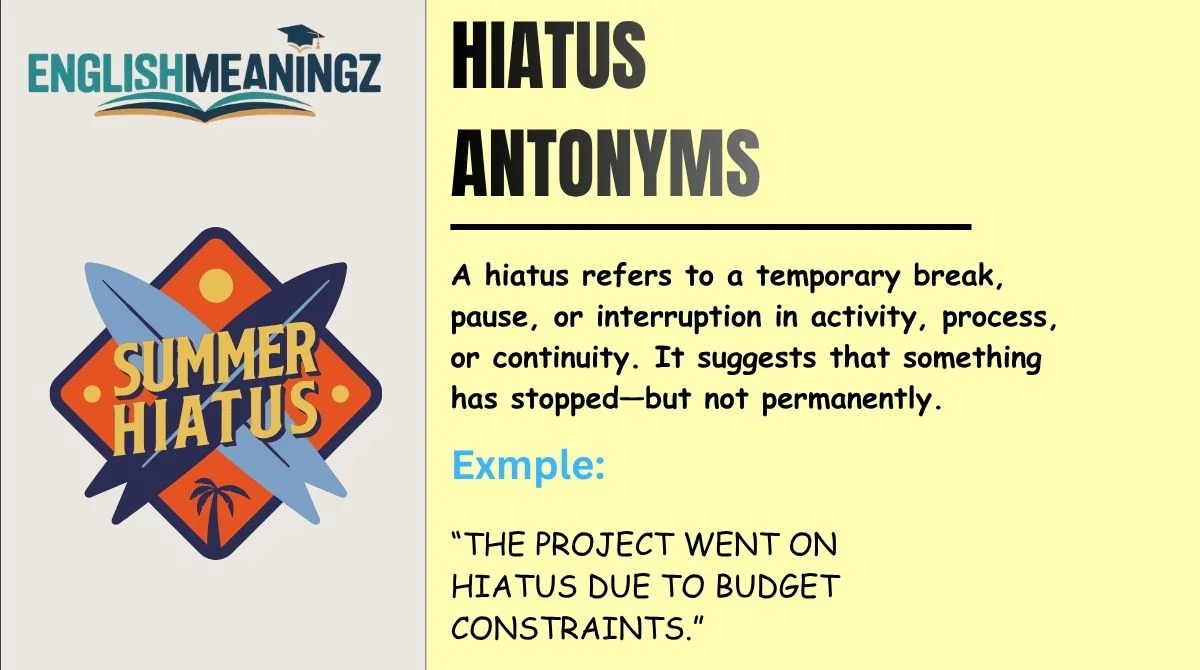
A hiatus refers to a temporary break, pause, or interruption in activity, process, or continuity. It suggests that something has stopped—but not permanently.
Tone Explanation:
The word carries a neutral-to-formal tone. It is often used in academic, professional, or literary contexts rather than casual speech.
Emotional or Action Intensity:
A hiatus implies intentional or circumstantial pause, not termination. It suggests a gap with the expectation of continuation.
Example:
- “The project went on hiatus due to budget constraints.”
Here, the activity pauses, but the possibility of resuming remains open.
19 Best Antonyms for “Hiatus”
1. Continuation
Meaning: Ongoing progress without interruption
Tone: Formal / Academic
Example: The continuation of the program ensured consistent results.
Why it’s opposite: It directly contrasts a pause by emphasizing uninterrupted flow.
2. Resumption
Meaning: Starting again after a pause
Tone: Formal
Example: The resumption of classes brought students back to routine.
Why it’s opposite: While related to hiatus, it cancels the pause by restarting action.
3. Persistence
Meaning: Continuous effort despite challenges
Tone: Academic / Motivational
Example: Her persistence led to long-term success.
Why it’s opposite: A hiatus implies stopping; persistence means never stopping.
4. Continuity
Meaning: Unbroken and consistent existence
Tone: Formal
Example: The continuity of leadership stabilized the company.
Why it’s opposite: It eliminates the concept of interruption entirely.
5. Progress
Meaning: Forward movement or advancement
Tone: Neutral / Professional
Example: The project showed steady progress over time.
Why it’s opposite: Progress suggests movement, not pause.
6. Activity
Meaning: State of being active
Tone: Neutral
Example: The office was full of activity all day.
Why it’s opposite: A hiatus removes activity; this restores it.
7. Operation
Meaning: Functioning or working state
Tone: Formal / Technical
Example: The system remained in full operation overnight.
Why it’s opposite: A hiatus halts operation; this maintains it.
8. Engagement
Meaning: Active involvement
Tone: Professional
Example: Employee engagement increased productivity.
Why it’s opposite: Engagement implies active participation, not withdrawal.
9. Action
Meaning: Doing something actively
Tone: Neutral
Example: Immediate action was required to fix the issue.
Why it’s opposite: A hiatus suspends action; this enforces it.
10. Momentum
Meaning: Force that keeps something moving
Tone: Professional / Motivational
Example: The team maintained momentum throughout the campaign.
Why it’s opposite: Momentum resists pauses and interruptions.
11. Flow
Meaning: Smooth and continuous movement
Tone: Informal / Professional
Example: The workflow ensured a smooth flow of tasks.
Why it’s opposite: Flow eliminates breaks entirely.
12. Consistency
Meaning: Regular and stable performance
Tone: Academic / Professional
Example: Consistency is key to long-term success.
Why it’s opposite: A hiatus disrupts consistency.
13. Advancement
Meaning: Moving forward or improving
Tone: Formal
Example: Technological advancement changed the industry.
Why it’s opposite: Advancement contradicts any form of pause.
14. Continuance
Meaning: Ongoing existence
Tone: Formal
Example: The continuance of support was crucial.
Why it’s opposite: It sustains what a hiatus interrupts.
15. Perpetuation
Meaning: Making something continue indefinitely
Tone: Academic
Example: The perpetuation of traditions preserved culture.
Why it’s opposite: It implies endless continuation, not pause.
16. Maintenance
Meaning: Keeping something in its current state
Tone: Professional
Example: Regular maintenance ensured system stability.
Why it’s opposite: Maintenance prevents interruption.
17. Execution
Meaning: Carrying out a plan
Tone: Professional
Example: The execution of the strategy was flawless.
Why it’s opposite: Execution involves active doing, not pausing.
18. Ongoing Process
Meaning: Something that continues over time
Tone: Neutral / Professional
Example: Learning is an ongoing process.
Why it’s opposite: Emphasizes continuous duration.
19. Stability
Meaning: Steady and unchanging condition
Tone: Formal
Example: Economic stability benefited investors.
Why it’s opposite: A hiatus disrupts stability.
Strong vs Mild Opposites
Not all antonyms carry the same intensity. Some strongly reject the idea of a hiatus, while others simply soften it.
Strong Opposites:
Words like continuity, perpetuation, and momentum completely eliminate the possibility of interruption. They suggest an uninterrupted, powerful flow.
Moderate Opposites:
Terms like progress, advancement, and execution focus on movement but don’t necessarily guarantee consistency.
Mild Opposites:
Words such as resumption and maintenance imply recovery from a hiatus rather than total avoidance.
Understanding this scale helps you match the word to your intent. If you want to emphasize unstoppable progress, choose a strong antonym. If you’re describing recovery after a pause, a mild one works better.
Context-Based Opposites
The best antonym often depends on context rather than dictionary definition.
Academic Context:
- Use continuity, consistency, or perpetuation
Business Context:
- Prefer operation, execution, or momentum
Creative Writing:
- Words like flow or action feel more natural
Personal Development:
- Persistence and progress are ideal
Example:
- “After a hiatus, the company regained momentum.”
Here, momentum works better than continuity because it emphasizes regained energy.
Common Mistakes When Using Opposites
1. Confusing Resumption with Continuation
Incorrect: The continuation started after a break.
Correct: The resumption started after a break.
2. Using Weak Opposites
Incorrect: The opposite of hiatus is “change.”
Correct: Use precise words like continuity or progress.
3. Ignoring Context
Incorrect: The emotional story had strong operation.
Correct: The emotional story had strong flow.
4. Overusing One Antonym
Repeating “continuation” reduces variety and weakens writing.
5. Mixing Tone Levels
Using informal words in academic writing reduces credibility.
Sentence Transformation Examples
1. Original: The project went on hiatus last year.
Rewritten: The project maintained continuity throughout last year.
2. Original: Her career took a hiatus.
Rewritten: Her career showed consistent progress.
3. Original: The company paused its operations.
Rewritten: The company continued its operations without interruption.
4. Original: The show returned after a hiatus.
Rewritten: The show resumed with strong momentum.
5. Original: There was a long hiatus in research.
Rewritten: The research maintained steady advancement.
FAQs
What is the most accurate antonym of hiatus?
The most accurate antonym is continuity because it directly represents an unbroken state.
Is “resumption” a true opposite of hiatus?
Yes, but it is a mild opposite since it follows a pause rather than preventing it.
Can “progress” replace hiatus in all contexts?
No, progress implies movement, but it may not fully capture uninterrupted continuity.
Which antonym is best for business writing?
Momentum, operation, and execution are highly effective in professional contexts.
Are all antonyms interchangeable?
No, context determines which antonym fits best.
What is the strongest antonym for hiatus?
Perpetuation or continuity are among the strongest because they eliminate interruption entirely.
How can I improve vocabulary using antonyms?
Practice rewriting sentences using different opposites to understand nuance and tone.
Conclusion
Mastering antonyms for hiatus is more than a vocabulary exercise—it’s a strategic advantage in writing. By choosing the right opposite, you can shift tone, clarify meaning, and communicate with precision.
Whether you’re aiming for academic authority, professional clarity, or creative impact, these 19 antonyms give you a powerful toolkit.
Instead of defaulting to generic language, select words that match your intent. The difference between resumption, continuity, and momentum may seem small—but in high-quality writing, these nuances define excellence.