Understanding opposites is one of the fastest ways to sharpen your writing. Whether you’re crafting essays, business emails, or creative content, knowing how to flip meaning with precision gives you control over tone, clarity, and impact.
Antonyms do more than replace words—they reshape intent. A single opposite word can shift a sentence from positive to negative, formal to casual, or neutral to emotional.
This flexibility is essential in academic writing, professional communication, and SEO content where nuance matters.
In this guide, you’ll explore 26 carefully selected antonyms for a commonly used root word, along with tone analysis, examples, and practical usage insights.
What Does “Alternative” Mean?
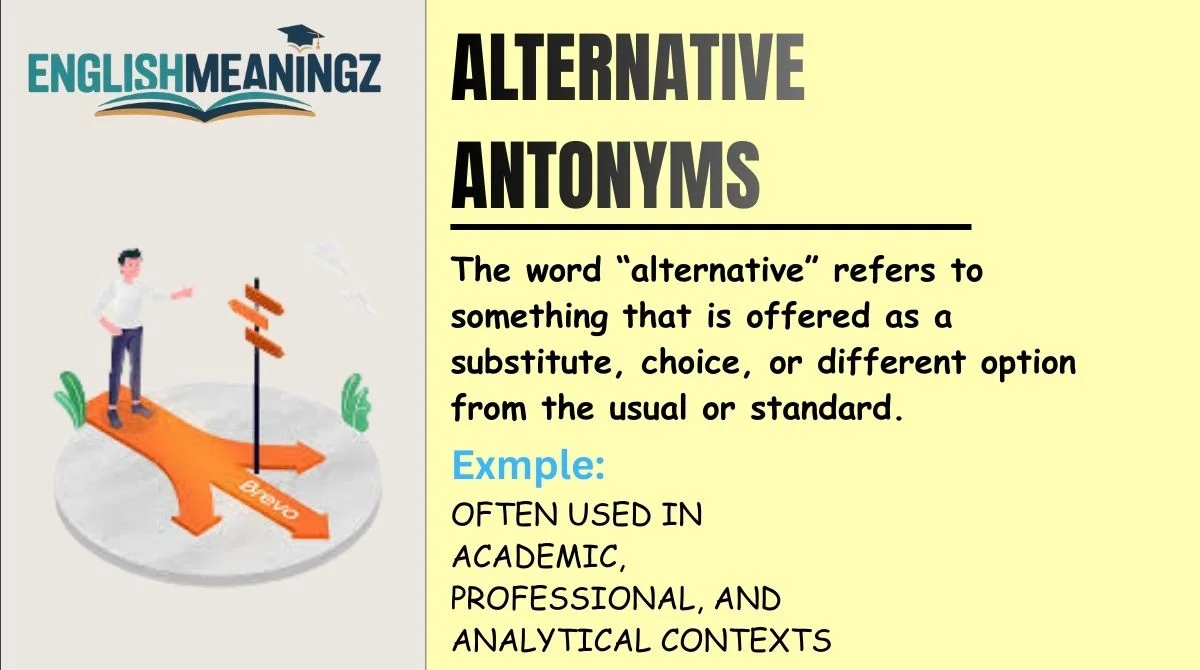
The word “alternative” refers to something that is offered as a substitute, choice, or different option from the usual or standard.
Definition
An alternative is another possibility or option available instead of the primary one.
Tone Explanation
- Neutral to formal
- Often used in academic, professional, and analytical contexts
- Suggests flexibility and choice
Emotional or Action Intensity
- Low emotional intensity
- High functional value (used for decision-making or comparison)
26 Best Antonyms for “Alternative”
1. Primary
Meaning: First or most important
Tone: Formal
Example: This is the primary solution, not an alternative.
Why opposite: It emphasizes the main option, not a substitute.
2. Original
Meaning: First version; not replaced
Tone: Neutral
Example: We prefer the original plan.
Why opposite: Opposes the idea of replacement.
3. Standard
Meaning: Accepted norm
Tone: Academic
Example: Follow the standard procedure.
Why opposite: Removes the need for variation.
4. Default
Meaning: Pre-set choice
Tone: Technical/Formal
Example: The system runs on default settings.
Why opposite: No alternative is required.
5. Main
Meaning: Most important or central
Tone: Informal to neutral
Example: Focus on the main idea.
Why opposite: Not optional or secondary.
6. Only
Meaning: Single option
Tone: Neutral
Example: This is the only solution.
Why opposite: Eliminates all alternatives.
7. Fixed
Meaning: Not changeable
Tone: Formal
Example: The schedule is fixed.
Why opposite: No room for substitution.
8. Certain
Meaning: Definite or sure
Tone: Formal
Example: The outcome is certain.
Why opposite: No alternative possibilities.
9. Mandatory
Meaning: Required by rule
Tone: Formal
Example: Attendance is mandatory.
Why opposite: No optional choices.
10. Required
Meaning: Necessary
Tone: Neutral
Example: This step is required.
Why opposite: Removes optional variation.
11. Compulsory
Meaning: Must be done
Tone: Academic
Example: Exams are compulsory.
Why opposite: No alternative allowed.
12. Definite
Meaning: Clearly decided
Tone: Formal
Example: We need a definite answer.
Why opposite: No ambiguity or options.
13. Settled
Meaning: Decided and final
Tone: Neutral
Example: The issue is settled.
Why opposite: No alternative discussion.
14. Exclusive
Meaning: Limited to one
Tone: Formal
Example: This offer is exclusive.
Why opposite: No alternatives included.
15. Singular
Meaning: One and only
Tone: Academic
Example: It’s a singular opportunity.
Why opposite: No other choices exist.
16. Unchangeable
Meaning: Cannot be altered
Tone: Formal
Example: The rules are unchangeable.
Why opposite: Alternatives require flexibility.
17. Final
Meaning: Last and conclusive
Tone: Formal
Example: This is the final decision.
Why opposite: No further options.
18. Absolute
Meaning: Complete and total
Tone: Academic
Example: There is absolute certainty.
Why opposite: No room for alternatives.
19. Sole
Meaning: Only one
Tone: Formal
Example: He is the sole owner.
Why opposite: No alternatives exist.
20. Exclusive Choice
Meaning: One restricted option
Tone: Formal
Example: This is an exclusive choice.
Why opposite: Limits variety.
21. Predetermined
Meaning: Decided in advance
Tone: Academic
Example: The outcome was predetermined.
Why opposite: No flexibility or alternatives.
22. Set
Meaning: Fixed or established
Tone: Informal
Example: The plan is set.
Why opposite: No room for variation.
23. Conventional
Meaning: Traditional and standard
Tone: Academic
Example: Use conventional methods.
Why opposite: Not alternative or innovative.
24. Traditional
Meaning: Based on long-standing practices
Tone: Neutral
Example: They prefer traditional methods.
Why opposite: Rejects alternative approaches.
25. Certain Path
Meaning: Specific direction
Tone: Formal
Example: Follow a certain path.
Why opposite: No branching options.
26. Nonnegotiable
Meaning: Cannot be changed or discussed
Tone: Professional
Example: The terms are nonnegotiable.
Why opposite: Removes all alternatives.
Strong vs Mild Opposites
Not all antonyms carry the same intensity. Some completely eliminate the idea of alternatives, while others simply reduce flexibility.
Strong Opposites
- Only
- Sole
- Mandatory
- Absolute
- Nonnegotiable
These words completely remove the concept of choice.
Mild Opposites
- Main
- Standard
- Conventional
- Primary
These suggest a preferred option, but alternatives may still exist in context.
Understanding this scale helps you control how rigid or flexible your message sounds.
Context-Based Opposites
Antonyms often depend on context rather than strict dictionary definitions.
Example Situations
- In technology:
“Default” is the opposite of “alternative” because systems rely on preset options. - In law or policy:
“Mandatory” replaces alternatives due to rules. - In creative writing:
“Original” opposes alternative as it emphasizes authenticity. - In business decisions:
“Final” eliminates the need for further options.
Context determines which antonym is most accurate and effective.
Common Mistakes When Using Opposites
1. Using Partial Opposites
Incorrect: Standard is the opposite of alternative in all cases.
Correct: It depends on context.
2. Confusing Synonyms with Antonyms
Incorrect: Option is an antonym of alternative.
Correct: They are similar, not opposite.
3. Ignoring Tone
Using “mandatory” in casual writing can sound too strict.
4. Overgeneralization
Not all situations require a strict opposite.
5. Misusing Formal Words
Words like “absolute” or “nonnegotiable” may sound too strong in everyday communication.
Sentence Transformation Examples
Original Sentence 1
We need an alternative solution.
Rewritten: We need the final solution.
Original Sentence 2
Consider an alternative method.
Rewritten: Use the standard method.
Original Sentence 3
There are several alternatives available.
Rewritten: There is only one option available.
Original Sentence 4
Try an alternative approach.
Rewritten: Follow the traditional approach.
Original Sentence 5
Choose an alternative path.
Rewritten: Follow the fixed path.
FAQs
What is the exact opposite of “alternative”?
The closest exact opposite is “only” or “sole”, as both eliminate choice entirely.
Are all antonyms context-dependent?
Yes, many antonyms depend on how the word is used in a sentence.
Can “standard” always replace “alternative”?
No, “standard” only works when referring to accepted norms.
Is “original” a strong antonym?
Yes, especially when emphasizing authenticity over substitution.
Why are antonyms important in writing?
They improve clarity, contrast, and precision.
Which antonym is best for formal writing?
Words like mandatory, primary, and definitive work well in formal contexts.
How can I learn antonyms faster?
Practice sentence rewriting and use vocabulary in real contexts.
Conclusion
Mastering antonyms like those for “alternative” gives you a powerful linguistic advantage.
It allows you to control tone, eliminate ambiguity, and communicate with precision across academic, professional, and creative writing.
Instead of relying on repetitive vocabulary, you can now choose from 26 precise opposites, each suited for different contexts and intensity levels. The result is clearer communication, stronger arguments, and more engaging content.