Mastering opposites is one of the fastest ways to elevate your writing from basic to compelling.
When you understand not only what a word means but also what it does not mean, your language becomes sharper, more precise, and more expressive.
This skill is especially valuable for students, content creators, professionals, and anyone aiming to communicate ideas clearly.
In academic and professional communication, using accurate antonyms helps you avoid ambiguity, create contrast, and strengthen arguments.
Whether you’re writing essays, reports, or SEO content, knowing the right opposite word can dramatically improve clarity and tone.
This article focuses on the keyword “bear antonyms”, delivering a structured, high-impact vocabulary guide that is practical, original, and easy to apply.
What Does “Bear” Mean?
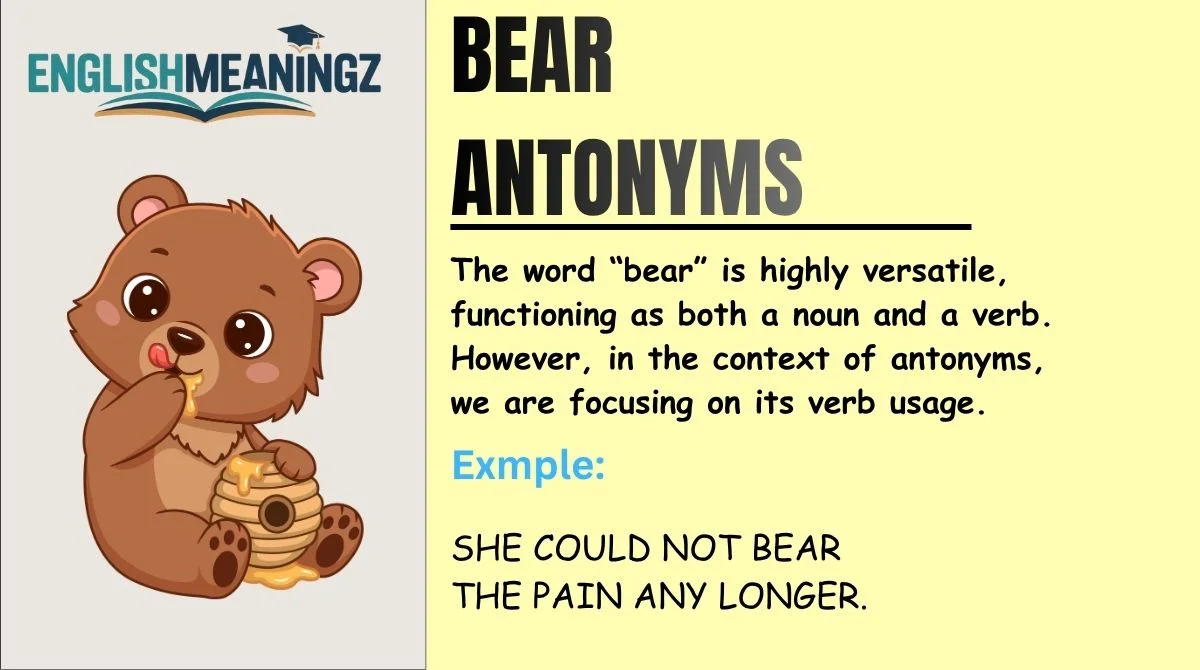
The word “bear” is highly versatile, functioning as both a noun and a verb. However, in the context of antonyms, we are focusing on its verb usage.
Core Definition
As a verb, “bear” commonly means:
- To carry or support something
- To endure or tolerate something difficult
- To accept responsibility or burden
Tone Explanation
“Bear” often carries a serious, enduring tone. It implies patience, strength, and the ability to handle pressure, pain, or responsibility without immediate resistance.
Emotional or Action Intensity
- Emotionally: It suggests tolerance under stress
- Action-wise: It involves holding, sustaining, or enduring over time
Example:
- She could not bear the pain any longer.
Here, “bear” reflects emotional and physical endurance.
13 Best Antonyms for “Bear”
1. Reject
Meaning: To refuse to accept something
Tone: Formal / Academic
Example: He rejected the proposal without hesitation.
Why it’s opposite: Instead of accepting or enduring, it actively refuses.
2. Refuse
Meaning: To decline or say no
Tone: Neutral / Formal
Example: She refused to take responsibility for the mistake.
Why it’s opposite: “Bear” involves acceptance; “refuse” denies it completely.
3. Abandon
Meaning: To leave behind or give up
Tone: Emotional / Formal
Example: They abandoned the project midway.
Why it’s opposite: “Bear” implies persistence; “abandon” shows withdrawal.
4. Resist
Meaning: To oppose or fight against
Tone: Academic / Strong
Example: He resisted the pressure to conform.
Why it’s opposite: Instead of enduring, it actively pushes back.
5. Escape
Meaning: To break free from something
Tone: Neutral
Example: She escaped the stressful situation.
Why it’s opposite: “Bear” stays and endures; “escape” avoids entirely.
6. Avoid
Meaning: To stay away from something
Tone: Informal / Neutral
Example: He avoided difficult conversations.
Why it’s opposite: Avoidance removes the need to endure.
7. Relinquish
Meaning: To give up control or responsibility
Tone: Formal / Academic
Example: She relinquished her duties.
Why it’s opposite: Opposes the idea of carrying or holding something.
8. Deny
Meaning: To refuse to admit or accept
Tone: Formal
Example: He denied all allegations.
Why it’s opposite: “Bear” accepts; “deny” rejects acknowledgment.
9. Discard
Meaning: To throw away or get rid of
Tone: Neutral
Example: They discarded outdated methods.
Why it’s opposite: Instead of carrying, it removes completely.
10. Oppose
Meaning: To act against something
Tone: Formal / Academic
Example: The committee opposed the decision.
Why it’s opposite: “Bear” tolerates; “oppose” confronts.
11. Surrender
Meaning: To give up resistance
Tone: Emotional / Formal
Example: He surrendered his position.
Why it’s opposite: While “bear” implies endurance, surrender ends resistance.
12. Shun
Meaning: To deliberately avoid
Tone: Formal
Example: She shunned negativity.
Why it’s opposite: Avoids engagement instead of enduring it.
13. Evade
Meaning: To escape cleverly or avoid responsibility
Tone: Academic
Example: He evaded answering the question.
Why it’s opposite: Avoids carrying or facing the burden.
Strong vs Mild Opposites
Not all antonyms carry the same intensity. Some completely negate the meaning of “bear,” while others offer a softer contrast.
Strong Opposites
These words completely reverse the meaning:
- Reject
- Abandon
- Discard
- Relinquish
They indicate complete removal or refusal, making them powerful in formal writing.
Mild Opposites
These provide partial contrast:
- Avoid
- Resist
- Evade
They suggest partial disengagement rather than total rejection.
Intensity Scale Example
- Bear → Resist → Avoid → Reject → Abandon
Understanding this scale helps you choose the right word based on context and tone.
Context-Based Opposites
The best antonym depends heavily on context. “Bear” can mean different things, so its opposite changes accordingly.
1. Emotional Context
- Bear pain → Escape pain
- Bear stress → Avoid stress
2. Responsibility Context
- Bear responsibility → Relinquish responsibility
- Bear the burden → Reject the burden
3. Physical Context
- Bear weight → Drop weight
- Bear a load → Discard a load
Key Insight
There is no single universal antonym for “bear.” Instead, the context defines the most accurate opposite.
Common Mistakes When Using Opposites
Even advanced learners make errors when selecting antonyms. Here are common pitfalls:
1. Using Weak Opposites
Incorrect:
- He bore the pain → He slightly disliked the pain
Correct:
- He bore the pain → He avoided the pain
2. Ignoring Context
Incorrect:
- She bore a child → She rejected a child
Correct:
- She bore a child → She did not give birth
3. Confusing Tone
- Using “shun” in casual speech unnecessarily
Incorrect:
Correct:
- Use “avoid” in informal contexts
4. Overusing One Antonym
Repeating “reject” everywhere reduces variety and clarity.
Sentence Transformation Examples
Here are five clear rewrites using antonyms of “bear”:
Original: She could not bear the criticism.
Rewritten: She chose to avoid the criticism.
Original: He bore the responsibility alone.
Rewritten: He relinquished the responsibility.
Original: They bore the financial burden.
Rewritten: They rejected the financial burden.
Original: I cannot bear this noise.
Rewritten: I will escape this noise.
Original: She bore the pressure calmly.
Rewritten: She resisted the pressure strongly.
FAQs
What is the exact opposite of “bear”?
There is no single exact opposite. Words like “reject,” “avoid,” and “abandon” work depending on context.
Is “avoid” always an antonym of “bear”?
No. It works in emotional contexts but not in physical or biological meanings.
Can “resist” replace “bear”?
Yes, in situations involving pressure or force, but it changes the tone from passive endurance to active opposition.
What is the most formal antonym of “bear”?
“Relinquish” and “reject” are the most formal and suitable for academic writing.
Is “escape” a strong antonym?
It is moderately strong, emphasizing leaving rather than refusing.
Why does context matter so much?
Because “bear” has multiple meanings, each requiring a different opposite for accuracy.
How can I improve my antonym usage?
Practice sentence transformation, learn context-based meanings, and expand your vocabulary regularly.
Conclusion
Understanding bear antonyms is more than memorizing opposite words—it’s about mastering nuance, tone, and context.
Whether you’re writing academically, professionally, or creatively, the ability to select the right opposite enhances clarity and precision.
By learning words like “reject,” “abandon,” “resist,” and “relinquish,” you gain control over how ideas are expressed and contrasted.
This not only strengthens your communication but also makes your writing more persuasive and impactful.
Consistent practice, awareness of context, and attention to tone will ensure you use antonyms effectively and naturally.