Understanding opposites is one of the fastest ways to sharpen your vocabulary and elevate your writing. When you learn antonyms, you don’t just memorize words—you gain the ability to express contrast, nuance, and precision.
This is essential whether you’re writing essays, crafting professional emails, or optimizing content for SEO.
In academic and professional communication, clarity matters. Using the right opposite word can completely change tone, readability, and intent.
Instead of repeating basic vocabulary, strong writers use contrasting terms to create balance and depth.
That’s exactly why learning antonyms of words like strenuous can dramatically improve how you communicate.
What Does “Strenuous” Mean?
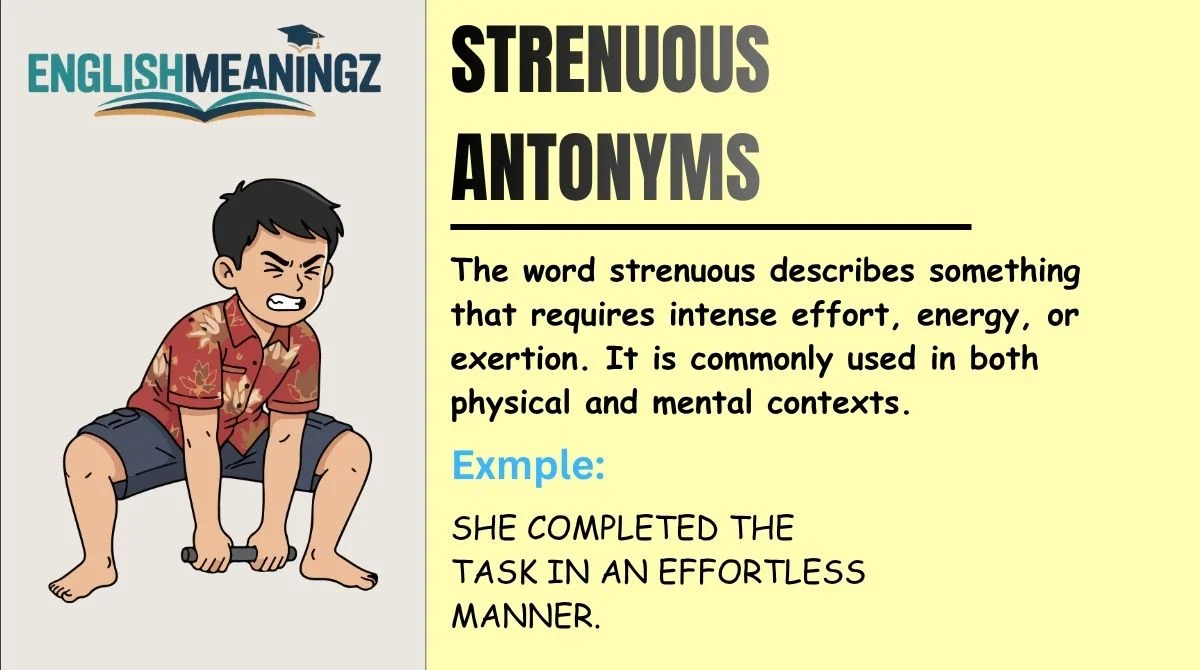
The word strenuous describes something that requires intense effort, energy, or exertion. It is commonly used in both physical and mental contexts.
- Definition: Requiring or using great effort, strength, or energy
- Tone: Formal / Academic
- Intensity Level: High effort, demanding, exhausting
A strenuous activity could be a tough workout, a demanding job task, or even a mentally draining project. The word carries a sense of difficulty and pressure.
15 Best Antonyms for “Strenuous”
Effortless
- Meaning: Done with ease; requiring no effort
- Tone: Neutral / Informal
- Example: She completed the task in an effortless manner.
- Why it’s opposite: It directly contrasts the heavy effort implied by “strenuous.”
Easy
- Meaning: Not difficult; simple to do
- Tone: Informal
- Example: The exam was surprisingly easy.
- Why it’s opposite: Removes the difficulty and intensity associated with strenuous activities.
Relaxing
- Meaning: Helping you rest and feel calm
- Tone: Emotional
- Example: Listening to music is a relaxing experience.
- Why it’s opposite: Strenuous implies stress; relaxing implies relief.
Gentle
- Meaning: Soft, mild, and not forceful
- Tone: Emotional / Descriptive
- Example: The workout was gentle enough for beginners.
- Why it’s opposite: Gentle actions lack the intensity of strenuous effort.
Light
- Meaning: Not heavy or demanding
- Tone: Neutral
- Example: He preferred light exercise over intense training.
- Why it’s opposite: Light tasks require minimal energy.
Simple
- Meaning: Easy to understand or do
- Tone: Neutral / Academic
- Example: The instructions were simple and clear.
- Why it’s opposite: Simplicity eliminates complexity and effort.
Leisurely
- Meaning: Done at a relaxed pace
- Tone: Formal
- Example: They enjoyed a leisurely walk in the park.
- Why it’s opposite: No urgency or exertion, unlike strenuous tasks.
Calm
- Meaning: Free from stress or agitation
- Tone: Emotional
- Example: The environment was calm and peaceful.
- Why it’s opposite: Strenuous situations often involve stress.
Comfortable
- Meaning: Providing ease and relaxation
- Tone: Neutral
- Example: The chair was comfortable to sit in for hours.
- Why it’s opposite: Comfort removes physical or mental strain.
Moderate
- Meaning: Average intensity; not extreme
- Tone: Academic
- Example: Engage in moderate exercise daily.
- Why it’s opposite: Strenuous implies extreme effort; moderate suggests balance.
Mild
- Meaning: Not severe or intense
- Tone: Neutral
- Example: The weather was mild and pleasant.
- Why it’s opposite: It reduces intensity significantly.
Undemanding
- Meaning: Not requiring much effort or skill
- Tone: Formal
- Example: The job was undemanding and stress-free.
- Why it’s opposite: No pressure or exertion is required.
Restful
- Meaning: Promoting rest and relaxation
- Tone: Emotional
- Example: The vacation was restful and refreshing.
- Why it’s opposite: Rest replaces effort.
Easygoing
- Meaning: Relaxed and carefree
- Tone: Informal
- Example: He has an easygoing personality.
- Why it’s opposite: No stress or intensity is involved.
Smooth
- Meaning: Free from difficulty or obstacles
- Tone: Neutral
- Example: The process was smooth and efficient.
- Why it’s opposite: Strenuous tasks often involve struggle.
Strong vs Mild Opposites
Not all antonyms carry the same intensity. Some words completely reverse the meaning of strenuous, while others only soften it.
- Strong Opposites: Effortless, relaxing, restful
These eliminate effort almost entirely. - Moderate Opposites: Easy, simple, smooth
These reduce difficulty but don’t remove it fully. - Mild Opposites: Moderate, mild, gentle
These suggest reduced intensity rather than full contrast.
Understanding this scale helps you choose the right word depending on context. For example, “effortless” is stronger than “moderate” when describing ease.
Context-Based Opposites
Antonyms often depend on context. The opposite of strenuous can vary based on how the word is used.
- Physical context:
Strenuous workout → Light or gentle exercise - Mental context:
Strenuous thinking → Simple or easy reasoning - Emotional context:
Strenuous situation → Calm or relaxing environment - Work context:
Strenuous job → Undemanding or easygoing role
Choosing the correct antonym requires understanding the situation, not just the word.
Common Mistakes When Using Opposites
Many learners misuse antonyms due to misunderstanding tone or context.
- Mistake 1: Using “lazy” as an antonym
Incorrect: This is a lazy task.
Why wrong: Lazy describes a person, not the task. - Mistake 2: Confusing “simple” with “boring”
Simple does not mean uninteresting. - Mistake 3: Overusing “easy”
Using one antonym repeatedly weakens writing. - Mistake 4: Ignoring tone
“Easygoing” is informal and not suitable for academic writing. - Mistake 5: Misjudging intensity
“Moderate” is not the complete opposite of “strenuous.”
Sentence Transformation Examples
Here are five examples showing how antonyms improve writing:
- Original: The training session was strenuous.
Rewritten: The training session was light and manageable. - Original: He had a strenuous schedule.
Rewritten: He followed a relaxed and flexible schedule. - Original: The hike was strenuous.
Rewritten: The hike was gentle and enjoyable. - Original: It was a strenuous task.
Rewritten: It was a simple and effortless task. - Original: The project felt strenuous.
Rewritten: The project was smooth and easy to complete.
FAQs
What is the simplest antonym of strenuous?
The simplest antonym is “easy,” as it directly contrasts effort and difficulty.
Is “relaxing” a strong opposite of strenuous?
Yes, because it not only removes effort but also adds comfort and calmness.
Can “moderate” be used as an antonym?
Yes, but it is a mild opposite, not a complete contrast.
Which antonym is best for academic writing?
“Undemanding,” “moderate,” and “simple” are more suitable in formal contexts.
Is “light” a physical or general antonym?
It is mostly used in physical contexts like exercise or workload.
Why are antonyms important in SEO writing?
They help diversify keywords, improve readability, and enhance semantic richness.
Can one word have multiple antonyms?
Yes, depending on context, tone, and intensity.
Conclusion
Mastering antonyms like those for strenuous gives you a powerful advantage in writing. It allows you to express contrast clearly, choose precise tones, and avoid repetitive language.
Whether you’re writing academically, professionally, or for SEO purposes, understanding both strong and mild opposites ensures your communication remains effective and engaging.
Instead of relying on basic vocabulary, use these 15 antonyms strategically to add depth and clarity to your writing.
The more consciously you apply them, the more natural and impactful your language will become.