Understanding opposites is one of the fastest ways to elevate your writing from average to precise and impactful. When you know not only what a word means but also what it doesn’t mean, your ability to communicate nuance improves dramatically.
This is especially important with emotionally loaded words like sarcastic, which carry tone, intent, and subtle attitude.
In academic and professional communication, clarity of tone is essential. Misusing sarcasm—or failing to recognize its opposite—can lead to misunderstandings, weakened arguments, or even damaged credibility.
By mastering antonyms of “sarcastic,” you gain better control over tone, allowing you to shift between sincerity, professionalism, and emotional neutrality with confidence.
What Does “Sarcastic” Mean?
Definition:
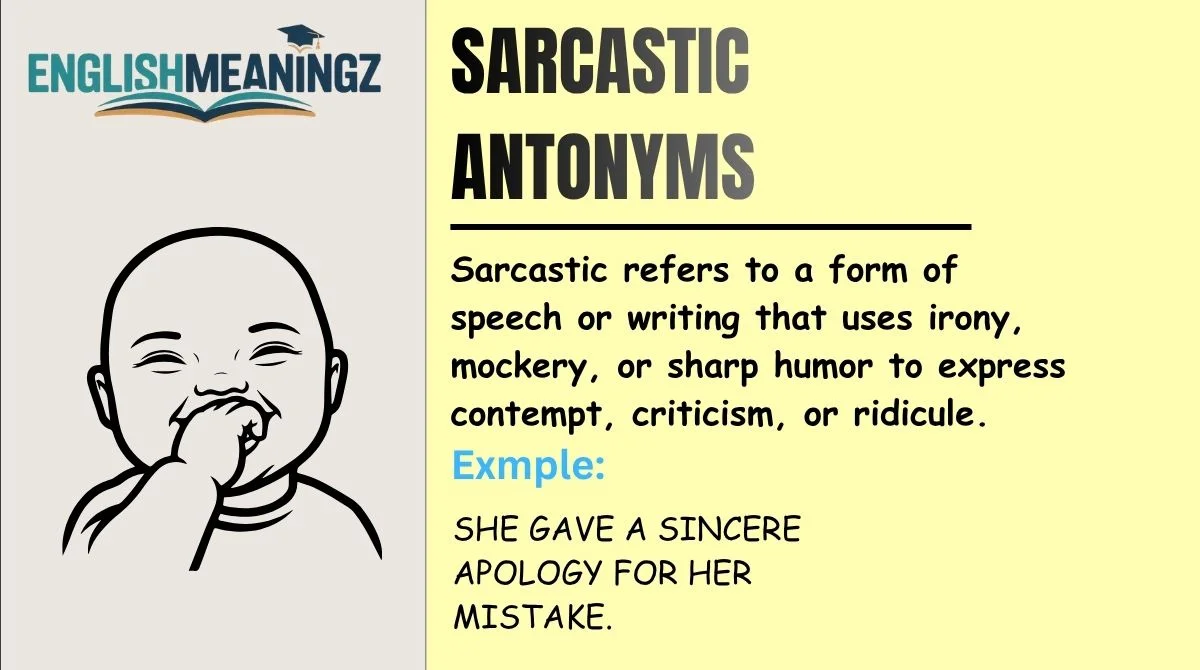
Sarcastic refers to a form of speech or writing that uses irony, mockery, or sharp humor to express contempt, criticism, or ridicule.
Tone Explanation:
Sarcasm is typically indirect. The speaker says one thing but means the opposite, often in a biting or humorous way. It can range from playful teasing to harsh criticism.
Emotional/Action Intensity:
- Mild sarcasm: light teasing, playful tone
- Moderate sarcasm: subtle criticism, ironic remarks
- Strong sarcasm: cutting, mocking, or even offensive
Sarcasm is rarely neutral—it carries an emotional charge. Therefore, its antonyms usually involve sincerity, clarity, kindness, or straightforwardness.
20 Best Antonyms for “Sarcastic”
1. Sincere
Meaning: Genuine and honest in expression
Tone: Emotional / Formal
Example: She gave a sincere apology for her mistake.
Why Opposite: Sarcasm hides intent, while sincerity reveals true feelings directly.
2. Genuine
Meaning: Real and authentic
Tone: Formal / Emotional
Example: His genuine concern comforted everyone.
Why Opposite: Sarcasm often masks authenticity; genuineness expresses it openly.
3. Honest
Meaning: Truthful and straightforward
Tone: Formal / Academic
Example: He gave an honest opinion without exaggeration.
Why Opposite: Sarcasm distorts truth; honesty communicates it plainly.
4. Straightforward
Meaning: Direct and clear without hidden meaning
Tone: Academic / Professional
Example: Her straightforward answer avoided confusion.
Why Opposite: Sarcasm relies on indirectness; straightforwardness eliminates ambiguity.
5. Earnest
Meaning: Serious and sincere in intention
Tone: Formal / Academic
Example: The student made an earnest effort to improve.
Why Opposite: Earnestness reflects seriousness, while sarcasm often trivializes.
6. Respectful
Meaning: Showing politeness and regard
Tone: Formal
Example: He remained respectful during the debate.
Why Opposite: Sarcasm can sound disrespectful; respect avoids mockery.
7. Polite
Meaning: Courteous and well-mannered
Tone: Formal / Social
Example: She responded in a polite and calm tone.
Why Opposite: Sarcasm can be rude; politeness maintains social harmony.
8. Kind
Meaning: Caring and considerate
Tone: Emotional
Example: His kind words lifted her spirits.
Why Opposite: Sarcasm may hurt; kindness aims to support.
9. Warm
Meaning: Friendly and affectionate
Tone: Emotional / Informal
Example: They welcomed us with a warm smile.
Why Opposite: Warmth invites connection, while sarcasm may create distance.
10. Supportive
Meaning: Encouraging and helpful
Tone: Emotional / Professional
Example: Her supportive feedback improved the team’s morale.
Why Opposite: Sarcasm often criticizes; support builds confidence.
11. Encouraging
Meaning: Giving hope or confidence
Tone: Emotional
Example: His encouraging words motivated the group.
Why Opposite: Sarcasm can discourage; encouragement inspires.
12. Complimentary
Meaning: Expressing praise
Tone: Formal / Social
Example: She gave a complimentary remark about his work.
Why Opposite: Sarcasm often disguises criticism; compliments show appreciation.
13. Literal
Meaning: Taking words at face value
Tone: Academic
Example: The instruction should be interpreted literally.
Why Opposite: Sarcasm depends on implied meaning; literal speech avoids it.
14. Serious
Meaning: Not joking or ironic
Tone: Formal / Academic
Example: He gave a serious response to the question.
Why Opposite: Sarcasm often uses humor; seriousness removes it.
15. Neutral
Meaning: Unbiased and emotionally balanced
Tone: Academic / Professional
Example: The report maintained a neutral tone throughout.
Why Opposite: Sarcasm carries emotional bias; neutrality avoids it.
16. Transparent
Meaning: Open and easy to understand
Tone: Professional
Example: The process was transparent and fair.
Why Opposite: Sarcasm hides intent; transparency reveals it.
17. Direct
Meaning: Clear and to the point
Tone: Professional
Example: He made a direct request for clarification.
Why Opposite: Sarcasm is indirect; directness eliminates hidden meanings.
18. Friendly
Meaning: Pleasant and approachable
Tone: Informal / Social
Example: She spoke in a friendly tone with everyone.
Why Opposite: Sarcasm may feel hostile; friendliness promotes ease.
19. Compassionate
Meaning: Showing empathy and concern
Tone: Emotional
Example: The nurse was compassionate toward patients.
Why Opposite: Sarcasm lacks empathy; compassion centers it.
20. Constructive
Meaning: Intended to help improve
Tone: Professional / Academic
Example: He offered constructive criticism to guide improvement.
Why Opposite: Sarcasm criticizes indirectly; constructive feedback helps directly.
Strong vs Mild Opposites
Not all antonyms carry equal intensity. Some are strong opposites, completely reversing the tone, while others provide a softer contrast.
Strong Opposites:
Sincere, genuine, compassionate, respectful
- These directly counter sarcasm’s emotional and social impact.
Moderate Opposites:
Honest, straightforward, direct, serious
- These remove sarcasm’s indirectness but may still lack emotional warmth.
Mild Opposites:
Neutral, literal, transparent
- These don’t strongly oppose sarcasm emotionally but eliminate ambiguity.
Understanding this scale helps you choose the right word depending on context—academic writing often prefers moderate or mild opposites, while personal communication benefits from stronger ones.
Context-Based Opposites
Antonyms of “sarcastic” can change depending on the situation:
- In professional settings:
Use professional, direct, constructive - In emotional conversations:
Use kind, compassionate, supportive - In academic writing:
Use neutral, literal, objective - In casual conversations:
Use friendly, warm, polite
For example, replacing sarcasm in a workplace email requires constructive or professional language, not necessarily emotional warmth.
Common Mistakes When Using Opposites
1. Confusing “honest” with “kind”
- Incorrect: “He was honest” (when kindness was needed)
- Fix: Use kind or compassionate when tone matters emotionally
2. Using “serious” in casual contexts
- Incorrect: “Be serious” in a friendly chat
- Fix: Use friendly or polite instead
3. Assuming “literal” always fits
- Incorrect: Using “literal” in emotional situations
- Fix: Use sincere or genuine
4. Overusing “polite” in formal writing
- Academic tone prefers neutral or objective
5. Ignoring audience expectations
- What sounds sincere in personal settings may sound overly emotional in academic work
Sentence Transformation Examples
1. Original:
“Oh great, another delay. Just what we needed.”
Rewritten:
“I understand the delay; let’s handle it constructively.”
2. Original:
“Wow, you’re so organized.”
Rewritten:
“I appreciate your effort to stay organized.”
3. Original:
“Nice job messing that up.”
Rewritten:
“Let’s review what went wrong and improve it.”
4. Original:
“Perfect timing, as always.”
Rewritten:
“Let’s try to coordinate better next time.”
5. Original:
“Yeah, because that idea makes total sense.”
Rewritten:
“I’d like to discuss some concerns about that idea.”
FAQs
What is the simplest antonym of sarcastic?
The simplest and most direct antonym is sincere, as it completely removes irony and hidden meaning.
Is “honest” always the opposite of sarcastic?
Not always. While honesty removes indirectness, sarcasm can still contain truth, making sincere a stronger opposite.
Can “polite” replace sarcasm in professional writing?
Yes, but constructive or professional is often more appropriate in formal contexts.
What antonym works best in academic writing?
Words like neutral, objective, and literal are most suitable.
Is sarcasm always negative?
Not necessarily. It can be humorous, but it often carries a critical or mocking tone.
Which antonym is best for emotional situations?
Compassionate or kind works best when empathy is required.
How can I avoid sounding sarcastic unintentionally?
Focus on clarity, avoid exaggeration, and choose direct, sincere language.
Conclusion
Mastering antonyms of “sarcastic” gives you precise control over tone, which is essential in both writing and speech.
Whether you aim to sound professional, empathetic, or academically neutral, choosing the right opposite word allows you to communicate clearly and effectively.
Instead of relying on indirect humor or irony, these alternatives help you express meaning with intention, respect, and clarity—qualities that define strong communication in 2026 and beyond.