Understanding opposites is one of the fastest ways to sharpen your language skills. When you know not only what a word means but also what it does not mean, your vocabulary becomes more flexible, precise, and expressive.
This is especially valuable in writing, where clarity and tone determine how effectively your message is received.
In academic and professional communication, using the right antonym can completely transform the strength of your argument.
Instead of vague or confusing language, you can deliver ideas that are direct, persuasive, and easy to understand. This article explores the most effective antonyms of “obscure,” helping you replace ambiguity with clarity and confidence.
What Does “Obscure” Mean?
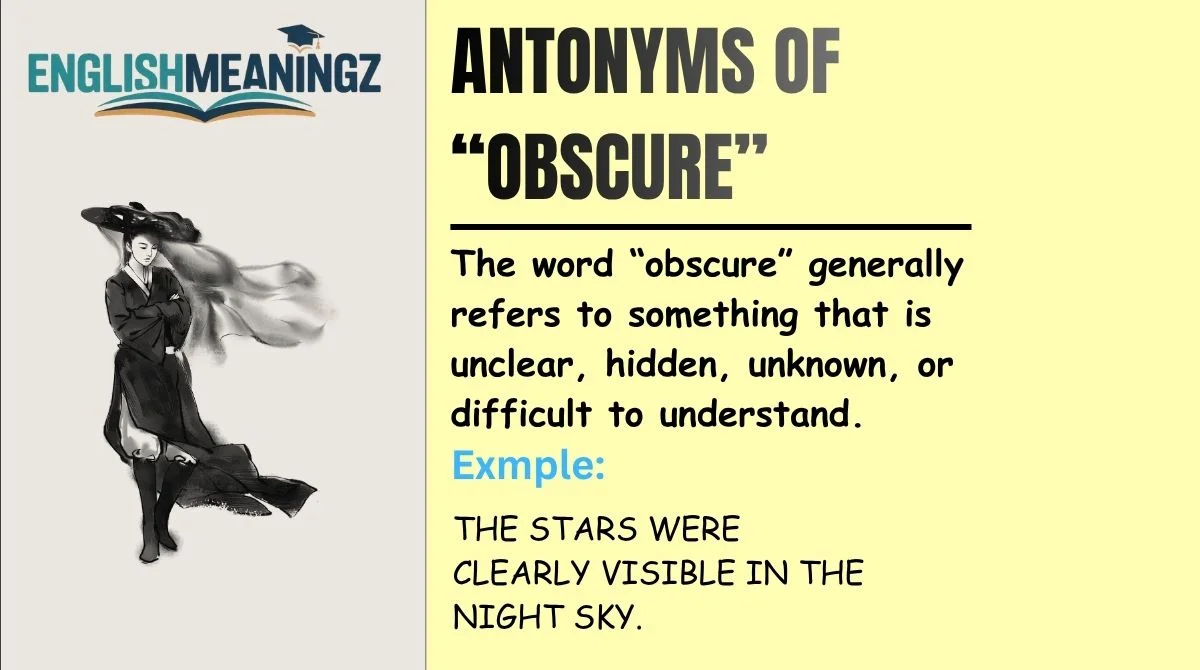
The word “obscure” generally refers to something that is unclear, hidden, unknown, or difficult to understand.
Core Definition
- Not easily seen, understood, or known
- Lacking clarity or visibility
- Hidden or not prominent
Tone Explanation
“Obscure” often carries a neutral to slightly negative tone, depending on context. It can describe:
- Complex ideas (academic tone)
- Hidden meanings (literary tone)
- Lack of recognition (social/professional tone)
Emotional or Action Intensity
The intensity of “obscure” varies:
- Mild: Slightly unclear or vague
- Strong: Completely hidden or unknown
Understanding this range helps in choosing the right opposite depending on how strong or subtle you want your expression to be.
20 Best Antonyms for “Obscure”
Clear
Meaning: Easy to understand
Tone: Academic / Formal
Example: Her explanation was clear and easy to follow.
Why it’s an opposite: It directly contrasts confusion with clarity.
Obvious
Meaning: Easily perceived or understood
Tone: Informal / Neutral
Example: The solution was obvious after reviewing the data.
Why it’s an opposite: Removes any sense of hidden meaning.
Visible
Meaning: Able to be seen
Tone: Neutral
Example: The stars were clearly visible in the night sky.
Why it’s an opposite: Opposes physical hiddenness.
Known
Meaning: Recognized or familiar
Tone: Formal
Example: He is a known expert in the field.
Why it’s an opposite: Counters the idea of being unknown.
Famous
Meaning: Widely recognized
Tone: Informal / Neutral
Example: The city is famous for its architecture.
Why it’s an opposite: Reverses obscurity in recognition.
Prominent
Meaning: Important or well-known
Tone: Academic
Example: She is a prominent figure in science.
Why it’s an opposite: Suggests high visibility and importance.
Apparent
Meaning: Clearly visible or understood
Tone: Formal
Example: The mistake became apparent quickly.
Why it’s an opposite: Eliminates ambiguity.
Evident
Meaning: Plain or obvious
Tone: Academic
Example: His dedication was evident in his work.
Why it’s an opposite: Reinforces clarity and visibility.
Transparent
Meaning: Easy to understand or see through
Tone: Professional
Example: The process was transparent and fair.
Why it’s an opposite: Opposes hidden or unclear systems.
Distinct
Meaning: Clearly different or recognizable
Tone: Formal
Example: There was a distinct improvement in performance.
Why it’s an opposite: Highlights clarity and definition.
Recognized
Meaning: Acknowledged or identified
Tone: Formal
Example: The theory is widely recognized.
Why it’s an opposite: Opposes being unknown.
Illuminated
Meaning: Made clear or bright
Tone: Literary
Example: The lecture illuminated complex ideas.
Why it’s an opposite: Suggests bringing something out of darkness.
Plain
Meaning: Simple and easy to understand
Tone: Informal
Example: He gave a plain explanation of the issue.
Why it’s an opposite: Removes complexity and confusion.
Straightforward
Meaning: Direct and uncomplicated
Tone: Professional
Example: The instructions were straightforward.
Why it’s an opposite: Opposes complexity and vagueness.
Clear-cut
Meaning: Definite and unambiguous
Tone: Formal
Example: The decision was clear-cut.
Why it’s an opposite: Eliminates uncertainty.
Bright
Meaning: Full of light or clarity
Tone: Emotional / Informal
Example: The room was bright and welcoming.
Why it’s an opposite: Contrasts darkness and obscurity.
Unambiguous
Meaning: Having only one clear meaning
Tone: Academic
Example: The message was unambiguous.
Why it’s an opposite: Opposes multiple unclear interpretations.
Explicit
Meaning: Clearly expressed
Tone: Formal
Example: The rules were explicit and detailed.
Why it’s an opposite: Removes any hidden meaning.
Open
Meaning: Accessible or not hidden
Tone: Neutral
Example: The discussion was open and honest.
Why it’s an opposite: Counters secrecy.
Understandable
Meaning: Easy to comprehend
Tone: Informal / Academic
Example: The concept became understandable after practice.
Why it’s an opposite: Opposes confusion and difficulty.
Strong vs Mild Opposites
Not all antonyms carry the same intensity. Choosing the right one depends on context.
Mild Opposites
- Clear
- Plain
- Understandable
- Straightforward
These are useful when something is only slightly unclear.
Moderate Opposites
- Apparent
- Evident
- Distinct
- Recognized
These add a stronger sense of clarity or visibility.
Strong Opposites
- Obvious
- Explicit
- Unambiguous
- Transparent
These completely eliminate any form of obscurity.
Tip: In academic writing, stronger antonyms often make arguments more persuasive, while mild ones suit casual or descriptive contexts.
Context-Based Opposites
The best antonym depends on how “obscure” is used.
When referring to clarity
- Obscure idea → Clear / Understandable
When referring to visibility
- Obscure object → Visible / Bright
When referring to fame
- Obscure person → Famous / Prominent
When referring to meaning
- Obscure message → Explicit / Unambiguous
Using the wrong antonym can weaken your sentence, so always match context carefully.
Common Mistakes When Using Opposites
Confusing “obvious” with “simple”
Incorrect: The theory is obvious.
Correct: The theory is straightforward.
“Obvious” implies ease of recognition, not simplicity.
Using “famous” for clarity
Incorrect: The instructions are famous.
Correct: The instructions are clear.
“Famous” relates to recognition, not understanding.
Overusing “clear”
Repeated use can make writing dull.
Instead, vary with:
- Evident
- Explicit
- Straightforward
Ignoring tone
“Plain” may sound too informal in academic writing, where “explicit” or “unambiguous” is better.
Sentence Transformation Examples
Original Sentence 1
The explanation was obscure.
Rewritten: The explanation was clear.
Original Sentence 2
His intentions remained obscure.
Rewritten: His intentions were explicit.
Original Sentence 3
The concept seems obscure to beginners.
Rewritten: The concept is understandable to beginners.
Original Sentence 4
She lived an obscure life.
Rewritten: She lived a prominent life.
Original Sentence 5
The message was obscure and confusing.
Rewritten: The message was unambiguous and direct.
FAQs
What is the simplest antonym of “obscure”?
The simplest antonym is “clear,” as it directly opposes lack of understanding.
Can “famous” always replace “obscure”?
No. It only works when referring to recognition, not clarity.
What is the strongest opposite of “obscure”?
“Unambiguous” and “explicit” are among the strongest opposites.
Is “visible” an antonym of “obscure”?
Yes, when referring to physical visibility rather than meaning.
Which antonym is best for academic writing?
“Explicit,” “evident,” and “unambiguous” are ideal for formal contexts.
Are there emotional opposites of “obscure”?
Yes, words like “bright” or “open” can carry emotional clarity.
How can I choose the right antonym?
Focus on context: clarity, visibility, recognition, or meaning.
Conclusion
Mastering antonyms of “obscure” gives you a powerful advantage in both writing and communication.
Whether you’re clarifying complex ideas, enhancing professional documents, or improving everyday speech, the right opposite word can instantly strengthen your message.
By understanding tone, intensity, and context, you can move beyond basic vocabulary and express ideas with precision and confidence.
The key is not just knowing words—but knowing when and how to use them effectively.