Understanding opposites is one of the fastest ways to sharpen your vocabulary and elevate your writing. When you learn not just what a word means—but what it doesn’t mean—you gain precision.
That precision allows you to express subtle differences in tone, attitude, and intention.
In academic and professional communication, this matters even more. Whether you’re writing essays, reports, or emails, the ability to switch between contrasting personality traits helps you avoid vague language.
Instead of repeating the same descriptors, you can present clear, nuanced ideas. This is especially useful in character analysis, psychology writing, and persuasive communication.
This guide focuses on personality antonyms, helping you master the opposites of common personality traits in a structured, practical way.
What Does “Personality” Mean?
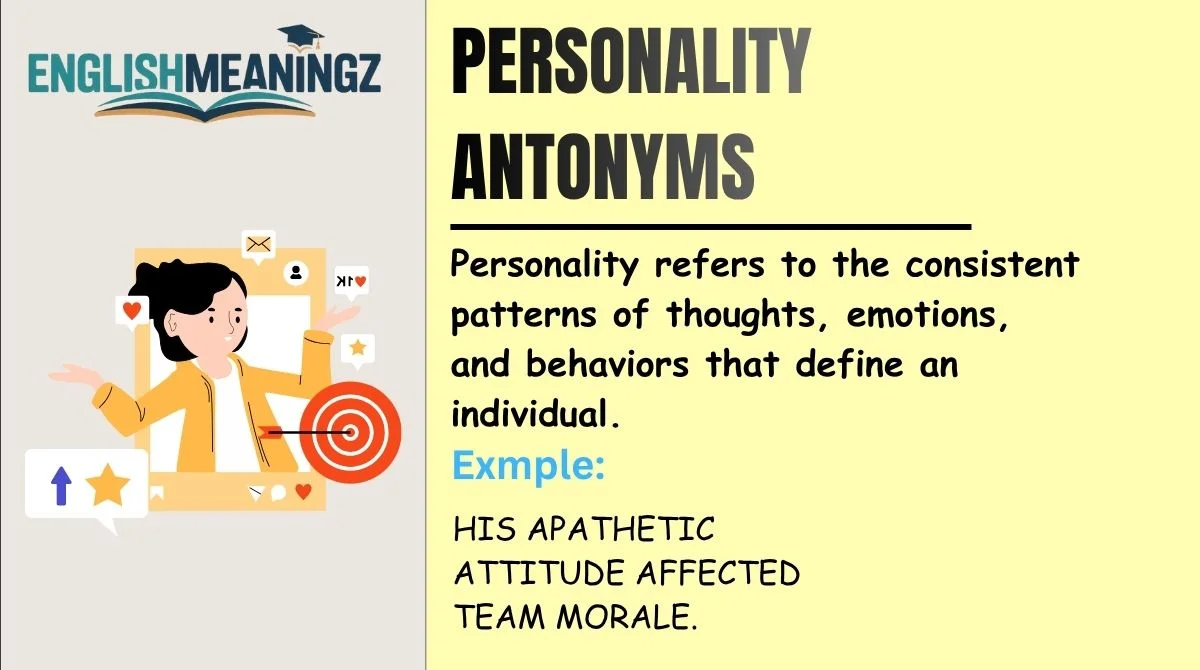
Personality refers to the consistent patterns of thoughts, emotions, and behaviors that define an individual. It shapes how a person reacts to situations, interacts with others, and expresses themselves.
Tone Explanation
The word “personality” is neutral to positive. It is often used in both formal and informal contexts without emotional bias.
Emotional or Action Intensity
Personality itself is not intense—it is a descriptive umbrella term. However, the traits within it (like “kind,” “aggressive,” or “introverted”) can vary widely in emotional intensity.
20 Best Antonyms for “Personality”
Since “personality” is a broad concept, its antonyms are best understood through contrasting personality traits. Below are 20 carefully selected opposites that highlight different dimensions of human behavior.
Introverted
Meaning: Reserved, inward-focused
Tone: Academic
Example: He prefers quiet evenings alone rather than social gatherings.
Why Opposite: Opposes outgoing or expressive personality traits.
Passive
Meaning: Lacking initiative or assertiveness
Tone: Formal
Example: She remained passive during the discussion.
Why Opposite: Contrasts with active, dominant personalities.
Apathetic
Meaning: Showing no interest or concern
Tone: Emotional
Example: His apathetic attitude affected team morale.
Why Opposite: Opposes passionate or enthusiastic personalities.
Reserved
Meaning: Emotionally restrained
Tone: Formal
Example: He gave a reserved response to the news.
Why Opposite: Opposes expressive or outgoing personalities.
Shy
Meaning: Nervous or timid in social situations
Tone: Informal
Example: She is shy around new people.
Why Opposite: Contrasts with confident, extroverted behavior.
Indifferent
Meaning: Unconcerned or neutral
Tone: Academic
Example: He seemed indifferent to the outcome.
Why Opposite: Opposes emotionally engaged personalities.
Withdrawn
Meaning: Socially detached
Tone: Formal
Example: After the incident, he became withdrawn.
Why Opposite: Contrasts with socially active individuals.
Cold
Meaning: Emotionally distant
Tone: Emotional
Example: Her cold response surprised everyone.
Why Opposite: Opposes warm, friendly personalities.
Detached
Meaning: Not emotionally involved
Tone: Academic
Example: He remained detached during the argument.
Why Opposite: Opposes emotionally expressive traits.
Unresponsive
Meaning: Not reacting or engaging
Tone: Formal
Example: The audience was unresponsive.
Why Opposite: Contrasts with lively, reactive personalities.
Submissive
Meaning: Yielding to others
Tone: Formal
Example: He took a submissive role in the team.
Why Opposite: Opposes dominant or assertive personalities.
Timid
Meaning: Lacking courage
Tone: Emotional
Example: The timid student avoided speaking.
Why Opposite: Opposes bold or confident traits.
Inactive
Meaning: Not energetic or engaged
Tone: Academic
Example: He remained inactive during the project.
Why Opposite: Contrasts with energetic personalities.
Quiet
Meaning: Not talkative
Tone: Neutral
Example: She is quiet in large groups.
Why Opposite: Opposes talkative or expressive traits.
Unenthusiastic
Meaning: Lacking excitement
Tone: Formal
Example: His response was unenthusiastic.
Why Opposite: Opposes energetic, lively personalities.
Emotionless
Meaning: Showing no feelings
Tone: Emotional
Example: He gave an emotionless reply.
Why Opposite: Contrasts with expressive individuals.
Hesitant
Meaning: Uncertain or reluctant
Tone: Formal
Example: She was hesitant to speak.
Why Opposite: Opposes confident personalities.
Disengaged
Meaning: Not involved or interested
Tone: Academic
Example: The employee appeared disengaged.
Why Opposite: Contrasts with active participation.
Unassertive
Meaning: Not confident in expressing opinions
Tone: Formal
Example: He is too unassertive in meetings.
Why Opposite: Opposes assertive personalities.
Aloof
Meaning: Distant and uninvolved
Tone: Formal
Example: She remained aloof from the group.
Why Opposite: Contrasts with friendly, sociable traits.
Strong vs Mild Opposites
Not all antonyms carry the same intensity. Some are mild contrasts, while others are strong opposites.
Mild Opposites
These show subtle differences:
- Quiet vs talkative
- Reserved vs expressive
- Hesitant vs confident
These are useful in academic writing where neutrality is preferred.
Strong Opposites
These show extreme contrast:
- Emotionless vs passionate
- Apathetic vs enthusiastic
- Cold vs warm
These are effective in persuasive or emotional writing.
Why This Matters
Choosing the right intensity helps avoid exaggeration. For example:
- Calling someone “quiet” is neutral
- Calling them “emotionless” is extreme
Context-Based Opposites
Antonyms are not always fixed—they depend on context.
Situational Examples
- In leadership:
Assertive ↔ Submissive - In emotional expression:
Expressive ↔ Detached - In social behavior:
Outgoing ↔ Withdrawn - In motivation:
Driven ↔ Apathetic
Key Insight
A word may have multiple opposites depending on usage. For example:
- “Active” could be opposed by passive, inactive, or lazy depending on context.
Common Mistakes When Using Opposites
1. Using Weak Opposites
❌ “Happy” vs “Calm”
✔ Use: Happy vs Sad
2. Ignoring Context
❌ “Introverted” vs “Angry”
✔ Use: Introverted vs Extroverted
3. Overusing Extreme Words
❌ “Quiet” vs “Emotionless”
✔ Match intensity levels
4. Confusing Tone
❌ Using informal antonyms in academic writing
✔ Choose tone-appropriate vocabulary
5. Literal vs Conceptual Opposites
❌ “Friendly” vs “Silent”
✔ Use: Friendly vs Hostile
Sentence Transformation Examples
Original → Improved with Antonyms
Original: He is very confident.
Rewritten: He is surprisingly timid in public settings.
Original: She enjoys social events.
Rewritten: She is withdrawn and avoids large gatherings.
Original: He shows strong emotions.
Rewritten: He remains emotionless even in difficult situations.
Original: She is very active in discussions.
Rewritten: She is often passive during meetings.
Original: He is very friendly.
Rewritten: He appears aloof in professional environments.
FAQs
What are personality antonyms?
Personality antonyms are words that express opposite traits or behaviors, such as confident vs timid.
Why should I learn antonyms?
They improve clarity, vocabulary range, and writing precision.
Are antonyms always exact opposites?
No. Many are context-based and vary in intensity.
Can one word have multiple antonyms?
Yes. The opposite depends on context and usage.
Are these useful in academic writing?
Absolutely. They help avoid repetition and improve expression.
How do I choose the right antonym?
Consider tone, intensity, and context.
Do antonyms change meaning in different fields?
Yes. For example, “passive” in psychology differs from general usage.
Conclusion
Mastering personality antonyms is more than a vocabulary exercise—it’s a strategic skill. By understanding how traits contrast with one another, you gain the ability to write with precision, adapt tone effectively, and communicate complex ideas clearly.
Whether you’re crafting academic essays, professional reports, or creative content, knowing the right opposite word can transform your message.
Instead of relying on repetitive descriptions, you can present sharp, meaningful contrasts that engage readers and strengthen your writing.
The key is not just memorization—but context, tone, and intensity awareness. Once you develop that, your language becomes more dynamic, persuasive, and impactful.