Understanding opposites is one of the most effective ways to elevate your writing. When you explore antonyms of a word like dialogue, you don’t just learn new vocabulary—you gain precision.
Instead of repeating the same term, you can choose words that sharpen tone, control meaning, and reflect subtle differences in communication style.
In academic and professional communication, this matters even more. Writers are expected to express ideas with clarity and nuance.
Knowing when to replace dialogue with a contrasting concept—such as silence, monologue, or conflict—can dramatically improve both readability and impact.
Whether you’re writing essays, reports, or creative content, mastering opposites helps you communicate with intention rather than habit.
What Does “Dialogue” Mean?
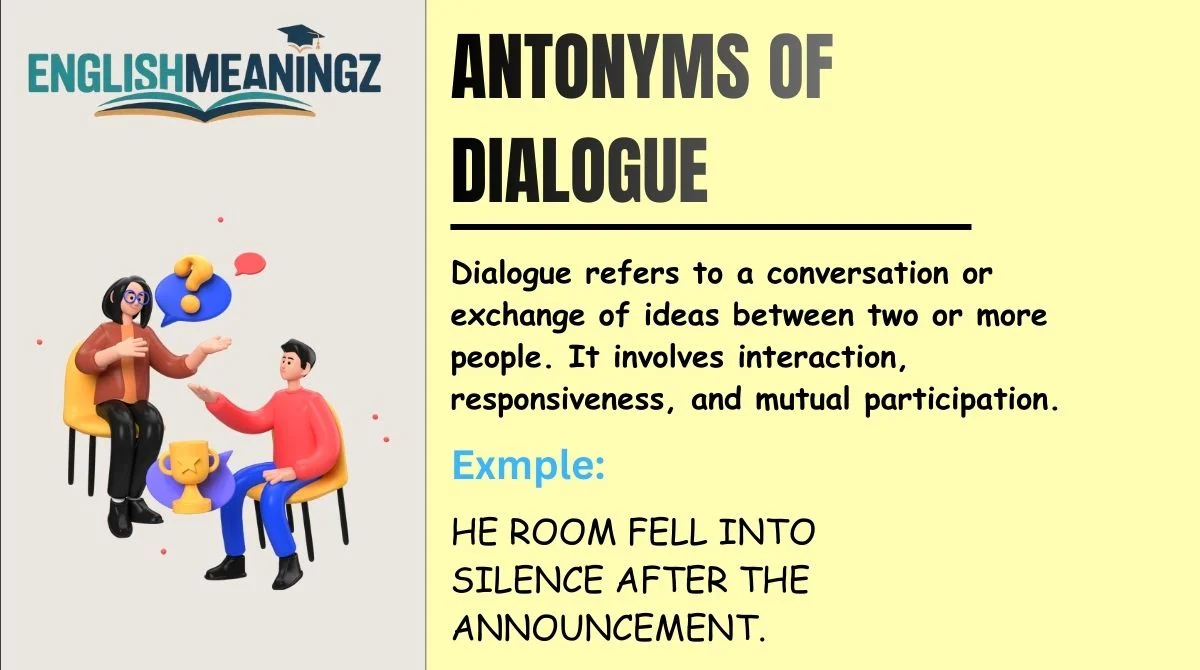
Dialogue refers to a conversation or exchange of ideas between two or more people. It involves interaction, responsiveness, and mutual participation.
Tone Explanation:
Dialogue usually carries a collaborative or communicative tone. It suggests openness, engagement, and shared understanding.
Emotional or Action Intensity:
The intensity of dialogue can vary—from calm discussions to heated debates—but its defining feature is interaction. Without participation from multiple sides, dialogue ceases to exist.
25 Best Antonyms for “Dialogue”
Silence
Meaning: Complete absence of speech
Tone: Emotional / Neutral
Example: The room fell into silence after the announcement.
Why Opposite: Dialogue requires communication, while silence eliminates it entirely.
Monologue
Meaning: A one-sided speech
Tone: Formal / Academic
Example: The lecture turned into a long monologue.
Why Opposite: Dialogue involves multiple voices; monologue allows only one.
Isolation
Meaning: State of being separated from others
Tone: Emotional
Example: His isolation prevented meaningful interaction.
Why Opposite: Dialogue thrives on connection; isolation removes it.
Secrecy
Meaning: Keeping information hidden
Tone: Formal
Example: The deal was conducted in secrecy.
Why Opposite: Dialogue promotes openness; secrecy restricts it.
Suppression
Meaning: Preventing expression
Tone: Academic
Example: The regime enforced suppression of public speech.
Why Opposite: Dialogue encourages expression; suppression blocks it.
Conflict
Meaning: Serious disagreement or argument
Tone: Emotional
Example: The meeting ended in conflict.
Why Opposite: Dialogue seeks exchange; conflict disrupts constructive communication.
Refusal
Meaning: Rejection of engagement
Tone: Formal
Example: His refusal to respond ended the discussion.
Why Opposite: Dialogue requires participation; refusal denies it.
Withdrawal
Meaning: Pulling away from interaction
Tone: Neutral
Example: Her withdrawal from the group stopped communication.
Why Opposite: Dialogue depends on involvement; withdrawal removes it.
Ignorance
Meaning: Lack of knowledge or awareness
Tone: Neutral
Example: Ignorance prevented meaningful discussion.
Why Opposite: Dialogue exchanges ideas; ignorance limits them.
Disconnection
Meaning: Lack of communication link
Tone: Neutral
Example: There was a clear disconnection between the teams.
Why Opposite: Dialogue connects; disconnection separates.
Solitude
Meaning: Being alone
Tone: Emotional
Example: He preferred solitude over conversation.
Why Opposite: Dialogue requires others; solitude excludes them.
Noncommunication
Meaning: Failure to communicate
Tone: Academic
Example: Noncommunication led to misunderstandings.
Why Opposite: Dialogue is active communication; this is its absence.
Avoidance
Meaning: Deliberately staying away from interaction
Tone: Informal / Neutral
Example: Her avoidance made collaboration impossible.
Why Opposite: Dialogue involves engagement; avoidance prevents it.
Rejection
Meaning: Dismissing communication
Tone: Emotional
Example: The proposal faced outright rejection.
Why Opposite: Dialogue invites exchange; rejection shuts it down.
Silence Policy
Meaning: Intentional lack of response
Tone: Formal
Example: The company followed a silence policy.
Why Opposite: Dialogue requires responses; silence policy avoids them.
Concealment
Meaning: Hiding information
Tone: Formal
Example: Concealment of facts halted discussion.
Why Opposite: Dialogue reveals; concealment hides.
Breakdown
Meaning: Failure in communication
Tone: Neutral
Example: A communication breakdown caused confusion.
Why Opposite: Dialogue functions smoothly; breakdown disrupts it.
Indifference
Meaning: Lack of interest
Tone: Emotional
Example: His indifference ended the conversation.
Why Opposite: Dialogue requires interest; indifference removes motivation.
Hostility
Meaning: Aggressive opposition
Tone: Emotional
Example: Hostility replaced constructive discussion.
Why Opposite: Dialogue is cooperative; hostility is destructive.
Silence Agreement
Meaning: Mutual decision not to speak
Tone: Formal
Example: They reached a silence agreement.
Why Opposite: Dialogue involves speaking; this avoids it.
Privacy
Meaning: Keeping matters personal
Tone: Neutral
Example: She valued privacy over discussion.
Why Opposite: Dialogue shares; privacy limits sharing.
Exclusion
Meaning: Leaving someone out
Tone: Formal
Example: Exclusion prevented open communication.
Why Opposite: Dialogue includes participants; exclusion removes them.
Detachment
Meaning: Emotional distance
Tone: Emotional
Example: His detachment hindered interaction.
Why Opposite: Dialogue requires engagement; detachment avoids it.
Neglect
Meaning: Ignoring communication
Tone: Emotional
Example: Neglect led to silence between them.
Why Opposite: Dialogue requires effort; neglect abandons it.
Censorship
Meaning: Restricting speech
Tone: Academic
Example: Censorship limited public discourse.
Why Opposite: Dialogue allows free expression; censorship restricts it.
Strong vs Mild Opposites
Not all antonyms carry the same intensity. Some are absolute opposites, while others are contextual contrasts.
Strong Opposites:
Words like silence, suppression, and censorship directly eliminate communication. These represent the strongest contrast to dialogue because they remove the possibility of exchange entirely.
Moderate Opposites:
Terms like conflict, hostility, and breakdown don’t eliminate communication but distort it. Dialogue still exists, but it loses its cooperative nature.
Mild Opposites:
Words such as indifference, avoidance, and detachment suggest reduced interaction rather than total absence. These are softer contrasts and depend heavily on context.
Understanding this scale helps you choose the right word based on emotional intensity and writing purpose.
Context-Based Opposites
Antonyms are not always fixed—they often depend on context.
- In literature, monologue is the clearest opposite of dialogue.
- In politics, censorship or suppression works better.
- In relationships, silence or withdrawal feels more accurate.
- In business communication, noncommunication or breakdown is preferred.
Choosing the right antonym depends on the situation, audience, and tone you want to convey.
Common Mistakes When Using Opposites
Confusing conflict with absence of dialogue:
Conflict still involves communication, so it’s not always a true opposite.
Using monologue incorrectly:
A monologue is still communication—it’s just one-sided.
Ignoring tone mismatch:
Using an emotional word like hostility in formal writing can sound inappropriate.
Overgeneralizing silence:
Silence can sometimes support dialogue (e.g., pauses), so context matters.
Sentence Transformation Examples
Original: The meeting encouraged open dialogue.
Rewritten: The meeting ended in complete silence.
Original: Their dialogue improved understanding.
Rewritten: Their noncommunication caused confusion.
Original: Dialogue resolved the issue.
Rewritten: Conflict worsened the issue.
Original: The dialogue was productive.
Rewritten: The discussion broke down completely.
Original: Dialogue builds relationships.
Rewritten: Withdrawal damages relationships.
FAQs
What is the simplest antonym of dialogue?
The simplest and most direct antonym is silence, as it represents the complete absence of communication.
Is monologue a true opposite of dialogue?
Yes, in structure. Dialogue involves multiple speakers, while monologue is one-sided.
Can conflict be considered an antonym?
Partially. Conflict contrasts with constructive dialogue but still involves communication.
Which antonym is best for academic writing?
Words like noncommunication, suppression, and censorship are more suitable in formal contexts.
Are all antonyms context-dependent?
Yes. The best opposite depends on the situation and intended meaning.
Why is learning antonyms important?
It improves vocabulary, clarity, and the ability to express nuanced ideas.
How can I practice using antonyms effectively?
Rewrite sentences, read widely, and focus on tone and context when choosing opposites.
Conclusion
Mastering antonyms of dialogue is more than a vocabulary exercise—it’s a strategic writing skill.
By understanding the range from silence to conflict, you gain control over tone, clarity, and precision.
Whether you’re writing academically, professionally, or creatively, selecting the right opposite allows you to communicate with intention and depth.
The key is not just knowing these words, but knowing when and why to use them.