Strong writing is not just about choosing the right words—it’s about understanding contrast. The ability to express opposites with precision allows writers to sharpen meaning, clarify arguments, and create more engaging content.
When you know how to counter a word effectively, your communication becomes more dynamic and persuasive.
In academic and professional contexts, mastering opposites is especially valuable. Whether you’re drafting essays, reports, or presentations, using accurate antonyms helps you explain ideas more clearly, highlight distinctions, and avoid vague language.
This is where understanding expository antonyms becomes essential.
What Does “Expository” Mean?
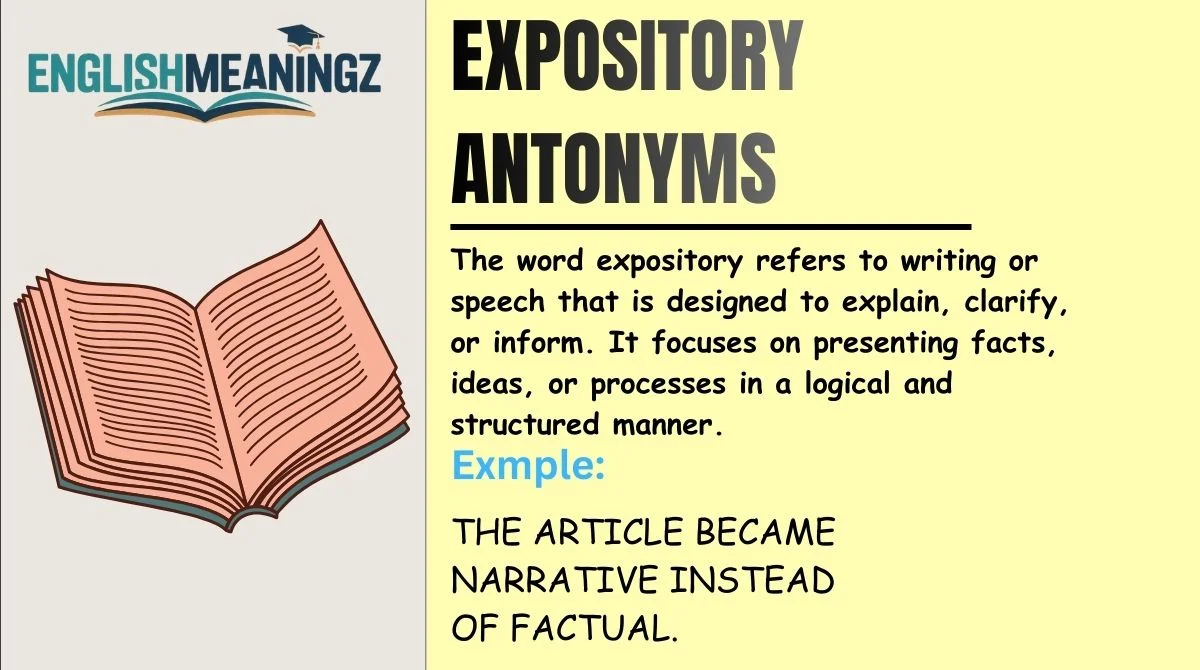
The word expository refers to writing or speech that is designed to explain, clarify, or inform. It focuses on presenting facts, ideas, or processes in a logical and structured manner.
Tone Explanation
Expository language is typically:
- Neutral
- Objective
- Informative
- Structured
It avoids emotional bias and focuses on clarity rather than persuasion.
Emotional or Action Intensity
Expository content is low in emotional intensity. It aims for rational explanation rather than dramatic expression. The goal is to make the reader understand—not to influence their feelings.
25 Best Antonyms for “Expository”
1. Persuasive
Meaning: Intended to convince or influence
Tone: Formal
Example: The speech was persuasive rather than purely informative.
Why Opposite: It aims to change opinions, unlike expository writing which explains.
2. Argumentative
Meaning: Focused on debate or proving a point
Tone: Academic
Example: His essay was argumentative instead of explanatory.
Why Opposite: It promotes a stance rather than presenting neutral facts.
3. Narrative
Meaning: Tells a story
Tone: Informal/Formal
Example: The article became narrative instead of factual.
Why Opposite: It focuses on storytelling rather than explanation.
4. Descriptive
Meaning: Focuses on vivid details
Tone: Creative
Example: Her writing was descriptive, not analytical.
Why Opposite: It emphasizes imagery over explanation.
5. Emotional
Meaning: Driven by feelings
Tone: Emotional
Example: The message was emotional rather than objective.
Why Opposite: Expository writing avoids emotional bias.
6. Subjective
Meaning: Based on personal opinion
Tone: Informal
Example: His response was subjective instead of factual.
Why Opposite: Expository writing relies on objectivity.
7. Biased
Meaning: Showing favoritism
Tone: Formal
Example: The report sounded biased, not neutral.
Why Opposite: Expository writing strives for neutrality.
8. Fictional
Meaning: Based on imagination
Tone: Creative
Example: The piece was fictional rather than informative.
Why Opposite: Expository content deals with real facts.
9. Dramatic
Meaning: Full of intense emotion
Tone: Emotional
Example: The tone was dramatic, not informative.
Why Opposite: Expository writing avoids exaggeration.
10. Poetic
Meaning: Artistic and expressive
Tone: Creative
Example: The language was poetic instead of clear.
Why Opposite: Poetry prioritizes beauty over clarity.
11. Opinionated
Meaning: Strong personal views
Tone: Informal
Example: The article sounded opinionated rather than neutral.
Why Opposite: Expository writing avoids personal bias.
12. Ambiguous
Meaning: Unclear or vague
Tone: Academic
Example: His explanation was ambiguous, not precise.
Why Opposite: Expository writing values clarity.
13. Vague
Meaning: Lacking detail
Tone: Informal
Example: The statement was vague instead of informative.
Why Opposite: Expository writing is specific.
14. Impressionistic
Meaning: Based on general impressions
Tone: Artistic
Example: The essay was impressionistic rather than analytical.
Why Opposite: It lacks structured explanation.
15. Speculative
Meaning: Based on guesswork
Tone: Academic
Example: The report was speculative instead of factual.
Why Opposite: Expository writing relies on evidence.
16. Emotionalized
Meaning: Filled with emotional appeal
Tone: Emotional
Example: The message felt emotionalized, not factual.
Why Opposite: Expository avoids emotional manipulation.
17. Informal
Meaning: Casual and relaxed
Tone: Informal
Example: The tone was informal instead of structured.
Why Opposite: Expository writing is structured and formal.
18. Creative
Meaning: Imaginative expression
Tone: Creative
Example: The piece leaned creative rather than explanatory.
Why Opposite: Expository writing prioritizes clarity.
19. Entertaining
Meaning: Designed to amuse
Tone: Informal
Example: The article was entertaining, not informative.
Why Opposite: Expository writing focuses on education.
20. Hypothetical
Meaning: Based on assumptions
Tone: Academic
Example: The discussion was hypothetical instead of factual.
Why Opposite: Expository writing uses real evidence.
21. Reflective
Meaning: Based on personal thought
Tone: Emotional
Example: The essay was reflective rather than analytical.
Why Opposite: It focuses on personal insight.
22. Anecdotal
Meaning: Based on personal stories
Tone: Informal
Example: The evidence was anecdotal, not factual.
Why Opposite: Expository writing uses verified data.
23. Expressive
Meaning: Showing feelings vividly
Tone: Emotional
Example: The language was expressive instead of neutral.
Why Opposite: Expository avoids emotional display.
24. Interpretive
Meaning: Based on interpretation
Tone: Academic
Example: The analysis was interpretive rather than factual.
Why Opposite: It introduces subjectivity.
25. Personal
Meaning: Based on individual experience
Tone: Informal
Example: The writing felt personal, not objective.
Why Opposite: Expository writing avoids personal bias.
Strong vs Mild Opposites
Not all antonyms carry the same intensity. Some are direct and strong opposites, while others are softer contrasts.
Strong Opposites:
- Emotional
- Persuasive
- Fictional
- Biased
These directly contradict the core qualities of expository writing.
Mild Opposites:
- Informal
- Descriptive
- Reflective
These partially oppose expository writing but may still overlap in certain contexts.
Understanding this scale helps you choose the right word depending on how sharply you want to contrast meaning.
Context-Based Opposites
Antonyms often depend on context. A word may be opposite in one situation but not in another.
- In academic writing, subjective is the opposite of expository
- In storytelling, narrative contrasts with expository
- In debate, argumentative is the key opposite
This shows that antonyms are not always fixed—they shift based on usage.
Common Mistakes When Using Opposites
1. Confusing Tone with Meaning
Incorrect: The text is descriptive, so it’s the opposite of expository.
Correct: Descriptive is not always opposite—it can coexist.
2. Using Weak Contrasts
Incorrect: Informal as a strict opposite
Correct: Emotional or persuasive is stronger
3. Ignoring Context
Incorrect: Narrative is always opposite
Correct: It depends on whether explanation is present
4. Mixing Subjective and Emotional
These are related but not identical.
5. Overusing One Antonym
Repeating “emotional” weakens writing variety.
Sentence Transformation Examples
Original 1
The report explains the process clearly.
Rewritten: The report persuades readers to adopt a viewpoint.
Original 2
The article provides factual information.
Rewritten: The article expresses personal opinions.
Original 3
The essay is neutral and objective.
Rewritten: The essay is biased and subjective.
Original 4
The explanation is structured and logical.
Rewritten: The explanation is vague and unclear.
Original 5
The text focuses on clarity.
Rewritten: The text focuses on emotional expression.
FAQs
What is the main purpose of expository writing?
It aims to inform, explain, and clarify ideas using facts and logic.
Are all antonyms exact opposites?
No, some are partial or context-based opposites.
Can expository writing include description?
Yes, but only to support clarity, not artistic expression.
What is the strongest antonym of expository?
“Emotional” or “persuasive” are among the strongest contrasts.
Is narrative always an opposite?
Not always—it depends on whether explanation is present.
Why is objectivity important in expository writing?
It ensures accuracy, clarity, and credibility.
How can I improve my use of antonyms?
Practice using them in context and understand tone differences.
Conclusion
Mastering expository antonyms is a powerful way to elevate your writing. It allows you to sharpen contrasts, clarify meaning, and adapt your tone to different contexts.
Whether you are writing academically or professionally, understanding these opposites helps you communicate with precision and confidence.
By choosing the right antonym, you don’t just change a word—you transform the entire message.