Understanding opposites—also known as antonyms—is one of the fastest ways to elevate your writing from average to impactful.
Whether you are crafting essays, business emails, or creative pieces, knowing how to use contrasting words allows you to express ideas with precision and depth.
Opposites sharpen clarity. When you know both what a word means and what it does not mean, you gain control over tone, intent, and emotional direction.
This is especially valuable in academic and professional communication, where subtle differences in meaning can influence interpretation, persuasion, and credibility.
In professional settings, using the right antonym can transform a vague sentence into a precise statement. In academic writing, it helps establish arguments, compare theories, and demonstrate critical thinking. Simply put, mastering antonyms strengthens both comprehension and expression.
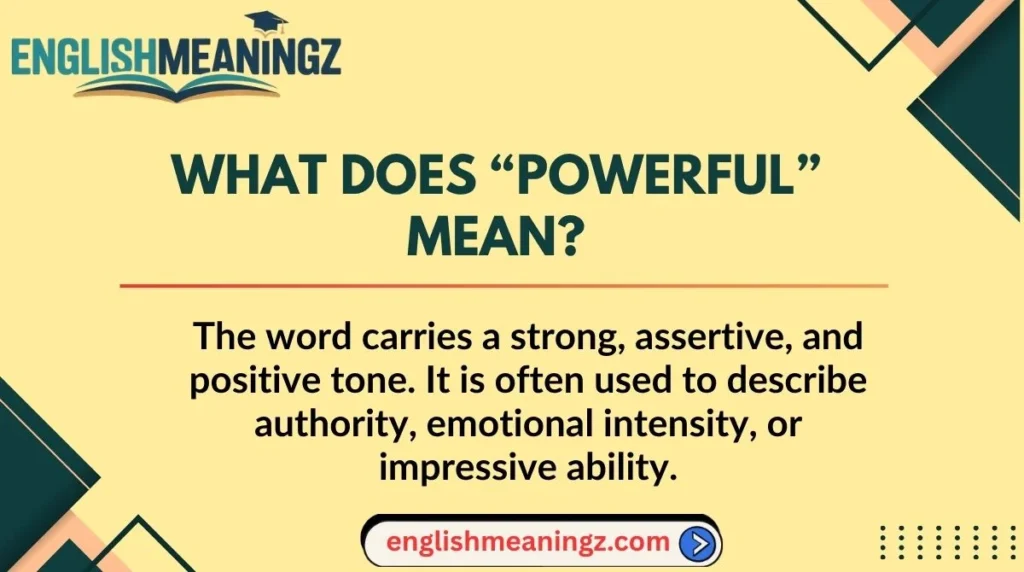
What Does “Powerful” Mean?
The root word we will focus on is “powerful.”
Definition:
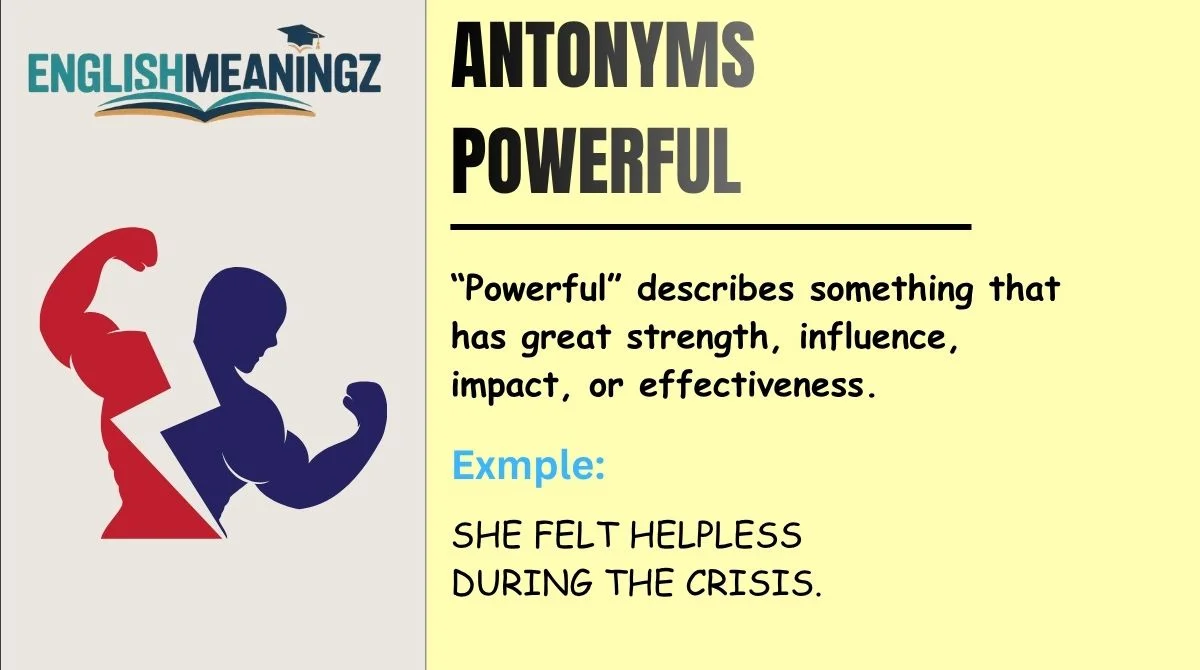
“Powerful” describes something that has great strength, influence, impact, or effectiveness.
Tone Explanation:
The word carries a strong, assertive, and positive tone. It is often used to describe authority, emotional intensity, or impressive ability.
Emotional / Action Intensity:
“Powerful” sits at a high-intensity level. It implies dominance, effectiveness, or strong presence—whether physical, emotional, or intellectual.
18 Best Antonyms for “Powerful”
1. Weak
Meaning: Lacking strength or force
Tone: Neutral
Example: His argument was weak and failed to convince the audience.
Why It’s Opposite: It directly contrasts strength and influence.
2. Helpless
Meaning: Unable to defend or act independently
Tone: Emotional
Example: She felt helpless during the crisis.
Why It’s Opposite: A powerful person has control; helplessness reflects a lack of it.
3. Fragile
Meaning: Easily broken or damaged
Tone: Descriptive
Example: The fragile structure collapsed under pressure.
Why It’s Opposite: Power implies durability; fragility suggests vulnerability.
4. Ineffective
Meaning: Not producing the desired result
Tone: Formal
Example: The policy proved ineffective in solving the issue.
Why It’s Opposite: Power implies effectiveness; this indicates failure.
5. Powerless
Meaning: Without authority or influence
Tone: Emotional
Example: Citizens felt powerless against corruption.
Why It’s Opposite: It directly negates the concept of power.
6. Feeble
Meaning: Physically or mentally weak
Tone: Slightly formal
Example: His feeble attempt did not succeed.
Why It’s Opposite: It represents minimal strength.
7. Submissive
Meaning: Ready to conform or yield
Tone: Behavioral
Example: The employee remained submissive under pressure.
Why It’s Opposite: Power involves dominance; submissiveness implies surrender.
8. Insignificant
Meaning: Too small to be important
Tone: Academic
Example: The difference was statistically insignificant.
Why It’s Opposite: Power often implies importance or impact.
9. Timid
Meaning: Showing lack of courage
Tone: Emotional
Example: His timid response weakened his position.
Why It’s Opposite: Power involves confidence; timidity reflects fear.
10. Inefficient
Meaning: Not performing well or productively
Tone: Professional
Example: The system was inefficient and slow.
Why It’s Opposite: Power often relates to effectiveness and efficiency.
11. Vulnerable
Meaning: Exposed to harm
Tone: Emotional
Example: The system is vulnerable to attacks.
Why It’s Opposite: Power implies protection; vulnerability suggests exposure.
12. Inferior
Meaning: Lower in quality or status
Tone: Formal
Example: The product is inferior to its competitors.
Why It’s Opposite: Power often suggests superiority.
13. Passive
Meaning: Not actively participating
Tone: Academic
Example: A passive approach rarely leads to success.
Why It’s Opposite: Power requires action and initiative.
14. Meek
Meaning: Quiet, gentle, and easily imposed upon
Tone: Emotional
Example: The meek response failed to assert authority.
Why It’s Opposite: Power is assertive; meekness is yielding.
15. Limited
Meaning: Restricted in scope or ability
Tone: Neutral
Example: His influence was limited.
Why It’s Opposite: Power suggests broad reach and capability.
16. Dependent
Meaning: Relying on others
Tone: Neutral
Example: The organization remained dependent on external funding.
Why It’s Opposite: Power implies independence.
17. Unconvincing
Meaning: Not persuasive
Tone: Formal
Example: Her explanation was unconvincing.
Why It’s Opposite: Powerful communication persuades effectively.
18. Soft
Meaning: Not forceful or intense
Tone: Informal
Example: His soft tone lacked authority.
Why It’s Opposite: Power involves intensity and firmness.
Strong vs Mild Opposites
Not all antonyms carry the same level of intensity. Some are direct and strong opposites, while others are mild contrasts.
Strong Opposites:
- Powerless
- Weak
- Helpless
These words completely reverse the meaning of “powerful.”
Moderate Opposites:
- Ineffective
- Passive
- Limited
These suggest reduced power rather than its total absence.
Mild Opposites:
- Soft
- Timid
- Meek
These focus more on tone and behavior rather than absolute lack of power.
Understanding this scale helps you choose the most accurate word based on context and emotional strength.
Context-Based Opposites
Antonyms are not always fixed. The opposite of a word can change depending on context.
- In leadership:
“Powerful” → “Submissive” - In communication:
“Powerful” → “Unconvincing” - In physical strength:
“Powerful” → “Weak” - In emotional tone:
“Powerful” → “Timid”
This flexibility is crucial in advanced writing. The best antonym depends on what aspect of the word you are targeting.
Common Mistakes When Using Opposites
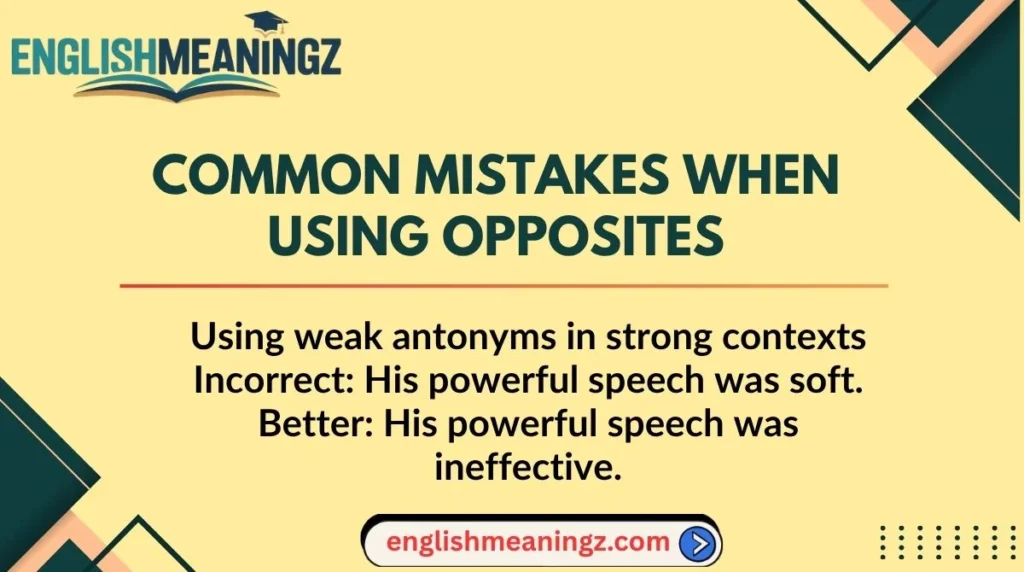
1. Using weak antonyms in strong contexts
Incorrect: His powerful speech was soft.
Better: His powerful speech was ineffective.
2. Confusing emotional vs physical opposites
Incorrect: The powerful machine was timid.
Better: The powerful machine was weak.
3. Overusing one antonym
Repeating “weak” reduces vocabulary variety and impact.
4. Ignoring tone mismatch
Using informal words in formal writing lowers credibility.
5. Choosing unrelated contrasts
Not all contrasting words are true antonyms.
Sentence Transformation Examples
1. Original:
She gave a powerful presentation.
Rewritten:
She gave an unconvincing presentation.
2. Original:
He is a powerful leader.
Rewritten:
He is a submissive leader.
3. Original:
The system is powerful and efficient.
Rewritten:
The system is inefficient and limited.
4. Original:
Her voice sounded powerful.
Rewritten:
Her voice sounded soft and timid.
5. Original:
They built a powerful strategy.
Rewritten:
They built an ineffective strategy.
FAQs
What is an antonym?
An antonym is a word that has the opposite meaning of another word.
Why are antonyms important in writing?
They improve clarity, enhance contrast, and strengthen arguments.
Can a word have multiple antonyms?
Yes, depending on context and meaning.
Are all antonyms exact opposites?
No, some are partial or context-based opposites.
How do I choose the right antonym?
Focus on tone, context, and intensity.
Are antonyms useful in SEO writing?
Yes, they expand keyword variation and improve readability.
How can I learn antonyms faster?
Practice using them in sentences and analyze context differences.
Conclusion
Mastering antonyms is more than a vocabulary exercise—it is a strategic tool for better communication. By understanding the opposite of a word like “powerful,” you gain the ability to express nuance, create contrast, and deliver precise meaning.
From academic essays to professional writing, the ability to choose the right opposite word enhances clarity, authority, and engagement. When used correctly, antonyms do not just replace words—they reshape ideas.
The more you practice, the more natural this skill becomes, allowing your writing to evolve from basic to highly effective.