Understanding opposites—also known as antonyms—is one of the fastest ways to improve your writing clarity, precision, and impact.
Whether you’re crafting an academic essay, writing professional emails, or building compelling content, knowing how to use contrasting words allows you to express ideas with greater depth and nuance.
Opposites are more than just vocabulary tools—they are cognitive anchors. They help readers understand meaning through contrast.
For example, describing something as “complex” becomes clearer when contrasted with “simple.” This duality strengthens comprehension and sharpens communication.
In academic and professional settings, antonyms play a critical role. They allow you to:
- Compare and evaluate ideas effectively
- Avoid repetition
- Improve argumentative writing
- Enhance tone control
This article explores 18 carefully selected pairs of antonyms, along with their meanings, tones, usage, and contextual relevance. By the end, you will not only recognize these opposites but use them with precision and confidence.
What Does “Antonyms” Mean?
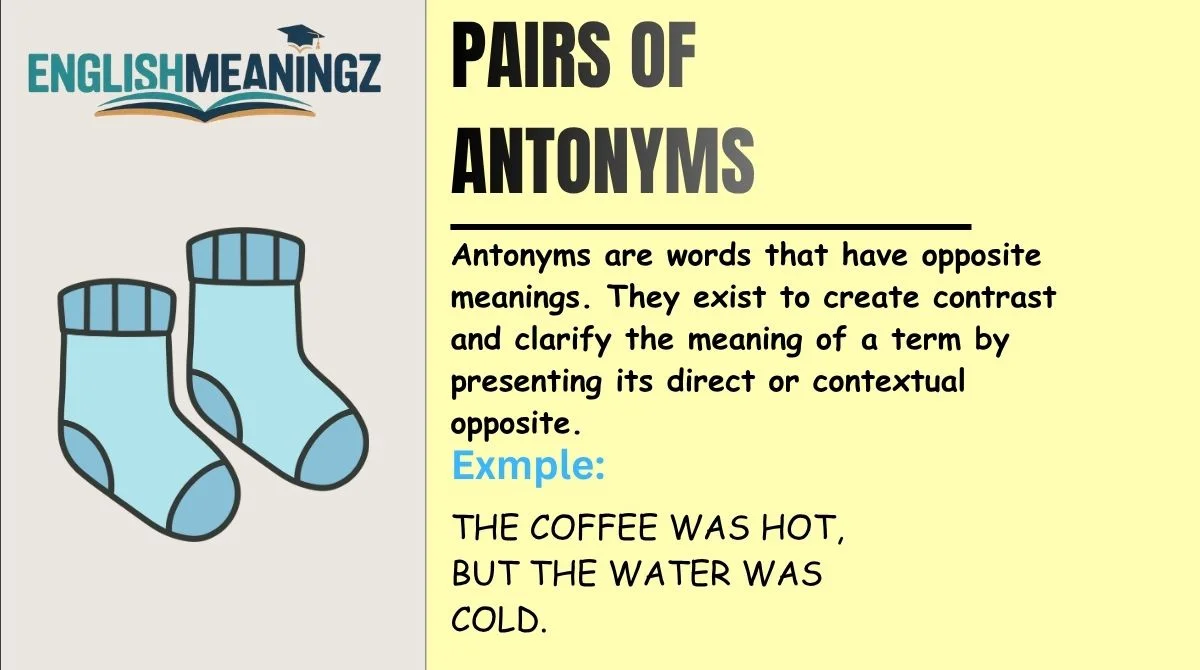
Antonyms are words that have opposite meanings. They exist to create contrast and clarify the meaning of a term by presenting its direct or contextual opposite.
Tone Explanation
Antonyms can vary in tone depending on usage. Some are:
- Formal (e.g., increase vs decrease)
- Informal (e.g., happy vs sad)
- Academic (e.g., theoretical vs practical)
- Emotional (e.g., love vs hate)
Emotional or Action Intensity
Not all opposites are equal in intensity. Some express extreme contrast (hot vs freezing), while others are milder (warm vs cool). Understanding this spectrum is essential for choosing the right word in context.
18 Best Antonyms for “Antonyms”
Below are 18 essential antonym pairs that demonstrate how opposites function across different tones and contexts.
1. Hot ↔ Cold
Meaning: Temperature extremes
Tone: Neutral
Example: The coffee was hot, but the water was cold.
Why Opposite: They represent opposite ends of the temperature spectrum.
2. Big ↔ Small
Meaning: Size contrast
Tone: Informal
Example: The elephant is big, while the mouse is small.
Why Opposite: They indicate maximum size difference.
3. Fast ↔ Slow
Meaning: Speed difference
Tone: Neutral
Example: The car is fast, but the bicycle is slow.
Why Opposite: They describe opposing motion speeds.
4. Happy ↔ Sad
Meaning: Emotional states
Tone: Emotional
Example: She felt happy after the news, but he remained sad.
Why Opposite: They represent contrasting emotions.
5. Easy ↔ Difficult
Meaning: Level of complexity
Tone: Academic
Example: The test was easy for some, but difficult for others.
Why Opposite: They define opposite effort levels.
6. Strong ↔ Weak
Meaning: Physical or metaphorical strength
Tone: Neutral
Example: The bridge is strong, but the rope is weak.
Why Opposite: They indicate power contrast.
7. Light ↔ Dark
Meaning: Brightness or color
Tone: Descriptive
Example: The room was light during the day but dark at night.
Why Opposite: They define visual extremes.
8. Rich ↔ Poor
Meaning: Economic status
Tone: Formal
Example: The rich investor helped the poor community.
Why Opposite: They represent financial extremes.
9. Begin ↔ End
Meaning: Time sequence
Tone: Neutral
Example: The show will begin at 6 and end at 9.
Why Opposite: They mark starting and finishing points.
10. Accept ↔ Reject
Meaning: Decision-making
Tone: Formal
Example: She chose to accept the offer, while he decided to reject it.
Why Opposite: They indicate opposite choices.
11. Increase ↔ Decrease
Meaning: Quantity change
Tone: Academic
Example: Prices increase in demand but decrease in surplus.
Why Opposite: They show numerical movement in opposite directions.
12. Love ↔ Hate
Meaning: Strong emotions
Tone: Emotional
Example: He felt love for his family but hate for injustice.
Why Opposite: They are emotional extremes.
13. Open ↔ Closed
Meaning: Physical or abstract accessibility
Tone: Neutral
Example: The door is open now, but it was closed earlier.
Why Opposite: They define availability.
14. Early ↔ Late
Meaning: Time relation
Tone: Neutral
Example: She arrived early, but he came late.
Why Opposite: They contrast timing.
15. True ↔ False
Meaning: Accuracy
Tone: Academic
Example: The statement is true, not false.
Why Opposite: They define correctness vs error.
16. Clean ↔ Dirty
Meaning: Condition or hygiene
Tone: Informal
Example: The room is clean, unlike the dirty garage.
Why Opposite: They show opposite states of cleanliness.
17. Win ↔ Lose
Meaning: Outcome
Tone: Informal
Example: One team will win, and the other will lose.
Why Opposite: They represent success vs failure.
18. Give ↔ Take
Meaning: Action exchange
Tone: Neutral
Example: It’s better to give than to take constantly.
Why Opposite: They show opposite directions of action.
Strong vs Mild Opposites
Not all antonyms carry equal weight. Some express absolute contrast, while others offer a relative difference.
Strong Opposites
These represent extreme differences:
- Love ↔ Hate
- True ↔ False
- Win ↔ Lose
These leave little room for middle ground.
Mild Opposites
These allow flexibility:
- Warm ↔ Cool
- Happy ↔ Unhappy
- Big ↔ Medium
Using mild antonyms is useful in nuanced writing, especially in academic or analytical contexts where precision matters.
Why It Matters
Choosing the wrong intensity can distort meaning. Saying “hate” instead of “dislike” may exaggerate emotion unnecessarily.
Context-Based Opposites
Some antonyms depend entirely on context rather than strict dictionary definitions.
Examples:
- “Light”
- Opposite of brightness → Dark
- Opposite of weight → Heavy
- “Open”
- Opposite of closed → Shut
- Opposite of secretive → Reserved
Key Insight
Contextual antonyms require understanding the situation. The same word can have multiple opposites depending on its meaning in a sentence.
Common Mistakes When Using Opposites
Even experienced writers misuse antonyms. Here are common errors:
1. Using Non-Exact Opposites
Incorrect: Hot ↔ Cool (not exact)
Correct: Hot ↔ Cold
2. Ignoring Context
Incorrect: Light ↔ Hard
Correct depends on meaning: Light ↔ Heavy
3. Overusing Extreme Opposites
Using “hate” instead of “dislike” creates unnecessary intensity.
4. Mixing Tone Levels
Combining formal and informal opposites can confuse readers.
Example:
The CEO felt ecstatic, but the employee was kinda sad. (tone mismatch)
5. Misunderstanding Gradable Antonyms
Some antonyms exist on a scale:
- Hot → Warm → Cool → Cold
Not all are direct opposites.
Sentence Transformation Examples
Here are five examples showing how antonyms can transform meaning:
1
Original: The task is easy.
Rewritten: The task is difficult.
2
Original: She arrived early.
Rewritten: She arrived late.
3
Original: The room is clean.
Rewritten: The room is dirty.
4
Original: He accepted the proposal.
Rewritten: He rejected the proposal.
5
Original: The company saw an increase in profits.
Rewritten: The company saw a decrease in profits.
FAQs
What are antonyms in simple words?
Antonyms are words that have opposite meanings, like hot and cold.
Why are antonyms important in writing?
They improve clarity, enhance contrast, and make communication more precise.
Can a word have more than one antonym?
Yes, depending on context. For example, light can have different opposites.
Are all antonyms exact opposites?
No. Some are gradual or context-based rather than absolute.
What is the difference between synonyms and antonyms?
Synonyms have similar meanings, while antonyms have opposite meanings.
How can I learn antonyms faster?
Practice in pairs, use them in sentences, and study them in context.
Are antonyms used in academic writing?
Yes, they are essential for comparisons, arguments, and clarity.
Conclusion
Mastering antonyms is a foundational step toward becoming a more effective and confident writer. These 18 pairs are not just vocabulary items—they are tools for thinking, comparing, and expressing ideas with precision.
By understanding tone, intensity, and context, you can avoid common mistakes and elevate your writing across academic, professional, and creative domains.
Whether you’re analyzing data, crafting essays, or improving everyday communication, antonyms provide the clarity and contrast your message needs.