Understanding opposites is one of the fastest ways to sharpen your writing and communication skills. When you know not just a word—but also its contrasting meanings—you gain precision, flexibility, and control over tone.
Whether you’re crafting essays, professional emails, or creative content, antonyms allow you to express contrast clearly and effectively.
In academic and professional communication, using the right opposite can completely shift meaning, tone, and impact. It helps avoid repetition, strengthens arguments, and improves clarity.
This guide explores the term “canal” and provides 18 carefully explained antonyms that will upgrade your vocabulary and writing power.
What Does “Canal” Mean?
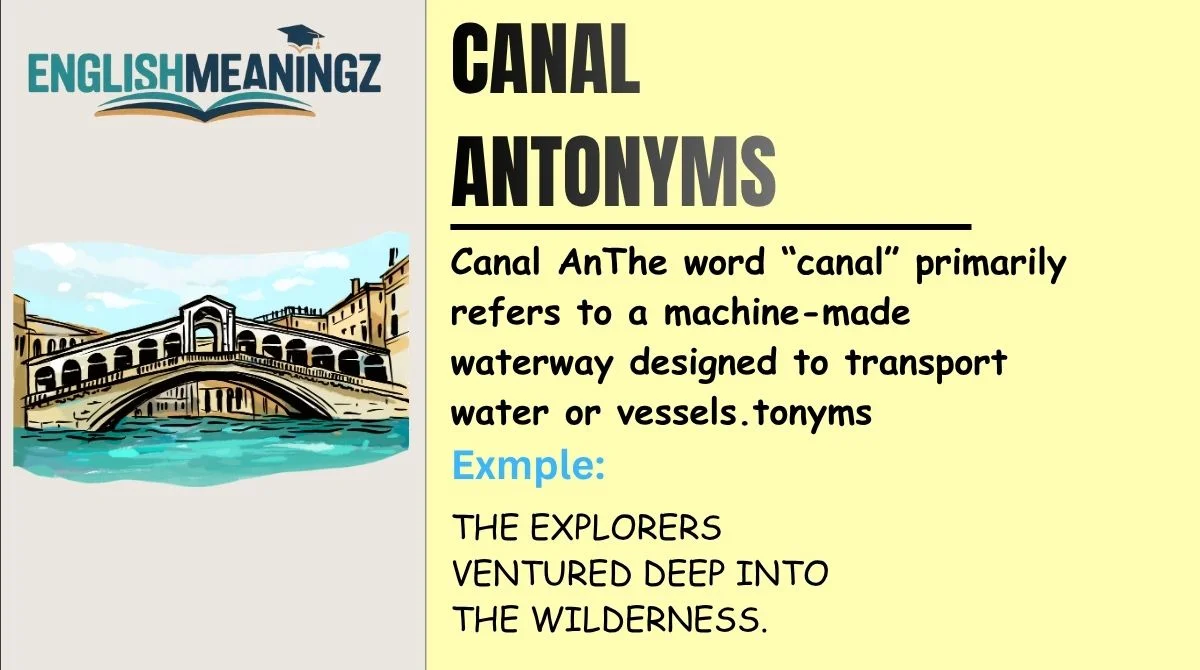
The word “canal” primarily refers to a machine-made waterway designed to transport water or vessels. It implies structure, direction, and controlled flow.
Definition:
A canal is an artificial channel constructed to carry water for irrigation, drainage, or navigation.
Tone Explanation:
The tone of “canal” is generally neutral and technical, often used in geographical, engineering, or infrastructural contexts.
Emotional or Action Intensity:
“Canal” suggests order, direction, and machine control over natural elements. It reflects planning and structured movement, rather than randomness or chaos.
18 Best Antonyms for “Canal”
Chaos
Meaning: Complete disorder or confusion
Tone: Emotional / Informal
Example: The city descended into chaos after the system collapsed.
Why Opposite: A canal represents controlled flow, while chaos represents total lack of structure.
Wilderness
Meaning: Untamed natural land
Tone: Descriptive / Neutral
Example: The explorers ventured deep into the wilderness.
Why Opposite: A canal is machine-made and controlled; wilderness is natural and untouched.
Blockage
Meaning: Obstruction preventing movement
Tone: Formal
Example: The blockage in the pipe stopped water flow completely.
Why Opposite: A canal facilitates flow; blockage stops it.
Barrier
Meaning: Something that prevents movement or access
Tone: Formal
Example: The wall acted as a barrier between the two regions.
Why Opposite: Canals enable passage, while barriers restrict it.
Obstruction
Meaning: Something that blocks or hinders
Tone: Academic
Example: An obstruction in the road caused delays.
Why Opposite: A canal is designed for smooth flow; obstruction interrupts it.
Closure
Meaning: The act of shutting something
Tone: Formal
Example: The closure of the road affected traffic.
Why Opposite: A canal is open and active; closure implies inactivity.
Dryness
Meaning: Lack of water or moisture
Tone: Neutral
Example: The dryness of the land made farming impossible.
Why Opposite: Canals carry water; dryness represents absence of it.
Desert
Meaning: A barren, dry area
Tone: Descriptive
Example: The desert stretched endlessly without water.
Why Opposite: A canal provides water, while deserts lack it.
Flood
Meaning: Excess overflow of water
Tone: Emotional / Neutral
Example: The flood destroyed homes in the area.
Why Opposite: A canal controls water flow; a flood represents uncontrolled water.
Stagnation
Meaning: Lack of movement or flow
Tone: Academic
Example: Economic stagnation affected growth.
Why Opposite: A canal ensures movement; stagnation means no movement.
Isolation
Meaning: Separation or lack of connection
Tone: Emotional / Formal
Example: The village suffered from isolation.
Why Opposite: Canals connect places; isolation disconnects them.
Disruption
Meaning: Disturbance or interruption
Tone: Neutral
Example: The storm caused major disruption in transport.
Why Opposite: Canals promote smooth operation; disruption interrupts it.
Congestion
Meaning: Overcrowding or blockage
Tone: Formal
Example: Traffic congestion delayed commuters.
Why Opposite: A canal allows flow; congestion restricts it.
Drought
Meaning: Extended lack of rainfall
Tone: Environmental / Formal
Example: The drought affected agricultural production.
Why Opposite: Canals supply water; drought represents scarcity.
Disorder
Meaning: Lack of organization
Tone: Formal
Example: The files were in complete disorder.
Why Opposite: A canal is structured; disorder is unstructured.
Natural Stream (Uncontrolled)
Meaning: A naturally flowing water body without machine control
Tone: Neutral
Example: The natural stream changed course after the storm.
Why Opposite: A canal is artificial and controlled; natural streams are unpredictable.
Collapse
Meaning: Sudden failure or breakdown
Tone: Emotional / Formal
Example: The system faced total collapse.
Why Opposite: Canals represent stable infrastructure; collapse is failure of structure.
Scatter
Meaning: To spread randomly
Tone: Informal
Example: Leaves scatter across the ground in autumn.
Why Opposite: A canal directs flow; scatter disperses it.
Strong vs Mild Opposites
Not all antonyms carry the same intensity. Some are direct, strong opposites, while others are situational or mild contrasts.
Strong Opposites:
Chaos, blockage, drought, stagnation
These directly contradict the purpose of a canal.
Moderate Opposites:
Barrier, obstruction, disruption
These partially oppose the function by limiting flow.
Mild or Contextual Opposites:
Wilderness, natural stream, scatter
These contrast indirectly by representing lack of control rather than direct opposition.
Understanding intensity helps you choose the most accurate word depending on your context.
Context-Based Opposites
The antonym of “canal” can vary depending on how the word is used.
- Engineering context: blockage, obstruction
- Environmental context: drought, desert
- Conceptual context: chaos, disorder
- Functional context: stagnation, congestion
For example, in a technical report, “obstruction” is more appropriate than “chaos,” while in creative writing, “wilderness” or “chaos” may be more effective.
Common Mistakes When Using Opposites
Confusing Similar Concepts
Incorrect: Canal → River
Correct: Canal → Drought / Blockage
(A river is not an opposite—it is similar.)
Using Weak Contrasts
Incorrect: Canal → Small stream
Correct: Canal → Stagnation
(Weak contrast reduces clarity.)
Ignoring Context
Incorrect: Canal → Chaos (in engineering report)
Correct: Canal → Obstruction
(Context determines the best antonym.)
Overusing One Antonym
Repeating the same opposite reduces writing quality. Use varied vocabulary for stronger impact.
Sentence Transformation Examples
Original:
The canal ensures smooth water flow.
Rewritten: The blockage prevents any water movement.
Original:
The canal connects two regions.
Rewritten: The barrier separates the two regions.
Original:
The canal supports irrigation.
Rewritten: The drought destroys agricultural productivity.
Original:
The canal maintains order in water distribution.
Rewritten: Chaos disrupts water distribution systems.
Original:
The canal allows continuous movement.
Rewritten: Stagnation halts all movement.
FAQs
What is the direct opposite of canal?
The most direct opposites are blockage, obstruction, and stagnation because they directly stop flow.
Can “river” be an antonym of canal?
No. A river is similar in function (water flow), not opposite.
Why does context matter when choosing antonyms?
Because the meaning of “canal” changes slightly depending on usage—technical, environmental, or metaphorical.
What is a strong antonym for creative writing?
Words like chaos, wilderness, and disorder work well in creative contexts.
What is the best antonym in academic writing?
Obstruction, blockage, and stagnation are more precise and formal.
Are all antonyms exact opposites?
No. Some are contextual or partial opposites depending on usage.
How can I improve my vocabulary using antonyms?
Practice using words in sentences, compare intensity levels, and apply them in different contexts.
Conclusion
Mastering antonyms like those of “canal” gives you a powerful advantage in writing and communication. Instead of relying on basic vocabulary, you gain the ability to express contrast with precision and clarity.
From strong opposites like blockage and drought to contextual contrasts like wilderness and chaos, each word offers a unique perspective.
By understanding tone, intensity, and context, you can choose the perfect antonym for any situation—making your writing more dynamic, engaging, and professional.