Understanding opposites is one of the fastest ways to sharpen your writing. When you learn antonyms, you don’t just expand your vocabulary—you gain control over tone, clarity, and precision.
Whether you’re writing essays, business emails, or creative content, knowing the right opposite word helps you express contrast effectively.
In academic and professional communication, clarity is everything. Misusing a word or failing to convey the correct intensity can weaken your message.
That’s where mastering antonyms becomes essential. By understanding the opposite of a word like respite, you can better describe pressure, continuity, or intensity without confusion.
What Does “Respite” Mean?
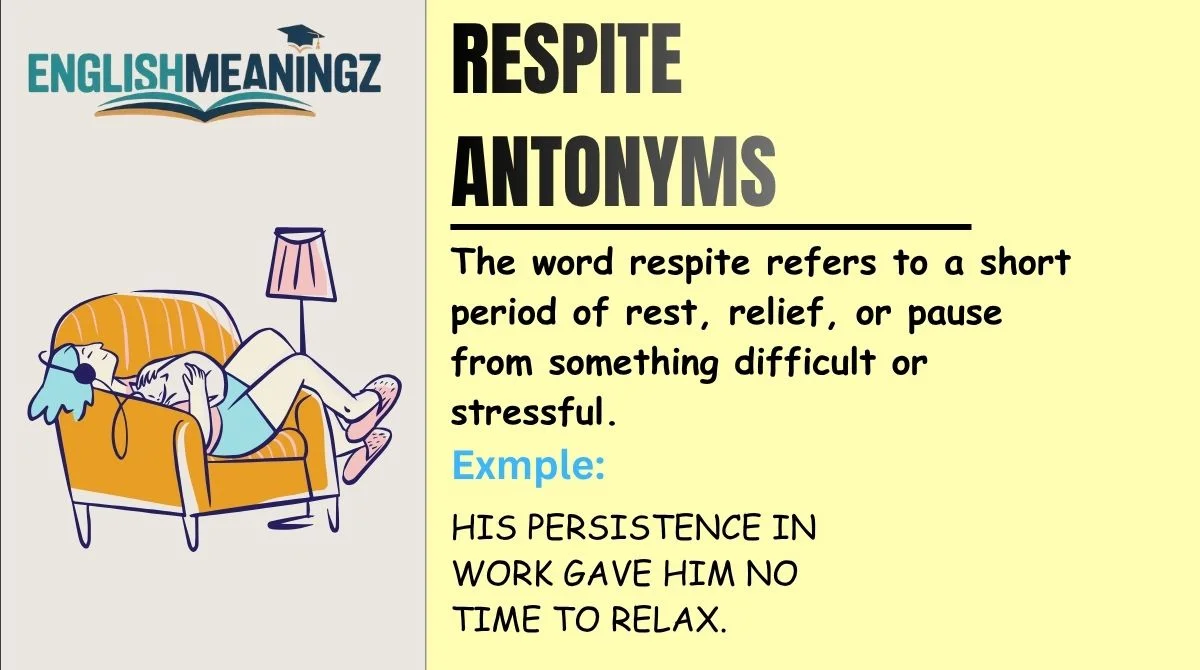
The word respite refers to a short period of rest, relief, or pause from something difficult or stressful. It is commonly used when someone temporarily escapes pressure, pain, or responsibility.
Tone Explanation:
“Respite” carries a calm, soothing tone. It suggests relief and recovery, often after hardship or fatigue.
Emotional or Action Intensity:
It indicates a break in intensity—a moment where stress, effort, or discomfort is reduced. The emotional weight is positive and comforting, often associated with relaxation or recovery.
19 Best Antonyms for “Respite”
1. Continuation
Meaning: Ongoing action without interruption
Tone: Formal
Example: The continuation of the project left no room for rest.
Why Opposite: Respite implies a break, while continuation removes that pause entirely.
2. Persistence
Meaning: Steady continuation despite difficulty
Tone: Academic
Example: His persistence in work gave him no time to relax.
Why Opposite: Persistence suggests no relief or pause.
3. Pressure
Meaning: Mental or physical strain
Tone: Emotional
Example: The constant pressure made her exhausted.
Why Opposite: Respite removes stress; pressure increases it.
4. Burden
Meaning: A heavy responsibility or load
Tone: Formal
Example: The financial burden never allowed him a break.
Why Opposite: A burden adds weight, while respite removes it temporarily.
5. Stress
Meaning: Mental tension or strain
Tone: Emotional
Example: Chronic stress replaced any chance of rest.
Why Opposite: Stress is the condition respite relieves.
6. Strain
Meaning: Physical or mental pressure
Tone: Academic
Example: The strain of deadlines continued without pause.
Why Opposite: Strain reflects ongoing effort without relief.
7. Hardship
Meaning: Severe suffering or difficulty
Tone: Formal
Example: The hardship persisted for months.
Why Opposite: Respite is a break from hardship.
8. Toil
Meaning: Hard and continuous work
Tone: Literary
Example: His life was full of toil without rest.
Why Opposite: Toil suggests constant effort with no break.
9. Exertion
Meaning: Physical or mental effort
Tone: Academic
Example: Continuous exertion drained his energy.
Why Opposite: Exertion contrasts with rest or relief.
10. Agitation
Meaning: State of anxiety or disturbance
Tone: Emotional
Example: Her agitation never gave her peace.
Why Opposite: Respite calms; agitation disturbs.
11. Turmoil
Meaning: State of confusion or disorder
Tone: Formal
Example: The country remained in turmoil.
Why Opposite: Turmoil replaces calm breaks with chaos.
12. Distress
Meaning: Extreme anxiety or sorrow
Tone: Emotional
Example: He lived in constant distress.
Why Opposite: Distress is the opposite emotional state of relief.
13. Endurance
Meaning: Ability to continue without stopping
Tone: Academic
Example: Endurance was required without any rest.
Why Opposite: Endurance implies no pause, unlike respite.
14. Overwork
Meaning: Excessive labor
Tone: Informal
Example: Overwork left her exhausted.
Why Opposite: Overwork eliminates opportunities for rest.
15. Fatigue
Meaning: Extreme tiredness
Tone: Academic
Example: Fatigue replaced any sense of recovery.
Why Opposite: Fatigue results from lack of respite.
16. Oppression
Meaning: Prolonged cruel treatment
Tone: Formal
Example: The people suffered oppression without relief.
Why Opposite: Oppression denies any break or comfort.
17. Demand
Meaning: Requirement or pressure
Tone: Formal
Example: The job’s demands never eased.
Why Opposite: Demand creates continuous pressure instead of relief.
18. Chaos
Meaning: Complete disorder
Tone: Informal
Example: The chaos offered no moment of peace.
Why Opposite: Chaos removes calm breaks.
19. Relentlessness
Meaning: Lack of pause or mercy
Tone: Academic
Example: The relentless pace allowed no rest.
Why Opposite: Relentlessness directly contradicts the idea of a break.
Strong vs Mild Opposites
Not all antonyms carry the same intensity. Some are mild contrasts, while others completely reverse the meaning.
Mild Opposites:
- Continuation
- Exertion
- Demand
These suggest absence of rest but not necessarily suffering.
Strong Opposites:
- Oppression
- Distress
- Turmoil
- Relentlessness
These go beyond lack of rest and imply emotional or physical hardship.
Understanding this scale helps you choose the right word depending on context. For example, in academic writing, “continuation” works better, while in emotional storytelling, “distress” is more powerful.
Context-Based Opposites
Antonyms change depending on context. “Respite” can mean relief from work, pain, or stress—so its opposite varies accordingly.
Work Context:
- Toil
- Overwork
Emotional Context:
- Distress
- Agitation
Situational Context:
- Chaos
- Turmoil
Professional Context:
- Demand
- Pressure
Choosing the correct antonym depends on what kind of “respite” you’re referring to.
Common Mistakes When Using Opposites
1. Using unrelated words
Incorrect: Happiness is the opposite of respite
Correct: Stress is the opposite of respite
2. Ignoring tone
Incorrect: Using “chaos” in a formal academic paper
Correct: Use “continuation” or “pressure” instead
3. Confusing intensity
Incorrect: Using “continuation” when describing emotional suffering
Correct: Use “distress” or “turmoil”
4. Misplacing context
Incorrect: Using “toil” for emotional relief
Correct: Use “distress” for emotional contrast
Sentence Transformation Examples
Original: She finally found respite after weeks of work.
Rewritten: She faced relentless work without any break.
Original: The vacation offered much-needed respite.
Rewritten: The ongoing pressure left her exhausted.
Original: He enjoyed a brief respite from stress.
Rewritten: He remained under constant stress.
Original: The team had a moment of respite.
Rewritten: The team worked continuously without pause.
Original: The silence gave him respite.
Rewritten: The chaos overwhelmed him.
FAQs
What is the simplest antonym of respite?
The simplest antonym is “pressure” or “continuation,” depending on context.
Can stress be an antonym of respite?
Yes, because stress is what respite relieves.
Is “work” an antonym of respite?
Not exactly. “Overwork” or “toil” are more accurate opposites.
Are all antonyms of respite negative?
Most are negative because they represent lack of relief or increased difficulty.
Which antonym is best for academic writing?
“Continuation,” “exertion,” and “pressure” are most suitable.
What is the strongest antonym of respite?
“Relentlessness” or “oppression” are among the strongest.
Why is context important when choosing antonyms?
Because the meaning of respite changes depending on whether it refers to emotional, physical, or situational relief.
Conclusion
Mastering antonyms like those of respite allows you to express contrast with precision and depth. Whether you’re describing stress, continuous effort, or emotional strain, choosing the right opposite word ensures clarity and impact.
From mild contrasts like “continuation” to powerful ones like “relentlessness,” each antonym serves a specific purpose.
To become a stronger writer in 2026 and beyond, focus not just on learning words—but on understanding their tone, intensity, and context. That’s what transforms basic vocabulary into expert-level communication.