Strong writing depends not only on ideas but also on vocabulary variety. When writers repeat the same word too often, their writing can appear basic and less engaging.
One simple technique that dramatically improves writing quality is the strategic use of synonyms.
The word “background” is extremely common in essays, blog posts, professional reports, and research papers.
Students often write sentences like “my educational background,” “the background of the study,” or “a background check.”
While these are correct, repeating the same term too frequently can reduce clarity and stylistic strength.
Using appropriate synonyms helps writers:
- Improve academic writing scores
- Avoid repetition penalties in IELTS and academic exams
- Make blog posts and articles more engaging
- Enhance professional communication
For students, vocabulary range is often part of grading criteria. For bloggers, varied language improves readability and SEO. For professionals, it demonstrates communication sophistication.
This guide explores 13 useful synonyms for “background,” explains when to use them, and shows how they function in real writing contexts.
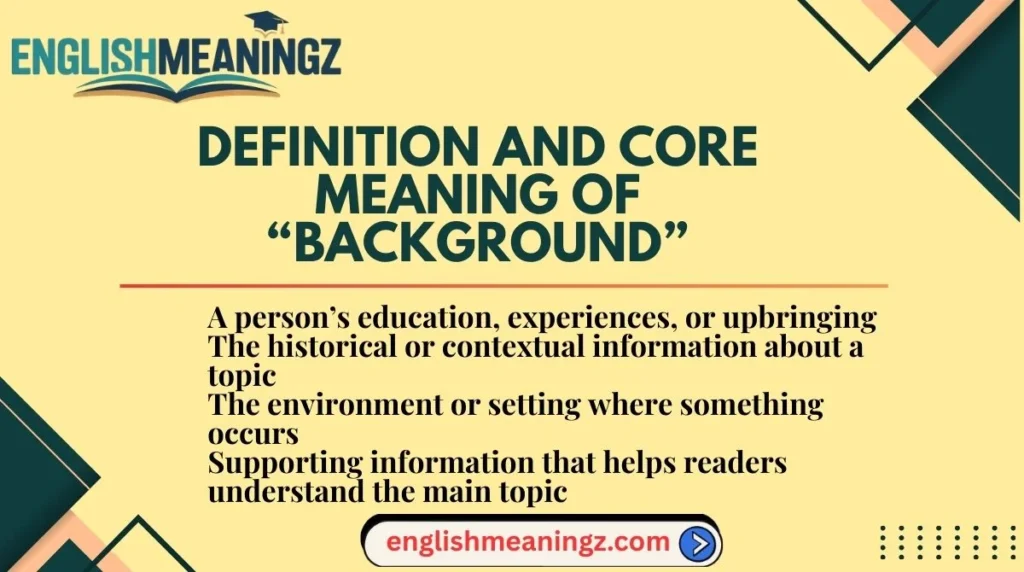
Definition and Core Meaning of “Background”
The word background has several related meanings depending on context, but its core concept is consistent.
Background generally refers to the underlying circumstances, context, history, or environment that surrounds a person, event, or subject.
In writing, it often describes:
- A person’s education, experiences, or upbringing
- The historical or contextual information about a topic
- The environment or setting where something occurs
- Supporting information that helps readers understand the main topic
For example:
- Her academic background includes degrees in economics and sociology.
- The study begins with a background of climate change research.
- The painting features mountains in the background.
In academic writing, “background” typically refers to contextual information that prepares readers for a topic.
Understanding this concept helps writers choose the most accurate synonym depending on the situation.
13 Synonyms for Background Grouped by Context
Not all synonyms work in every situation. Some are formal and suitable for academic essays, while others are informal or technical.
Below are 13 useful synonyms, grouped by context to help writers choose the most appropriate word.
General Use
Context
Meaning: The surrounding circumstances or situation that helps explain something.
Explanation
“Context” is one of the most widely accepted substitutes for “background.” It is common in academic writing, journalism, and everyday communication.
Example Sentence
Understanding the historical context of the novel helps readers interpret the author’s message more accurately.
Setting
Meaning: The environment or location where an event occurs.
Explanation
“Setting” is frequently used in storytelling, literature analysis, and descriptive writing.
Example Sentence
The rural setting of the story influences the characters’ lifestyle and choices.
Circumstances
Meaning: Conditions surrounding an event or situation.
Explanation
This word is useful when explaining why something happened.
Example Sentence
The decision was influenced by the economic circumstances of the time.
Environment
Meaning: The physical or social conditions that surround a person or activity.
Explanation
“Environment” works well in discussions about education, social development, or workplace culture.
Example Sentence
Children develop critical thinking skills in a supportive learning environment.
Formal & Academic Writing
History
Meaning: The past events or development of a person, institution, or subject.
Explanation
This synonym works best when referring to past development or previous events.
Example Sentence
The research paper provides a detailed history of renewable energy policies.
Foundation
Meaning: The basic structure or underlying support for something.
Explanation
In academic writing, “foundation” is often used to describe theoretical or conceptual support.
Example Sentence
This theory forms the intellectual foundation of modern psychology.
Basis
Meaning: The underlying reason or principle for something.
Explanation
“Basis” is common in scientific and analytical writing.
Example Sentence
The experiment provides the scientific basis for further medical research.
Framework
Meaning: A structured system that supports analysis or understanding.
Explanation
Researchers frequently use this word when discussing theoretical models.
Example Sentence
The study uses a sociological framework to analyze urban development.
Informal Usage
Roots
Meaning: The origin or source of something.
Explanation
This word is often used in conversations about culture, identity, or traditions.
Example Sentence
She explored her cultural roots during her visit to her ancestral village.
Upbringing
Meaning: The way a person was raised during childhood.
Explanation
This synonym is specifically related to personal background.
Example Sentence
His strict upbringing influenced his strong sense of discipline.
Past
Meaning: Previous experiences or events in someone’s life.
Explanation
This word is simple and commonly used in everyday speech.
Example Sentence
Her professional past includes several years in international marketing.
Technical or Subject-Specific Use
Profile
Meaning: A summary description of someone’s qualifications or characteristics.
Explanation
This synonym is often used in business, recruitment, or professional contexts.
Example Sentence
The candidate’s professional profile includes extensive leadership experience.
Credentials
Meaning: Qualifications or achievements that prove someone’s expertise.
Explanation
This word is particularly common in academic and professional evaluations.
Example Sentence
The professor’s academic credentials include three doctoral degrees.
Word Intensity & Tone Comparison Table
| Synonym | Formal Level | Tone Strength | Typical Usage |
|---|---|---|---|
| Context | Medium | Neutral | Academic writing |
| Setting | Medium | Neutral | Literature and storytelling |
| Circumstances | Medium | Moderate | Analytical discussions |
| Environment | Medium | Neutral | Social sciences |
| History | High | Moderate | Research papers |
| Foundation | High | Strong | Academic theory |
| Basis | High | Strong | Scientific explanations |
| Framework | Very High | Strong | Research methodology |
| Roots | Low | Emotional | Cultural discussion |
| Upbringing | Medium | Personal | Biographical writing |
This comparison helps writers choose the most suitable synonym based on formality and tone.
Common Mistakes When Using These Synonyms
Many writers incorrectly replace “background” with words that do not fully match the intended meaning.
Understanding these mistakes helps maintain clarity.
Mistake 1: Using “setting” in professional context
Incorrect:
Her professional setting includes experience in finance.
Correct:
Her professional background includes experience in finance.
or
Her professional profile includes experience in finance.
Mistake 2: Using “roots” in academic research
Incorrect:
The roots of the research study are explained in Chapter 2.
Correct:
The foundation of the research study is explained in Chapter 2.
Mistake 3: Using “credentials” for environmental context
Incorrect:
The city’s credentials influenced industrial growth.
Correct:
The city’s environment influenced industrial growth.
Synonyms in Academic Writing
Using synonyms effectively improves academic writing clarity and vocabulary diversity.
Below are two sample academic paragraphs.
Example 1
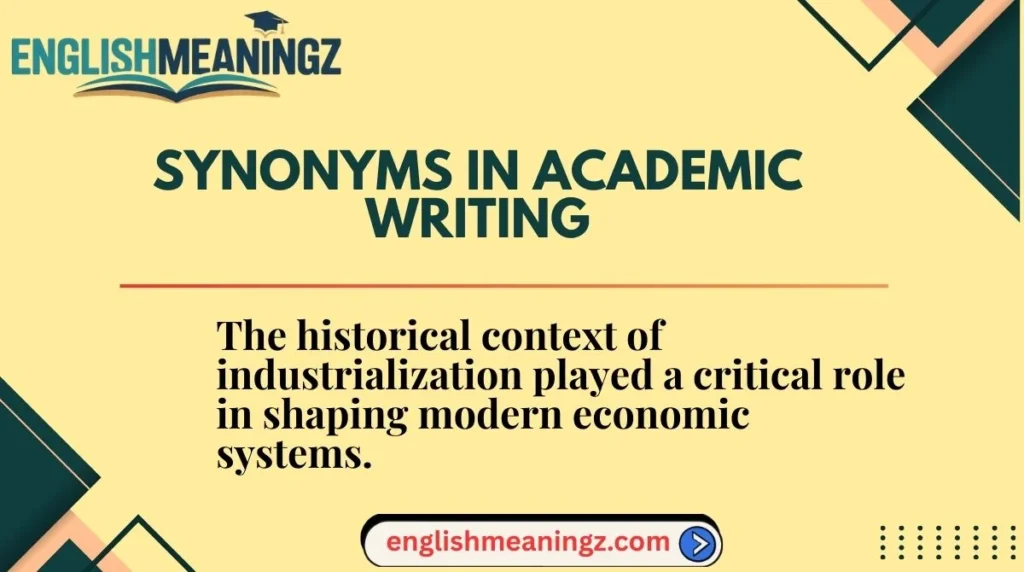
The historical context of industrialization played a critical role in shaping modern economic systems. Scholars argue that understanding this context helps explain the rapid technological advancements of the nineteenth century. Without examining the broader circumstances surrounding industrial growth, it is difficult to understand the transformation of labor markets and global trade networks.
Example 2
This research is based on a theoretical framework that integrates economic and sociological perspectives. The foundation of the model is built upon previous studies that examined social inequality and education access. By combining these perspectives, the study provides a deeper understanding of how educational environment influences career opportunities.
IELTS & Exam Writing Tips
Students preparing for IELTS, TOEFL, or academic exams often struggle with word repetition.
Here are several effective strategies.
1. Replace words only when meaning stays accurate
Not all synonyms are interchangeable. Always ensure the replacement word fits the context.
Example:
Incorrect replacement:
The roots of the study show economic change.
Correct version:
The background of the study shows economic change.
2. Use synonyms to improve lexical variety
Examiners reward vocabulary range. Using alternatives like context, framework, and foundation can improve scores.
3. Do not replace key technical terms
Some words should remain unchanged when they have precise meanings.
For example:
“background research” is often better than “environment research.”
4. Avoid excessive synonym replacement
Overusing unusual synonyms can make writing unnatural.
Balance clarity with vocabulary diversity.
Similar Words vs True Synonyms
Some words appear similar to “background” but are not true synonyms.
Understanding subtle differences prevents confusion.
Background vs Context
“Background” refers to general information about a topic, while “context” focuses on the situation that explains meaning.
Example:
Background: historical overview
Context: conditions that explain interpretation
Background vs Environment
“Environment” refers mainly to physical or social surroundings.
Example:
Children grow better in supportive environments.
Background vs History
“History” refers specifically to past events, not present conditions.
Example:
The history of the organization spans fifty years.
Practice Sentences
Try completing the sentences using suitable synonyms.
- The researcher explained the historical ______ of the experiment.
- Her professional ______ includes experience in international law.
- The rural ______ of the novel creates a peaceful atmosphere.
- Understanding cultural ______ helps explain social traditions.
- The theoretical ______ of the study is based on economic models.
- His strict ______ influenced his disciplined personality.
- The social ______ plays a role in shaping behavior.
These exercises help strengthen vocabulary retention.
FAQs
What is the best synonym for background in academic writing?
The best academic alternatives include context, framework, foundation, and basis, because they clearly describe underlying information or theoretical structure.
Can I use “context” instead of background in essays?
Yes. “Context” is one of the most accurate substitutes when discussing historical, social, or cultural conditions.
Is “upbringing” a synonym for background?
Yes, but only when referring to personal or family background during childhood.
What synonym works best for professional background?
Words like profile, credentials, and experience are commonly used in professional contexts.
Why should writers use synonyms in essays?
Synonyms improve lexical variety, reduce repetition, and demonstrate stronger vocabulary skills.
Conclusion
Expanding vocabulary is one of the most effective ways to improve writing quality. The word background is widely used in essays, articles, and professional documents, but repeating it too often can weaken clarity and style.
Learning alternatives such as context, framework, foundation, environment, and profile allows writers to communicate ideas more precisely.
For students, using varied vocabulary improves academic scores. For bloggers, it enhances readability and SEO performance. For professionals, it strengthens communication credibility.
Developing a habit of exploring synonyms not only enriches language but also helps writers express ideas with greater accuracy and sophistication.
Continuous vocabulary improvement is a powerful step toward becoming a more confident and effective writer.