Understanding opposites is one of the fastest ways to sharpen your language skills. When you know not just a word but also its semantic counterpoints, your writing becomes more dynamic, precise, and expressive.
Antonyms allow you to contrast ideas, highlight meaning, and avoid repetition—essential tools for academic, professional, and creative communication.
In academic writing, using accurate opposites strengthens argumentation and clarity. In professional settings, it improves tone control and helps convey intent without ambiguity.
Whether you’re drafting essays, reports, or content, mastering antonyms enhances both comprehension and expression.
This guide focuses on the keyword “bequeath antonyms”, delivering a clean, structured, and fully original exploration designed to elevate your vocabulary in 2026 and beyond.
What Does “Bequeath” Mean?
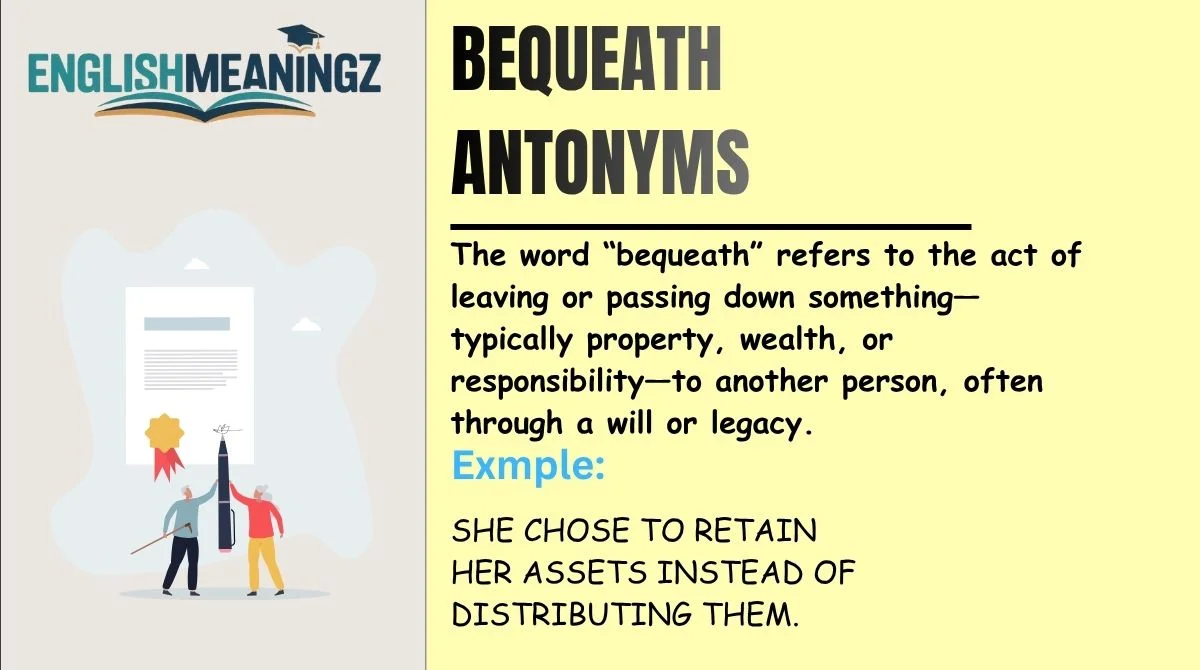
The word “bequeath” refers to the act of leaving or passing down something—typically property, wealth, or responsibility—to another person, often through a will or legacy.
Definition:
To transfer ownership, rights, or responsibilities to someone else, usually after death or as a symbolic legacy.
Tone Explanation:
- Formal and legal in most contexts
- Sometimes carries emotional or sentimental weight
- Often associated with inheritance, legacy, or tradition
Emotional / Action Intensity:
- Medium to strong intensity
- Implies intentional transfer or giving
- Often final or irreversible
Understanding this meaning is key because antonyms will revolve around withholding, taking away, rejecting, or preventing transfer.
15 Best Antonyms for “Bequeath”
1. Retain
Meaning: To keep possession of something
Tone: Formal
Example: She chose to retain her assets instead of distributing them.
Why Opposite: Bequeath gives away; retain keeps.
2. Withhold
Meaning: To refuse to give something
Tone: Formal / Academic
Example: The organization decided to withhold funds.
Why Opposite: Bequeath transfers; withhold denies transfer.
3. Keep
Meaning: To continue having something
Tone: Informal
Example: He decided to keep the property for himself.
Why Opposite: Opposes the act of giving away.
4. Confiscate
Meaning: To take something away officially
Tone: Formal
Example: Authorities confiscated the assets.
Why Opposite: Bequeath gives voluntarily; confiscate takes forcibly.
5. Seize
Meaning: To take control suddenly or forcefully
Tone: Strong / Legal
Example: The government seized the estate.
Why Opposite: Opposes voluntary giving.
6. Reclaim
Meaning: To take something back
Tone: Formal
Example: The family reclaimed their ancestral land.
Why Opposite: Bequeath gives forward; reclaim pulls back.
7. Deny
Meaning: To refuse to grant something
Tone: Neutral
Example: He denied access to his inheritance.
Why Opposite: Bequeath grants; deny refuses.
8. Reject
Meaning: To refuse or dismiss
Tone: Neutral
Example: She rejected the idea of passing on the wealth.
Why Opposite: Reject blocks transfer.
9. Hoard
Meaning: To accumulate and keep excessively
Tone: Emotional
Example: He hoarded his wealth instead of sharing it.
Why Opposite: Bequeath distributes; hoard accumulates.
10. Withdraw
Meaning: To remove or take back
Tone: Formal
Example: The donor withdrew his financial support.
Why Opposite: Opposes giving or leaving behind.
11. Revoke
Meaning: To cancel or take back formally
Tone: Legal
Example: The will was revoked before execution.
Why Opposite: Cancels the act of bequeathing.
12. Take
Meaning: To acquire or remove something
Tone: General
Example: He took the valuables instead of passing them on.
Why Opposite: Direct reversal of giving.
13. Confine
Meaning: To restrict or limit
Tone: Formal
Example: The wealth was confined within the family.
Why Opposite: Bequeath expands ownership; confine limits it.
14. Retake
Meaning: To take back possession
Tone: Neutral
Example: The company retook control of its assets.
Why Opposite: Opposes permanent transfer.
15. Appropriate
Meaning: To take for one’s own use, often unfairly
Tone: Formal / Negative
Example: He appropriated the funds instead of distributing them.
Why Opposite: Self-serving vs giving to others.
Strong vs Mild Opposites
Not all antonyms carry the same intensity. Some are direct reversals, while others are context-based.
Strong Opposites (Direct Reversal):
- Confiscate
- Seize
- Revoke
- Take
These words actively oppose the act of giving by introducing force or cancellation.
Moderate Opposites:
- Withhold
- Deny
- Reject
- Withdraw
These suggest a refusal rather than force.
Mild Opposites:
- Keep
- Retain
- Hoard
These simply imply not giving, without aggressive action.
Understanding this scale helps you choose the right word based on tone and context.
Context-Based Opposites
Some antonyms depend heavily on context rather than being strict opposites.
- Legal Context: Revoke, confiscate
- Emotional Context: Hoard, reject
- Financial Context: Withhold, withdraw
- General Usage: Keep, take
For example, “revoke” is only relevant when discussing legal inheritance, while “hoard” fits better in emotional or behavioral descriptions.
Common Mistakes When Using Opposites
1. Using weak opposites in strong contexts
Incorrect: He hoarded the property (legal context)
Correct: He revoked the inheritance
2. Confusing refusal with reversal
Incorrect: He denied the property (unclear meaning)
Correct: He withheld the property
3. Misusing tone
Incorrect: The government kept the assets
Correct: The government confiscated the assets
4. Overusing informal words in academic writing
Avoid “keep” when “retain” fits better.
Sentence Transformation Examples
Original → Revised with Antonyms
- He bequeathed his fortune to his children.
→ He retained his fortune instead of distributing it. - She bequeathed her estate through a will.
→ She revoked the transfer of her estate. - The king bequeathed land to his heirs.
→ The king reclaimed the land from his heirs. - He bequeathed his legacy to future generations.
→ He withheld his legacy from future generations. - The donor bequeathed funds to charity.
→ The donor withdrew funds from the charity.
FAQs
What is the closest opposite of “bequeath”?
The closest opposite is retain, as it directly contrasts giving with keeping.
Is “confiscate” a true antonym?
Yes, in legal contexts, it strongly opposes voluntary transfer by enforcing removal.
Can “deny” be used as an antonym?
Yes, but it is a weaker, context-based antonym.
Which antonym is best for academic writing?
“Retain,” “withhold,” and “revoke” are most suitable.
Are all antonyms interchangeable?
No, context and tone determine the correct choice.
Is “hoard” an exact opposite?
Not exact, but it contrasts distribution with accumulation.
Why is understanding antonyms important?
It improves clarity, precision, and expressive power in writing.
Conclusion
Mastering antonyms of “bequeath” is more than just expanding vocabulary—it’s about gaining control over tone, context, and meaning.
From formal words like “revoke” and “retain” to more expressive options like “hoard” and “seize,” each antonym serves a specific purpose.
By understanding their nuances, intensity, and usage, you can write with greater precision and authority.
Whether you’re working on academic papers, professional documents, or SEO content, these opposites will help you communicate more effectively and avoid vague or repetitive language.