Understanding opposites is one of the fastest ways to sharpen your writing. When you learn how a word contrasts with another, you don’t just expand vocabulary—you gain control over nuance, clarity, and emotional direction.
Writers who master antonyms can shift meaning with precision, making their communication more persuasive, dynamic, and engaging.
In academic and professional contexts, tone plays a critical role in how messages are received. A slight change in tone can transform a sentence from authoritative to casual, from respectful to dismissive, or from optimistic to critical.
Knowing the antonyms of “tone” helps you deliberately adjust how your message sounds to readers, ensuring alignment with purpose, audience, and context.
What Does “Tone” Mean?
Definition:
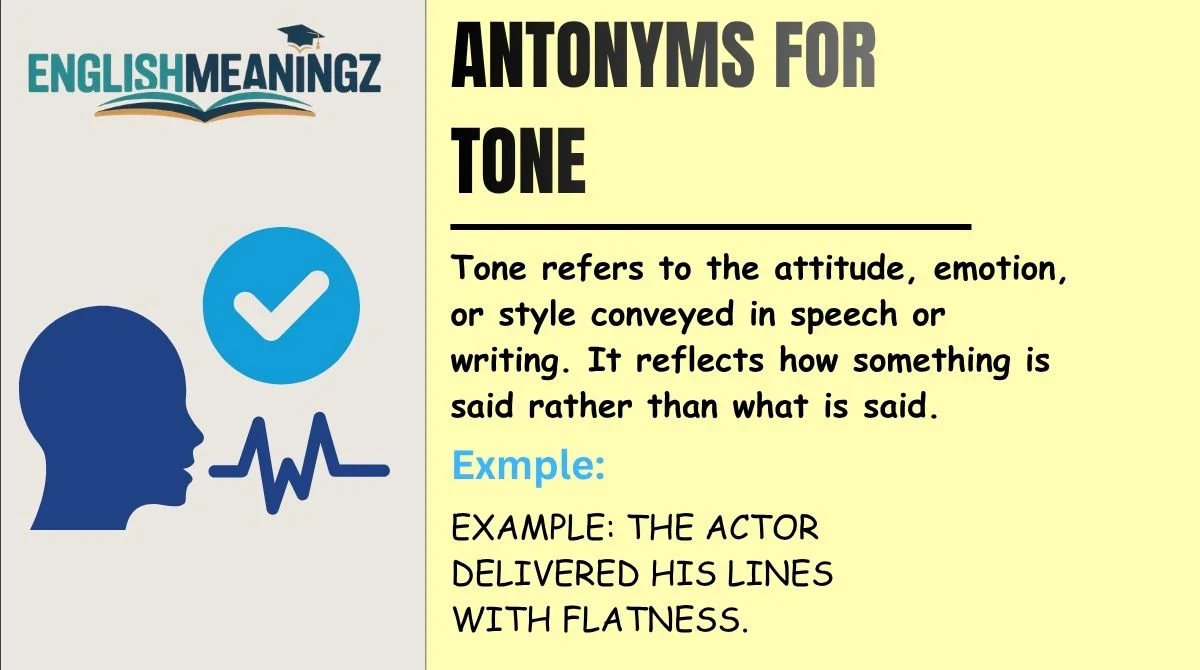
Tone refers to the attitude, emotion, or style conveyed in speech or writing. It reflects how something is said rather than what is said.
Tone explanation:
Tone is shaped by word choice, sentence structure, and context. It can be formal, sarcastic, enthusiastic, neutral, critical, or persuasive. It signals intent and influences how the audience interprets meaning.
Emotional or action intensity explanation:
Tone ranges from highly expressive (emotional, dramatic) to completely neutral (objective, detached). It can amplify or soften the message. For example, a harsh tone intensifies criticism, while a gentle tone reduces perceived severity.
19 Best Antonyms for “Tone”
1. Monotony
Meaning: Lack of variation or emotional expression
Tone label: Academic
Example: His speech was filled with monotony, lacking any engaging tone.
Why opposite: Tone implies variation and emotional shading, while monotony removes all expressiveness.
2. Silence
Meaning: Complete absence of sound or expression
Tone label: Formal
Example: Her silence conveyed more than words ever could.
Why opposite: Tone requires expression; silence eliminates it entirely.
3. Flatness
Meaning: Lack of emotion or variation
Tone label: Informal
Example: The actor delivered his lines with flatness.
Why opposite: Tone adds depth; flatness removes emotional dimension.
4. Neutrality
Meaning: Absence of strong feeling or bias
Tone label: Academic
Example: The report maintained neutrality throughout.
Why opposite: Tone often carries emotion or attitude; neutrality avoids it.
5. Indifference
Meaning: Lack of interest or concern
Tone label: Emotional
Example: Her indifference made the conversation cold.
Why opposite: Tone conveys engagement; indifference suggests emotional absence.
6. Apathy
Meaning: Complete lack of feeling or enthusiasm
Tone label: Emotional
Example: His apathy drained energy from the discussion.
Why opposite: Tone expresses emotion; apathy suppresses it.
7. Stillness
Meaning: Absence of movement or activity
Tone label: Formal
Example: The stillness of the room contrasted with earlier excitement.
Why opposite: Tone implies dynamic expression; stillness suggests inactivity.
8. Calmness
Meaning: Peaceful and unexpressive state
Tone label: Emotional
Example: Her calmness softened the tense atmosphere.
Why opposite: Tone can be intense or expressive; calmness reduces emotional fluctuation.
9. Detachment
Meaning: Emotional distance or lack of involvement
Tone label: Academic
Example: The article was written with detachment.
Why opposite: Tone connects emotion; detachment removes emotional connection.
10. Lifelessness
Meaning: Absence of vitality or energy
Tone label: Informal
Example: The presentation had a sense of lifelessness.
Why opposite: Tone brings energy; lifelessness removes it.
11. Dullness
Meaning: Lack of excitement or brightness
Tone label: Informal
Example: The lecture suffered from dullness.
Why opposite: Tone creates engagement; dullness reduces interest.
12. Passivity
Meaning: Lack of active response or expression
Tone label: Academic
Example: His passivity weakened the argument.
Why opposite: Tone reflects active intent; passivity lacks assertiveness.
13. Blandness
Meaning: Lack of strong characteristics
Tone label: Informal
Example: The email’s blandness made it forgettable.
Why opposite: Tone adds flavor; blandness removes distinction.
14. Inexpressiveness
Meaning: Inability to convey emotion
Tone label: Academic
Example: Her inexpressiveness confused the audience.
Why opposite: Tone depends on expression; this removes it.
15. Restraint
Meaning: Controlled or limited expression
Tone label: Formal
Example: The writer showed restraint in criticism.
Why opposite: Tone can be expressive; restraint limits expression.
16. Coldness
Meaning: Lack of warmth or emotion
Tone label: Emotional
Example: His coldness offended the team.
Why opposite: Tone often carries warmth or feeling; coldness lacks both.
17. Blankness
Meaning: Absence of visible emotion
Tone label: Informal
Example: Her blankness revealed nothing.
Why opposite: Tone communicates emotion; blankness conceals it.
18. Quietness
Meaning: Soft or minimal expression
Tone label: Informal
Example: The quietness of his voice hid his true intent.
Why opposite: Tone can be vivid and expressive; quietness minimizes impact.
19. Expressionlessness
Meaning: Total lack of emotional display
Tone label: Academic
Example: His expressionlessness made interpretation difficult.
Why opposite: Tone relies on emotional signals; this eliminates them.
Strong vs Mild Opposites
Not all antonyms oppose “tone” with the same intensity. Some completely eliminate expression, while others merely reduce it.
Strong opposites (extreme absence):
Silence, expressionlessness, inexpressiveness
These remove tone entirely, leaving no emotional or stylistic signal.
Moderate opposites (reduced expression):
Neutrality, detachment, restraint
These still allow communication but minimize emotional impact.
Mild opposites (low energy or variation):
Dullness, blandness, flatness
These retain some tone but weaken its effect.
Understanding this scale helps you choose the right word depending on how strongly you want to contrast tone.
Context-Based Opposites
Antonyms for “tone” are highly context-dependent. The correct opposite changes based on usage.
In writing:
Tone vs neutrality (objective academic writing)
In speech:
Tone vs monotony (lack of vocal variation)
In emotion:
Tone vs apathy (absence of feeling)
In performance:
Tone vs flatness (lack of delivery depth)
In communication style:
Tone vs detachment (emotional distance)
Choosing the wrong antonym can distort meaning. Always consider the context before selecting a contrasting word.
Common Mistakes When Using Opposites
1. Confusing neutrality with silence
Incorrect: The report used silence.
Correct: The report used neutrality.
Silence refers to no expression at all, while neutrality is balanced expression.
2. Using dullness instead of detachment
Incorrect: The article showed dullness toward the topic.
Correct: The article showed detachment.
Dullness relates to style, while detachment relates to emotional distance.
3. Overusing blandness for all contexts
Blandness doesn’t fit emotional or vocal contexts well. It’s more suitable for writing style.
4. Misapplying apathy in formal writing
Apathy is emotional and informal; avoid it in academic tone analysis.
5. Ignoring intensity differences
Using “silence” instead of “neutrality” can exaggerate meaning.
Sentence Transformation Examples
Original: The manager spoke in a confident tone.
Rewritten: The manager spoke with noticeable detachment.
Original: Her tone was full of excitement.
Rewritten: Her voice carried a sense of flatness.
Original: The teacher used a serious tone.
Rewritten: The teacher maintained strict neutrality.
Original: His tone showed anger.
Rewritten: His response reflected coldness.
Original: The speech had an inspiring tone.
Rewritten: The speech suffered from dullness.
FAQs
What is the exact opposite of tone?
There is no single exact opposite. Words like silence, neutrality, and monotony serve as opposites depending on context.
Can tone have multiple antonyms?
Yes. Because tone has different dimensions (emotion, style, intensity), it has multiple valid opposites.
Is neutrality always the best antonym?
No. Neutrality works in academic contexts but not in emotional or vocal situations.
What is the strongest antonym for tone?
Silence is the strongest because it removes expression entirely.
Are dullness and monotony the same?
Not exactly. Monotony refers to lack of variation, while dullness refers to lack of interest.
Why is context important when choosing antonyms?
Because tone varies across writing, speech, and emotion, the opposite must match the situation.
Can tone exist without emotion?
Yes. Tone can be neutral or formal, but it still conveys a style or attitude.
Conclusion
Mastering antonyms for “tone” gives you control over how your message is perceived. Whether you aim to intensify emotion, create neutrality, or eliminate expression entirely, the right opposite word allows you to shape communication with precision.
By understanding intensity levels, contextual usage, and common mistakes, you can elevate both your writing and speaking to a more professional and impactful level.