Strong writing depends not only on the words you choose but also on how precisely you contrast ideas. One of the most powerful ways to sharpen clarity and emotional impact is by mastering opposites.
When you understand antonyms deeply, you gain control over tone, nuance, and reader perception. Instead of sounding vague or repetitive, your sentences become vivid, balanced, and intentional.
In academic and professional communication, this skill is especially valuable. Whether you’re writing essays, reports, or persuasive content, using accurate opposites helps eliminate ambiguity and strengthens arguments.
It allows you to present contrasts clearly, refine meaning, and communicate with authority. In short, knowing the right antonyms doesn’t just improve vocabulary—it transforms how effectively you express ideas.
What Does “Foreboding” Mean?
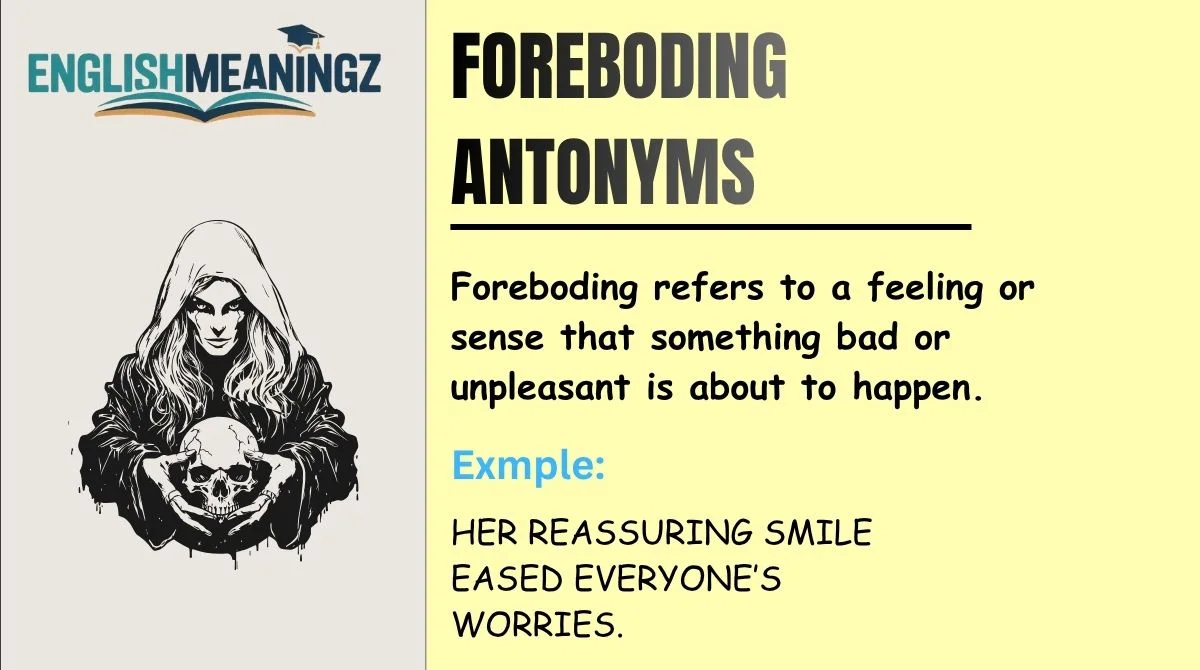
Foreboding refers to a feeling or sense that something bad or unpleasant is about to happen. It carries a strong emotional weight, often linked to fear, tension, or anticipation of danger.
Tone Explanation
The tone of “foreboding” is typically dark, uneasy, and suspenseful. It creates a mood of anxiety or looming threat, commonly used in storytelling, literature, and descriptive writing.
Emotional or Action Intensity
“Foreboding” has a moderate-to-high emotional intensity. It doesn’t confirm that something bad will happen—it signals the expectation of it. This makes it powerful for building tension without revealing outcomes.
18 Best Antonyms for “Foreboding”
1. Reassuring
Meaning: Providing comfort or removing doubt
Tone: Emotional / Professional
Example: Her reassuring smile eased everyone’s worries.
Why Opposite: It replaces fear with calm confidence.
2. Hopeful
Meaning: Expecting positive outcomes
Tone: Emotional
Example: The team remained hopeful despite setbacks.
Why Opposite: Hope counters the negativity of foreboding.
3. Optimistic
Meaning: Seeing the best possible outcome
Tone: Academic / Professional
Example: Investors stayed optimistic about future growth.
Why Opposite: It reflects positivity instead of dread.
4. Encouraging
Meaning: Inspiring confidence or support
Tone: Professional
Example: The teacher gave encouraging feedback.
Why Opposite: Encouragement removes fear and doubt.
5. Promising
Meaning: Showing signs of future success
Tone: Academic
Example: The results look promising for the project.
Why Opposite: Suggests positive anticipation, not negative expectation.
6. Bright
Meaning: Full of hope and positivity
Tone: Informal / Emotional
Example: She has a bright future ahead.
Why Opposite: Indicates positive outlook instead of gloom.
7. Cheerful
Meaning: Noticeably happy and lively
Tone: Informal
Example: His cheerful attitude lifted the mood.
Why Opposite: Cheerfulness removes emotional heaviness.
8. Uplifting
Meaning: Improving mood or spirit
Tone: Emotional
Example: The speech was deeply uplifting.
Why Opposite: Counters the weight of foreboding feelings.
9. Comforting
Meaning: Providing emotional ease
Tone: Emotional
Example: The familiar voice was comforting.
Why Opposite: Replaces anxiety with calm.
10. Secure
Meaning: Free from danger or risk
Tone: Academic / Professional
Example: The system is secure and reliable.
Why Opposite: Removes the sense of impending threat.
11. Safe
Meaning: Protected from harm
Tone: Informal / Professional
Example: The children felt safe at home.
Why Opposite: Eliminates fear entirely.
12. Positive
Meaning: Focused on good outcomes
Tone: Academic
Example: She maintained a positive mindset.
Why Opposite: Shifts perspective from negative to favorable.
13. Calm
Meaning: Free from agitation or stress
Tone: Emotional
Example: The sea remained calm throughout the night.
Why Opposite: Removes tension and unease.
14. Confident
Meaning: Certain about outcomes
Tone: Professional
Example: He felt confident about the presentation.
Why Opposite: Confidence eliminates fear-based anticipation.
15. Assuring
Meaning: Giving confidence or certainty
Tone: Formal
Example: His tone was steady and assuring.
Why Opposite: Counters uncertainty and dread.
16. Delightful
Meaning: Bringing joy and pleasure
Tone: Informal
Example: It was a delightful surprise.
Why Opposite: Opposes the negative emotional weight.
17. Pleasant
Meaning: Giving a sense of enjoyment
Tone: Neutral
Example: The weather was pleasant all day.
Why Opposite: Indicates comfort rather than discomfort.
18. Tranquil
Meaning: Peaceful and undisturbed
Tone: Literary / Emotional
Example: The lake looked tranquil at sunset.
Why Opposite: Replaces tension with serenity.
Strong vs Mild Opposites
Not all antonyms function at the same intensity level. Understanding this helps you choose the right word for your context.
Strong Opposites:
Words like secure, safe, tranquil, and confident completely eliminate any sense of danger or anxiety. They are ideal when you want to show a full contrast.
Moderate Opposites:
Terms such as reassuring, encouraging, and assuring reduce fear but don’t completely remove uncertainty.
Mild Opposites:
Words like pleasant, bright, and cheerful simply shift tone toward positivity without directly addressing fear.
Key Insight:
The stronger the antonym, the more dramatic the contrast. In formal writing, moderate antonyms often sound more balanced and precise.
Context-Based Opposites
Antonyms are not always fixed—they depend on context.
- In emotional writing, “foreboding” contrasts best with hopeful or uplifting.
- In security-related contexts, safe or secure are stronger opposites.
- In literary descriptions, tranquil or pleasant fit better.
For example:
- “A foreboding silence filled the room.”
→ Opposite: “A tranquil silence filled the room.” - “There was a foreboding sense of failure.”
→ Opposite: “There was a promising sense of success.”
Choosing the right antonym requires understanding the situation, not just the dictionary definition.
Common Mistakes When Using Opposites
1. Using Weak Contrasts
❌ The atmosphere was foreboding → slightly nice
✔ The atmosphere was foreboding → reassuring
Issue: “Slightly nice” is too vague to be a true opposite.
2. Ignoring Tone
❌ Foreboding → funny
✔ Foreboding → comforting
Issue: Humor is not always the correct emotional opposite.
3. Misjudging Context
❌ Foreboding security system → cheerful system
✔ Foreboding security system → secure system
Issue: Use logical opposites, not emotional mismatches.
4. Overusing One Antonym
Repeating positive or good reduces impact. Variety strengthens writing.
Sentence Transformation Examples
1
Original: A foreboding feeling filled the room.
Rewritten: A reassuring feeling filled the room.
2
Original: The sky looked dark and foreboding.
Rewritten: The sky looked bright and pleasant.
3
Original: His tone was foreboding and tense.
Rewritten: His tone was calm and assuring.
4
Original: There was a foreboding sense of failure.
Rewritten: There was a promising sense of success.
5
Original: The silence felt foreboding.
Rewritten: The silence felt tranquil.
FAQs
1. What is the simplest antonym of “foreboding”?
The simplest antonym is reassuring, as it directly removes fear or anxiety.
2. Can “happy” be an antonym of foreboding?
Not exactly. While it’s positive, it doesn’t directly oppose the sense of impending danger.
3. Which antonym is best for academic writing?
Optimistic, promising, and secure work best in formal contexts.
4. Are antonyms always exact opposites?
No. Many antonyms vary in strength and depend on context.
5. What is a strong emotional opposite of foreboding?
Uplifting or comforting are strong emotional contrasts.
6. Can “calm” replace foreboding in all cases?
Not always. It works best when describing mood, not outcomes.
7. Why is choosing the right antonym important?
It ensures clarity, precision, and the correct emotional tone in writing.
Conclusion
Understanding antonyms for “foreboding” goes far beyond memorizing vocabulary. It’s about mastering tone, context, and emotional precision.
Whether you’re writing academically, professionally, or creatively, selecting the right opposite word can completely transform your message.
From strong contrasts like secure and tranquil to milder ones like pleasant and bright, each antonym offers a different shade of meaning.
The key is to match the intensity and context of your sentence. When done correctly, this skill elevates your writing from basic to impactful—making your communication clearer, sharper, and far more engaging.