Understanding opposites is one of the fastest ways to elevate your writing from average to exceptional. When you know not just what a word means but also what it does not mean, your ability to communicate becomes sharper, more deliberate, and more persuasive.
Antonyms help you create contrast, clarify intent, and avoid ambiguity—skills that are essential in both academic and professional settings.
In formal writing, especially in essays, reports, and research papers, precise language matters. A single misused word can distort meaning or weaken your argument.
Learning antonyms of a word like “denote” equips you to express ideas with accuracy, whether you’re clarifying definitions or challenging interpretations.
This article provides a comprehensive breakdown of 26 antonyms of “denote,” along with meanings, tone classifications, examples, and practical usage insights.
What Does “Denote” Mean?
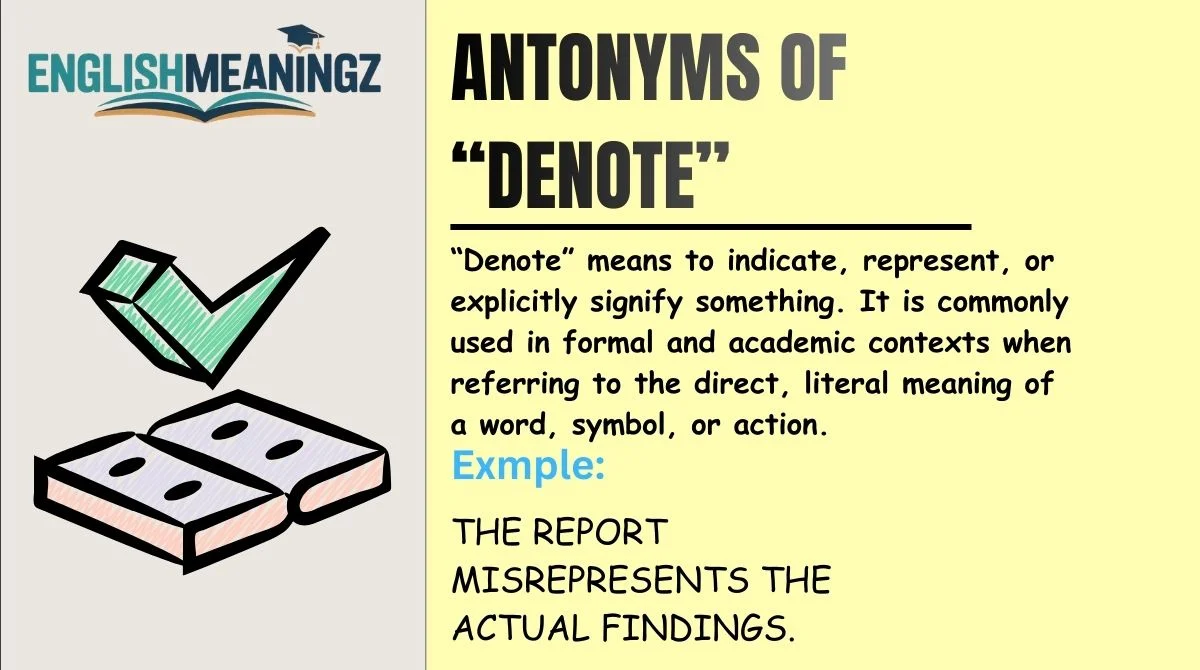
“Denote” means to indicate, represent, or explicitly signify something. It is commonly used in formal and academic contexts when referring to the direct, literal meaning of a word, symbol, or action.
Tone Explanation:
The word “denote” carries a formal and precise tone. It is often used in technical writing, linguistics, and scholarly discussions.
Intensity and Usage:
“Denote” implies clarity and directness. There is little room for ambiguity—it signals something explicitly rather than suggesting or implying it indirectly.
26 Best Antonyms for “Denote”
Misrepresent
Meaning: To present something inaccurately
Tone: Formal
Example: The report misrepresents the actual findings.
Why Opposite: Instead of clearly indicating meaning, it distorts it.
Obscure
Meaning: To make unclear or difficult to understand
Tone: Academic
Example: Complex jargon can obscure the main idea.
Why Opposite: Denote clarifies, while obscure hides meaning.
Confuse
Meaning: To make something unclear or difficult to interpret
Tone: Informal
Example: His explanation only confused the audience.
Why Opposite: Denote provides clarity; confuse removes it.
Distort
Meaning: To twist or alter meaning
Tone: Formal
Example: The media distorted the original statement.
Why Opposite: Denote reflects accuracy; distort changes truth.
Conceal
Meaning: To hide or keep secret
Tone: Formal
Example: She tried to conceal her emotions.
Why Opposite: Denote reveals; conceal hides.
Hide
Meaning: To keep something out of sight
Tone: Informal
Example: He tried to hide the truth.
Why Opposite: Denote exposes meaning; hide suppresses it.
Mask
Meaning: To cover or disguise
Tone: Formal
Example: His smile masked his anxiety.
Why Opposite: Denote shows openly; mask disguises.
Blur
Meaning: To make unclear or indistinct
Tone: Informal
Example: The details blur over time.
Why Opposite: Denote sharpens meaning; blur softens it.
Complicate
Meaning: To make something more complex
Tone: Academic
Example: Extra details complicate the explanation.
Why Opposite: Denote simplifies; complicate adds confusion.
Contradict
Meaning: To assert the opposite
Tone: Formal
Example: His statement contradicts earlier claims.
Why Opposite: Denote affirms meaning; contradict opposes it.
Mislabel
Meaning: To label incorrectly
Tone: Informal
Example: The product was mislabelled.
Why Opposite: Denote labels correctly; mislabel does not.
Suppress
Meaning: To prevent expression
Tone: Formal
Example: The data was suppressed in the report.
Why Opposite: Denote expresses meaning; suppress blocks it.
Veil
Meaning: To partially hide
Tone: Literary
Example: The truth was veiled in ambiguity.
Why Opposite: Denote reveals; veil conceals partially.
Camouflage
Meaning: To disguise
Tone: Informal
Example: He tried to camouflage his intentions.
Why Opposite: Denote clarifies; camouflage hides.
Misinterpret
Meaning: To understand wrongly
Tone: Academic
Example: The reader misinterpreted the text.
Why Opposite: Denote gives correct meaning; misinterpret distorts it.
Disguise
Meaning: To alter appearance
Tone: Neutral
Example: He disguised his true feelings.
Why Opposite: Denote expresses truth; disguise hides it.
Cloud
Meaning: To make unclear
Tone: Informal
Example: Emotions cloud judgment.
Why Opposite: Denote clarifies; cloud confuses.
Deceive
Meaning: To mislead
Tone: Emotional
Example: The advertisement deceived customers.
Why Opposite: Denote informs; deceive misleads.
Misguide
Meaning: To lead wrongly
Tone: Formal
Example: Incorrect advice can misguide students.
Why Opposite: Denote directs accurately; misguide leads astray.
Falsify
Meaning: To alter information dishonestly
Tone: Academic
Example: The data was falsified.
Why Opposite: Denote reflects truth; falsify corrupts it.
Twist
Meaning: To change meaning unfairly
Tone: Informal
Example: He twisted my words.
Why Opposite: Denote preserves meaning; twist alters it.
Muddle
Meaning: To mix up confusingly
Tone: Informal
Example: The instructions were muddled.
Why Opposite: Denote organizes meaning; muddle disrupts it.
Compromise
Meaning: To weaken integrity
Tone: Formal
Example: The message was compromised.
Why Opposite: Denote maintains clarity; compromise reduces it.
Distract
Meaning: To divert attention
Tone: Informal
Example: Noise distracts from understanding.
Why Opposite: Denote focuses meaning; distract diverts it.
Garble
Meaning: To distort in a confusing way
Tone: Informal
Example: The message was garbled in transmission.
Why Opposite: Denote communicates clearly; garble distorts.
Obfuscate
Meaning: To deliberately make unclear
Tone: Academic
Example: The politician obfuscated the issue.
Why Opposite: Denote clarifies; obfuscate confuses intentionally.
Strong vs Mild Opposites
Not all antonyms carry the same intensity. Some completely reverse the meaning, while others only partially weaken it.
Strong Opposites:
Words like falsify, deceive, and misrepresent directly oppose the truth-revealing nature of “denote.” They actively distort or invert meaning.
Mild Opposites:
Words like blur, cloud, and complicate don’t fully oppose meaning but reduce clarity. They weaken the effectiveness of communication rather than reversing it.
Understanding this scale helps you choose the right word depending on how strong you want your contrast to be.
Context-Based Opposites
Antonyms often depend on context rather than strict dictionary definitions.
- In academic writing, “denote” may be opposed by misinterpret or falsify
- In emotional contexts, hide or conceal may work better
- In communication settings, confuse or obscure are more appropriate
Choosing the correct antonym requires understanding both the word and the situation in which it is used.
Common Mistakes When Using Opposites
Using weak opposites in strong contexts
Incorrect: The data blurred the conclusion.
Better: The data falsified the conclusion.
Confusing antonyms with synonyms
Incorrect: “Imply” as an opposite of denote (it is related, not opposite)
Ignoring tone differences
Using informal words like “mess up” in academic writing reduces credibility.
Overusing dramatic antonyms
Not every situation requires strong words like “deceive” or “falsify.”
Sentence Transformation Examples
Original: The symbol denotes peace.
Rewritten: The symbol obscures the idea of peace.
Original: His tone denotes confidence.
Rewritten: His tone conceals his insecurity.
Original: The data denotes a clear trend.
Rewritten: The data distorts the actual trend.
Original: This term denotes a specific meaning.
Rewritten: This term confuses the intended meaning.
Original: The gesture denotes respect.
Rewritten: The gesture disguises true intentions.
FAQs
What is the simplest antonym of “denote”?
“Hide” is one of the simplest and most commonly used opposites.
Is “imply” an antonym of denote?
No, “imply” is related but not opposite. It suggests rather than directly indicates.
Which antonym is best for academic writing?
“Misrepresent,” “falsify,” and “obfuscate” are strong academic choices.
Are all antonyms exact opposites?
No, some are partial opposites that only reduce clarity rather than reverse meaning.
Can tone affect antonym choice?
Yes, tone determines whether you should use formal, informal, or emotional alternatives.
Why is “obfuscate” considered an antonym?
Because it deliberately makes meaning unclear, opposing the clarity of “denote.”
How can I remember antonyms easily?
Practice using them in sentences and group them by intensity and context.
Conclusion
Mastering antonyms of “denote” gives you a powerful linguistic advantage. Instead of relying on vague or repetitive language, you gain the ability to express contrast, highlight inaccuracies, and refine your message with precision.
Whether you’re writing academically, professionally, or creatively, understanding how meaning can be clarified—or distorted—allows you to communicate with authority and clarity.
By learning these 26 antonyms, you’re not just expanding vocabulary—you’re strengthening your control over language itself.