Language becomes powerful when writers understand not only what words mean but also how their opposites reshape tone, emotion, and clarity. One of the most effective ways to strengthen writing is by learning antonyms—words that carry the opposite meaning of another.
These linguistic contrasts allow writers to express emotional shifts, highlight change, and create stronger narratives.
Understanding opposites also improves vocabulary precision. Instead of repeatedly using negative or discouraging expressions, writers can replace them with positive or hopeful alternatives that communicate a completely different emotional perspective.
In academic and professional communication, this skill is especially valuable. Scholars, journalists, business professionals, and students rely on nuanced vocabulary to convey tone accurately.
Knowing the right antonym can transform a pessimistic statement into an inspiring one or convert discouragement into confidence.
The word despondent represents a deep emotional state of sadness, hopelessness, or discouragement. By exploring its opposites, writers gain tools to express optimism, confidence, motivation, and emotional strength.
This guide explores the 12 best antonyms for “despondent,” explains their tone and usage, and demonstrates how they can enrich your writing.
What Does “Despondent” Mean?
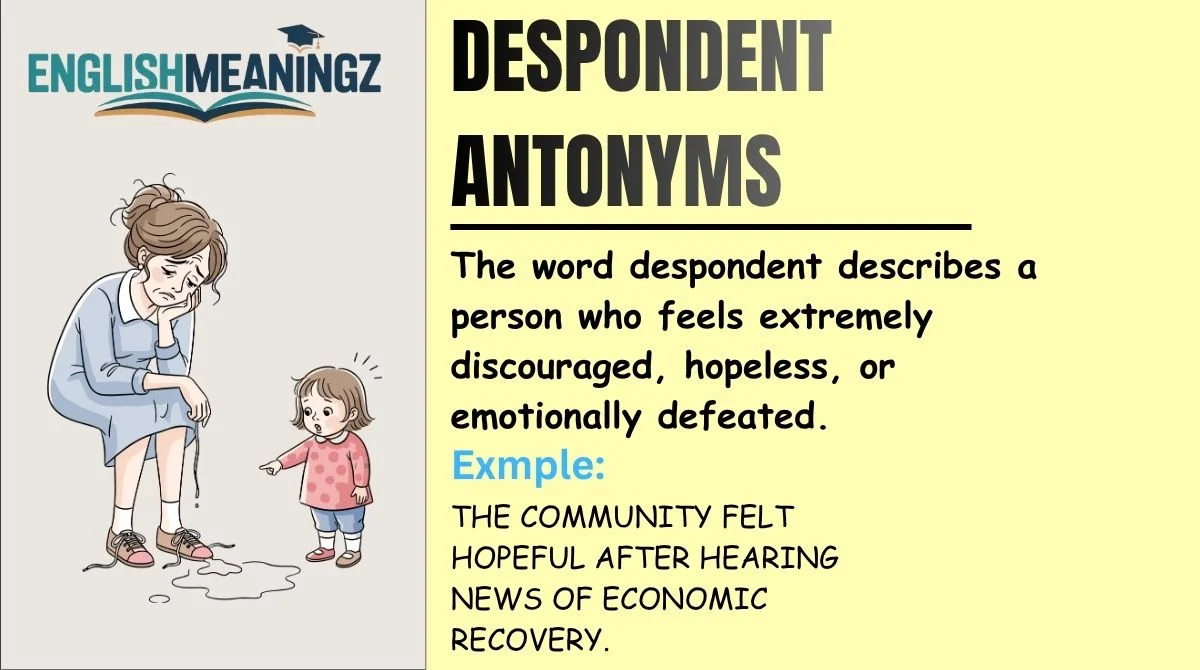
The word despondent describes a person who feels extremely discouraged, hopeless, or emotionally defeated. It usually appears in situations where someone believes improvement is unlikely or where motivation has completely faded.
A despondent person often feels overwhelmed by disappointment, failure, or prolonged difficulty.
Example meaning in context:
After several rejected job applications, he felt deeply despondent about his future.
Tone Explanation
The tone of despondent is strongly negative and emotional. It communicates more than simple sadness; it suggests a deeper sense of despair or loss of hope.
Emotional Intensity
Emotionally, despondent sits near the stronger end of negative feelings. It represents a stage where optimism is fading or entirely absent. Because of this strong emotional intensity, its opposites often include words related to hope, positivity, motivation, and confidence.
12 Best Antonyms for “Despondent”
Optimistic
Meaning: expecting positive outcomes in the future
Tone: Emotional / Academic
Example Sentence:
Despite the challenges, she remained optimistic about achieving her goals.
Why It Is an Opposite:
While despondent reflects hopelessness, optimistic represents confidence that things will improve.
Hopeful
Meaning: feeling expectation and desire for a positive result
Tone: Emotional
Example Sentence:
The community felt hopeful after hearing news of economic recovery.
Why It Is an Opposite:
Hopeful thinking directly counters the despair associated with despondency.
Cheerful
Meaning: noticeably happy and positive in attitude
Tone: Informal / Emotional
Example Sentence:
His cheerful personality brightened the entire office.
Why It Is an Opposite:
Despondent moods are heavy and negative, while cheerful attitudes radiate happiness.
Encouraged
Meaning: feeling motivated or supported to continue
Tone: Academic / Professional
Example Sentence:
The teacher’s feedback encouraged the students to keep improving.
Why It Is an Opposite:
Encouragement restores motivation, which is typically absent in a despondent state.
Confident
Meaning: having belief in one’s ability or success
Tone: Academic / Professional
Example Sentence:
She felt confident presenting her research findings to the panel.
Why It Is an Opposite:
Despondency often involves doubt and emotional defeat, while confidence reflects belief in success.
Positive
Meaning: focusing on good possibilities and constructive thinking
Tone: Neutral / Professional
Example Sentence:
Maintaining a positive mindset helped him navigate difficult situations.
Why It Is an Opposite:
Positive thinking replaces discouragement with possibility.
Upbeat
Meaning: lively, optimistic, and energetic in attitude
Tone: Informal
Example Sentence:
The manager remained upbeat even during stressful project deadlines.
Why It Is an Opposite:
Upbeat individuals display enthusiasm rather than despair.
Inspired
Meaning: mentally stimulated to feel creative or motivated
Tone: Emotional / Academic
Example Sentence:
The speech left the audience inspired to pursue their dreams.
Why It Is an Opposite:
Inspiration generates energy and motivation, which counteracts emotional defeat.
Motivated
Meaning: driven by a strong desire to act or succeed
Tone: Professional
Example Sentence:
The athlete stayed motivated throughout months of intense training.
Why It Is an Opposite:
Motivation replaces hopelessness with determination.
Reassured
Meaning: comforted and relieved from worry or doubt
Tone: Academic / Emotional
Example Sentence:
The doctor’s explanation reassured the patient about the treatment plan.
Why It Is an Opposite:
Reassurance reduces anxiety and discouragement associated with despondency.
Enthusiastic
Meaning: showing strong excitement and eagerness
Tone: Emotional / Informal
Example Sentence:
The students were enthusiastic about the new learning program.
Why It Is an Opposite:
Enthusiasm expresses high energy and excitement rather than emotional defeat.
Joyful
Meaning: experiencing great happiness or delight
Tone: Emotional
Example Sentence:
The celebration created a joyful atmosphere throughout the city.
Why It Is an Opposite:
Joyful emotions replace the deep sadness characteristic of despondency.
Strong vs Mild Opposites
Not all antonyms oppose a word with equal intensity. Some represent extreme contrasts, while others offer softer alternatives.
Strong Opposites
Strong antonyms completely reverse the emotional state.
Examples include:
- Joyful
- Enthusiastic
- Inspired
These words express powerful positivity that directly contrasts with the deep discouragement of despondency.
Mild Opposites
Mild antonyms shift the tone but not dramatically.
Examples include:
- Reassured
- Encouraged
- Positive
These words suggest improvement from discouragement but may not imply intense happiness.
Understanding intensity helps writers select the most appropriate word depending on context.
Context-Based Opposites
Some antonyms depend on the situation rather than strict dictionary contrast.
For example:
Professional Context
Instead of despondent, a workplace environment may prefer:
- confident
- motivated
- encouraged
Emotional Context
When discussing personal feelings, better opposites include:
- hopeful
- joyful
- cheerful
Motivational Context
For speeches or self-development writing, strong opposites such as:
- inspired
- enthusiastic
- optimistic
create a more impactful tone.
Context determines which antonym communicates the message most effectively.
Common Mistakes When Using Opposites
Even experienced writers occasionally misuse antonyms. Several common errors appear when replacing emotionally charged words like despondent.
Choosing a Word with the Wrong Intensity
Incorrect:
She felt ecstatic after the meeting.
Correct:
She felt encouraged after the meeting.
“Ecstatic” represents extreme joy and may exaggerate the situation.
Using an Opposite That Does Not Match Tone
Incorrect:
The academic report sounded upbeat.
Correct:
The academic report sounded optimistic.
Formal writing usually avoids overly casual language.
Replacing Meaning Without Considering Context
Incorrect:
The patient felt enthusiastic after hearing the diagnosis.
Correct:
The patient felt reassured after hearing the diagnosis.
Some antonyms are emotionally inappropriate for specific situations.
Sentence Transformation Examples
Transforming sentences helps illustrate how antonyms change tone and meaning.
Original Sentence:
He felt despondent after failing the exam.
Rewritten:
He felt motivated to improve after failing the exam.
Original Sentence:
The team looked despondent after the loss.
Rewritten:
The team remained optimistic about the next match.
Original Sentence:
She became despondent about her progress.
Rewritten:
She stayed confident about her progress.
Original Sentence:
The workers were despondent during the crisis.
Rewritten:
The workers remained hopeful during the crisis.
Original Sentence:
The atmosphere was despondent after the announcement.
Rewritten:
The atmosphere became positive after the announcement.
FAQs
What is the closest opposite of despondent?
The closest opposite is optimistic, because it directly replaces hopelessness with positive expectation.
Is hopeful always an antonym of despondent?
Yes, in most emotional contexts hopeful functions as a direct opposite because it represents expectation of improvement.
Can confident replace despondent in professional writing?
Yes. In professional communication, confident is often used to contrast feelings of discouragement or doubt.
Are cheerful and joyful interchangeable?
Both describe happiness, but joyful is stronger and more emotionally intense than cheerful.
Which antonym works best in academic writing?
Words like optimistic, confident, and encouraged typically fit academic tone best.
Is motivated the opposite of despondent?
In many contexts, yes. Motivation represents action and determination, which directly contrast emotional defeat.
Why should writers learn antonyms?
Learning antonyms improves vocabulary range, enhances emotional precision, and strengthens overall writing clarity.
Conclusion
Understanding antonyms is one of the fastest ways to improve vocabulary and writing impact. The word despondent represents deep discouragement and loss of hope, but its opposites introduce powerful alternatives that convey confidence, motivation, and positivity.
By learning words such as optimistic, hopeful, cheerful, confident, inspired, and enthusiastic, writers gain the ability to shift tone and communicate emotional transformation effectively.
These antonyms are not merely vocabulary replacements—they are tools that reshape meaning, strengthen expression, and help writers convey the exact emotional message they intend.
Developing awareness of both strong and mild opposites also ensures that each word matches the context, whether academic, professional, or conversational.
Mastering these contrasts ultimately leads to clearer communication, richer vocabulary, and more persuasive writing.