Language becomes more powerful when we understand both meanings and opposites. Knowing antonyms allows writers to control tone, contrast ideas clearly, and express emotions with precision.
Whether you’re writing academic essays, professional reports, or creative content, using accurate opposites strengthens clarity and readability.
When readers see a strong contrast between words, the message becomes more memorable. Instead of repeating the same description, writers can present balanced perspectives and sharper imagery.
Understanding antonyms is particularly useful for descriptive vocabulary. Some words carry strong emotional intensity, and choosing the correct opposite helps maintain the right tone.
The word “putrid” is one of those powerful descriptive terms. It expresses strong negativity, usually related to smell, decay, or moral disgust.
Learning its antonyms allows writers to describe freshness, purity, and cleanliness with equal precision.
In academic communication, vocabulary accuracy signals credibility. In professional writing, it prevents misunderstanding. In everyday communication, it makes expression more vivid and engaging.
This guide explores the meaning of putrid and introduces carefully explained antonyms that improve vocabulary, writing skills, and communication effectiveness.
What Does “Putrid” Mean?
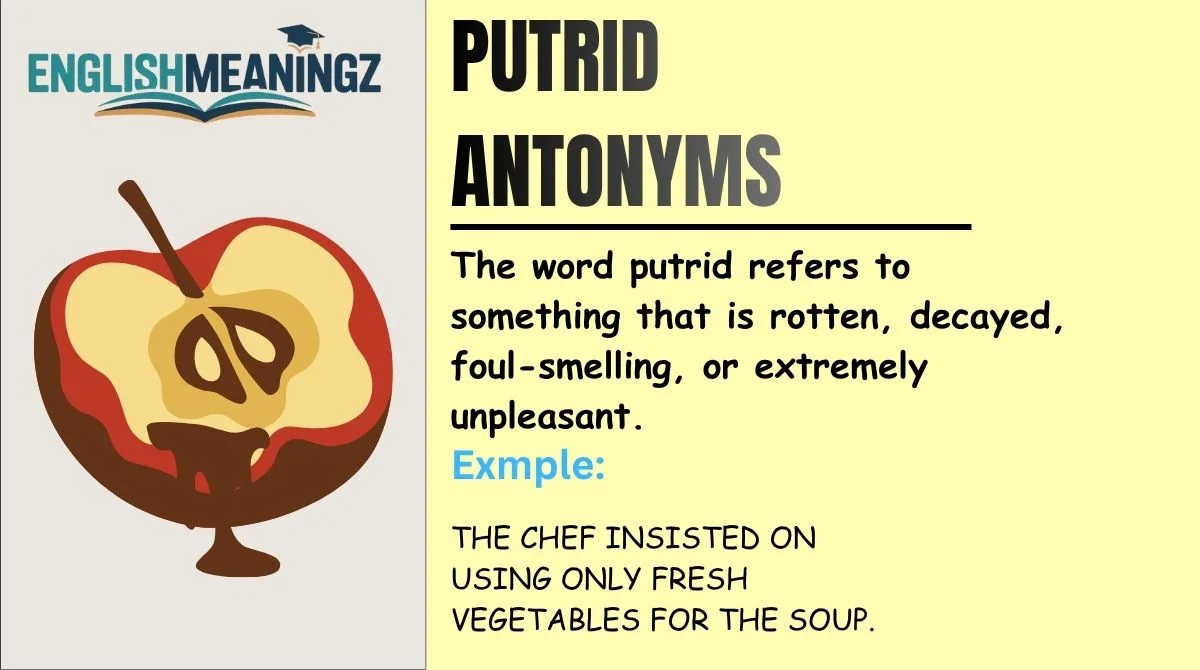
The word putrid refers to something that is rotten, decayed, foul-smelling, or extremely unpleasant. It is commonly used to describe decomposing organic matter, spoiled food, or environments with a strong, offensive odor.
However, the word can also be used figuratively. In emotional or moral contexts, putrid may describe behavior, attitudes, or situations that feel corrupt, disgusting, or morally rotten.
Core Definition
Putrid means rotten, decomposed, or producing a strong and offensive smell.
Tone Explanation
The tone of putrid is strongly negative. It carries a sense of disgust, decay, and contamination. Writers often use it to emphasize unpleasantness rather than mild discomfort.
Emotional or Intensity Level
The intensity of this word is very high. It is stronger than words like bad, stale, or unpleasant. When someone uses putrid, they usually want to create a vivid sensory reaction.
Because the word describes extreme unpleasantness, its antonyms usually express freshness, cleanliness, purity, or pleasantness.
12 Best Antonyms for “Putrid”
Fresh
Meaning: Recently produced, clean, and not spoiled.
Tone: Neutral / Everyday
Example sentence:
The chef insisted on using only fresh vegetables for the soup.
Why it is an opposite:
Putrid describes something rotten and decayed, while fresh indicates the exact opposite—new, clean, and free from spoilage.
Fragrant
Meaning: Pleasantly scented or sweet-smelling.
Tone: Emotional / Descriptive
Example sentence:
The garden was filled with fragrant roses after the rain.
Why it is an opposite:
Putrid smells extremely unpleasant, whereas fragrant describes a pleasing and enjoyable aroma.
Aromatic
Meaning: Having a strong but pleasant smell.
Tone: Academic / Culinary
Example sentence:
The aromatic spices gave the dish a rich and inviting scent.
Why it is an opposite:
Aromatic scents attract and please the senses, the opposite effect of a putrid odor.
Pleasant
Meaning: Enjoyable, agreeable, or comfortable.
Tone: Neutral
Example sentence:
The room had a pleasant scent of lavender.
Why it is an opposite:
Putrid evokes disgust and discomfort, while pleasant creates positive sensory experiences.
Clean
Meaning: Free from dirt, contamination, or decay.
Tone: Neutral / Practical
Example sentence:
The laboratory must remain clean to prevent contamination.
Why it is an opposite:
Putrid suggests decay and filth, while clean represents purity and hygiene.
Pure
Meaning: Uncontaminated, clear, and free from impurities.
Tone: Formal / Academic
Example sentence:
The mountain air felt pure and refreshing.
Why it is an opposite:
Something putrid is corrupted and decomposed, whereas pure remains uncontaminated.
Wholesome
Meaning: Healthy, nourishing, and beneficial.
Tone: Positive / Emotional
Example sentence:
The farm produced wholesome food for the local community.
Why it is an opposite:
Putrid substances are harmful and rotten, while wholesome things support health and well-being.
Refreshing
Meaning: Reviving, cooling, and pleasant.
Tone: Emotional
Example sentence:
The refreshing breeze carried the scent of the ocean.
Why it is an opposite:
Refreshing sensations create comfort and vitality, opposite of the discomfort caused by putrid smells.
Inviting
Meaning: Attractive, welcoming, or appealing.
Tone: Emotional / Descriptive
Example sentence:
The bakery had an inviting smell of warm bread.
Why it is an opposite:
Putrid odors repel people, while inviting smells attract them.
Hygienic
Meaning: Clean and promoting good health.
Tone: Formal / Professional
Example sentence:
Hospitals must maintain hygienic environments.
Why it is an opposite:
Putrid environments are unhealthy and contaminated, whereas hygienic spaces are sanitized and safe.
Sweet-Smelling
Meaning: Having a soft and pleasant fragrance.
Tone: Informal / Descriptive
Example sentence:
The sweet-smelling jasmine filled the night air.
Why it is an opposite:
A sweet-smelling scent provides pleasure, while a putrid smell causes disgust.
Pristine
Meaning: Perfectly clean and untouched.
Tone: Formal
Example sentence:
The lake remained pristine despite increasing tourism.
Why it is an opposite:
Putrid describes decay and corruption, while pristine represents untouched purity.
Strong vs Mild Opposites
Not all antonyms carry the same level of intensity. Some directly oppose the strong negativity of putrid, while others provide a softer contrast.
Strong Opposites
These antonyms create a dramatic contrast:
- Pristine
- Pure
- Hygienic
- Fresh
They directly oppose decay and contamination.
Mild Opposites
These words soften the contrast:
- Pleasant
- Inviting
- Refreshing
They oppose unpleasantness but do not emphasize purity or cleanliness as strongly.
Understanding intensity helps writers choose vocabulary that matches the emotional strength of the message.
Context-Based Opposites
Antonyms often depend on context. The opposite of a word may change depending on how the original word is used.
Physical Context
If putrid describes smell or food, suitable opposites include:
- Fresh
- Aromatic
- Fragrant
Environmental Context
If describing a place or environment:
- Clean
- Hygienic
- Pristine
Emotional or Figurative Context
If putrid refers to behavior or moral corruption:
- Pure
- Wholesome
- Honest
Context awareness ensures vocabulary choices remain accurate.
Common Mistakes When Using Opposites
Many learners misunderstand antonyms by choosing words that are only partially opposite.
Mistake 1: Using Weak Opposites
Incorrect:
The garbage smelled putrid, but the flowers smelled normal.
Better:
The garbage smelled putrid, but the flowers smelled fragrant.
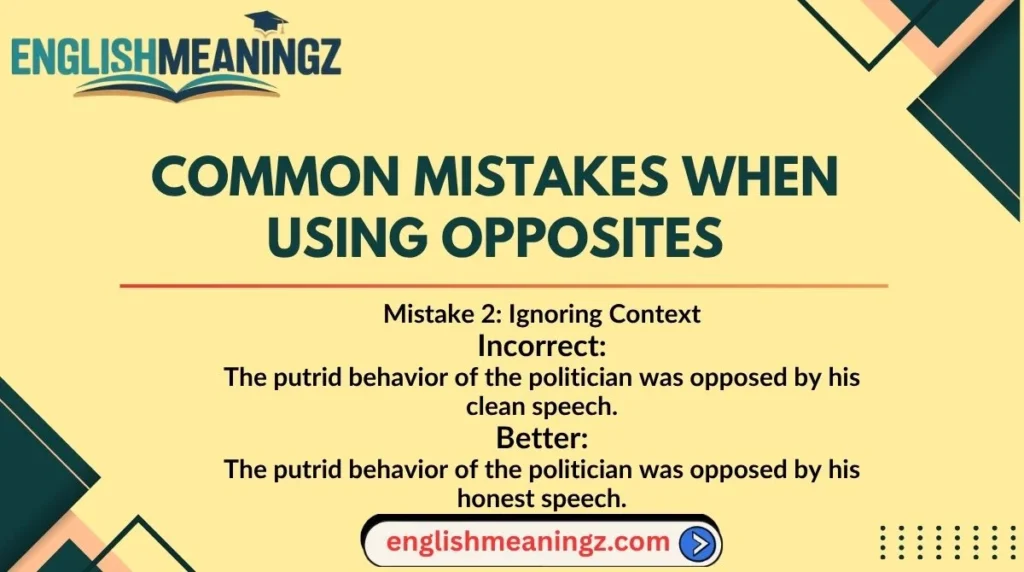
Mistake 2: Ignoring Context
Incorrect:
The putrid behavior of the politician was opposed by his clean speech.
Better:
The putrid behavior of the politician was opposed by his honest speech.
Mistake 3: Mixing Physical and Emotional Meanings
Incorrect:
The putrid meat tasted awful, but the soup was moral.
Better:
The putrid meat tasted awful, but the soup was fresh.
Understanding context prevents awkward vocabulary choices.
Sentence Transformation Examples
Transforming sentences with antonyms helps strengthen vocabulary skills.
Original:
The abandoned building had a putrid smell.
Rewritten:
The renovated building had a fresh scent.
Original:
The trash produced a putrid odor.
Rewritten:
The garden produced a fragrant aroma.
Original:
The swamp released a putrid scent.
Rewritten:
The forest released a refreshing fragrance.
Original:
The spoiled food smelled putrid.
Rewritten:
The freshly prepared meal smelled aromatic.
Original:
The room had a putrid atmosphere.
Rewritten:
The room had a pleasant and inviting atmosphere.
FAQs
What is the simplest antonym of putrid?
The simplest and most commonly used antonym is fresh, because it directly contrasts with rottenness and decay.
Is fragrant the opposite of putrid?
Yes. Fragrant describes a pleasant smell, which directly contrasts with the foul odor implied by putrid.
Can putrid be used metaphorically?
Yes. Writers often use it metaphorically to describe corruption, immoral behavior, or extremely unpleasant situations.
What is a formal antonym of putrid?
Formal opposites include pristine, pure, and hygienic, which are commonly used in academic or professional contexts.
Is clean always an antonym of putrid?
Not always. Clean works when the context involves hygiene or contamination but may not fit when describing smells.
Which antonym is strongest?
Pristine and pure are among the strongest opposites because they represent complete absence of corruption or decay.
Why is learning antonyms important?
Antonyms improve writing clarity, expand vocabulary, and help writers express contrast more effectively.
Conclusion
Understanding the antonyms of putrid helps writers describe positive sensory experiences with accuracy and impact.
Since the word itself carries strong negativity associated with decay and foul odor, its opposites typically express freshness, cleanliness, and purity.
Words such as fresh, fragrant, aromatic, pristine, and wholesome allow writers to replace unpleasant imagery with vivid positive descriptions.
Choosing the right opposite also depends heavily on context. Physical environments, smells, food quality, and moral descriptions may each require different antonyms.
By learning these opposites and practicing sentence transformations, writers gain greater control over tone, intensity, and clarity. Strong vocabulary choices make writing more engaging, persuasive, and memorable.
Mastering antonyms is not just avocabulary exercise—it is a practical tool for more precise and effective communication.