Strong writing depends on precision. One of the most effective ways to sharpen your vocabulary is by understanding opposites—also known as antonyms. When writers know the exact opposite of a word, they gain better control over tone, meaning, and clarity.
Opposites are not just simple vocabulary tools. They allow writers to highlight contrast, create emphasis, and communicate ideas with greater depth.
Whether you’re writing academic papers, professional emails, or creative content, choosing the right antonym can transform an ordinary sentence into a powerful one.
Understanding opposites also improves comprehension. When readers see contrasting words in a sentence or paragraph, it becomes easier to grasp the intended meaning.
In academic and professional communication, this skill becomes even more valuable. Essays, research papers, and formal reports often rely on precise word choices. Using the correct antonym helps avoid confusion and ensures your message remains clear.
This guide explores the most effective antonyms for the word appropriate, along with explanations, examples, and usage tips.
By the end, you will understand not only the best opposite words but also how to use them naturally in real writing.
What Does “Appropriate” Mean?
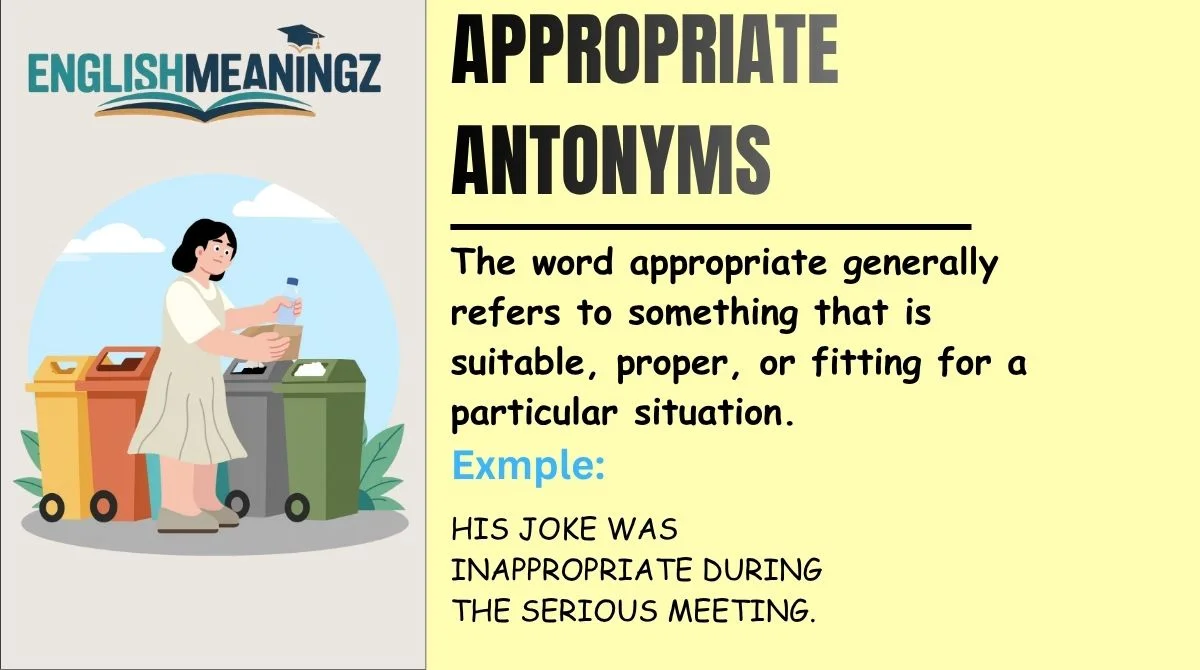
The word appropriate generally refers to something that is suitable, proper, or fitting for a particular situation.
When something is appropriate, it matches the expectations, context, or standards of a specific environment. For example, wearing formal clothing to a job interview is considered appropriate because it aligns with professional norms.
In communication, appropriate language means words that fit the audience and situation. Academic writing requires formal vocabulary, while casual conversations may allow informal expressions.
Tone Explanation
The word appropriate typically carries a neutral to formal tone. It appears frequently in academic writing, professional documents, workplace communication, and formal discussions.
For instance:
- Appropriate behavior
- Appropriate response
- Appropriate clothing
- Appropriate language
Emotional or Action Intensity
The intensity of the word is generally moderate. It does not express strong emotion but focuses on correctness or suitability.
Because of this, its antonyms usually describe something that is:
- unsuitable
- improper
- unfit
- incorrect for the situation
Understanding these opposites helps writers clearly express when something does not match expectations.
12 Best Antonyms for “Appropriate”
Below are the most effective opposite words for appropriate, explained with meaning, tone, examples, and reasoning.
Inappropriate
Meaning: Not suitable or proper for the situation.
Tone: Formal / Academic
Example Sentence:
His joke was inappropriate during the serious meeting.
Why it is an opposite:
If something appropriate fits the context, something inappropriate directly violates that context.
Improper
Meaning: Not correct according to social rules or standards.
Tone: Formal
Example Sentence:
It would be improper to interrupt the speaker during the presentation.
Why it is an opposite:
Appropriate actions follow accepted norms, while improper actions break them.
Unsuitable
Meaning: Not fitting or acceptable for a particular purpose.
Tone: Formal / Professional
Example Sentence:
These shoes are unsuitable for hiking in rough terrain.
Why it is an opposite:
Appropriate items fit the situation, whereas unsuitable ones do not meet the requirements.
Unfit
Meaning: Not qualified or not suitable for a role or situation.
Tone: Formal / Academic
Example Sentence:
The candidate was considered unfit for the leadership position.
Why it is an opposite:
Appropriate means fitting or proper, while unfit suggests the opposite condition.
Wrong
Meaning: Incorrect or unsuitable in a given context.
Tone: Informal / Neutral
Example Sentence:
Wearing casual clothes to the ceremony would be completely wrong.
Why it is an opposite:
Appropriate behavior is correct; wrong behavior contradicts expectations.
Irrelevant
Meaning: Not related to the subject or situation.
Tone: Academic
Example Sentence:
The student included several irrelevant details in the research paper.
Why it is an opposite:
Appropriate content is relevant and fitting, while irrelevant content does not belong.
Inapt
Meaning: Not suitable or not fitting.
Tone: Formal / Academic
Example Sentence:
His comment was inapt for the sensitive discussion.
Why it is an opposite:
Appropriate means fitting; inapt means poorly suited.
Indecent
Meaning: Offensive or morally unacceptable.
Tone: Emotional / Formal
Example Sentence:
The advertisement was criticized for containing indecent imagery.
Why it is an opposite:
Appropriate content respects moral standards, while indecent content violates them.
Awkward
Meaning: Socially uncomfortable or poorly suited.
Tone: Informal
Example Sentence:
His awkward response made the conversation uncomfortable.
Why it is an opposite:
Appropriate responses maintain social harmony, while awkward responses disrupt it.
Ill-suited
Meaning: Poorly matched to a specific purpose or role.
Tone: Formal
Example Sentence:
The building design was ill-suited for extreme weather conditions.
Why it is an opposite:
Appropriate means well-matched; ill-suited means mismatched.
Misplaced
Meaning: Incorrectly directed or used in the wrong context.
Tone: Formal
Example Sentence:
Her anger was completely misplaced in that situation.
Why it is an opposite:
Appropriate reactions fit the situation, while misplaced ones occur at the wrong time or place.
Absurd
Meaning: Ridiculously unreasonable or illogical.
Tone: Emotional
Example Sentence:
The suggestion sounded absurd during the serious debate.
Why it is an opposite:
Appropriate ideas make sense within context, while absurd ones completely violate logic.
Offensive
Meaning: Causing resentment or discomfort.
Tone: Emotional
Example Sentence:
Many people found the comment offensive.
Why it is an opposite:
Appropriate language respects listeners, whereas offensive language harms them.
Unacceptable
Meaning: Not allowed or tolerated.
Tone: Formal
Example Sentence:
Such behavior is unacceptable in a professional workplace.
Why it is an opposite:
Appropriate actions are acceptable, while unacceptable actions are rejected.
Disrespectful
Meaning: Showing a lack of respect.
Tone: Emotional
Example Sentence:
Interrupting elders during conversation is disrespectful.
Why it is an opposite:
Appropriate behavior demonstrates respect; disrespectful behavior violates it.
Strong vs Mild Opposites
Not all antonyms express the same level of intensity. Some are mild, while others are extremely strong.
Mild Opposites
These suggest something is slightly unsuitable but not severely wrong.
Examples include:
- awkward
- inapt
- misplaced
- unsuitable
These words are often used when the mistake is minor or unintentional.
Moderate Opposites
These describe clear mismatches or incorrect choices.
Examples include:
- inappropriate
- improper
- ill-suited
- irrelevant
They indicate that something clearly does not belong in the context.
Strong Opposites
These words suggest serious problems or offensive behavior.
Examples include:
- indecent
- offensive
- unacceptable
- absurd
These antonyms carry stronger emotional weight and are often used in criticism or serious discussions.
Understanding this scale allows writers to choose the exact word that matches the situation.
Context-Based Opposites
Some antonyms only function as opposites depending on the context. These are called situational antonyms.
For example, the opposite of appropriate clothing might be:
- casual
- revealing
- informal
But the opposite of appropriate answer might be:
- irrelevant
- incorrect
- absurd
Similarly, the opposite of appropriate behavior may include:
- rude
- offensive
- disrespectful
Because of this, writers should always consider the context before choosing an antonym. The best opposite word depends on whether the discussion involves behavior, language, clothing, decisions, or information.
Common Mistakes When Using Opposites
Even experienced writers sometimes misuse antonyms. Below are common mistakes and how to avoid them.
Using “Wrong” in Formal Writing
Incorrect:
The argument is wrong for the research paper.
Better:
The argument is inappropriate or irrelevant for the research paper.
Academic writing prefers more precise vocabulary.
Confusing “Irrelevant” With “Incorrect”
Incorrect:
Your answer is irrelevant to the math equation.
Better:
Your answer is incorrect.
Irrelevant means unrelated, not necessarily wrong.
Overusing “Inappropriate”
Many writers use inappropriate for everything.
Example mistake:
- inappropriate data
- inappropriate shoes
- inappropriate answer
Using varied antonyms improves writing clarity.
Better options include:
- unsuitable
- ill-suited
- irrelevant
- incorrect
Ignoring Tone Differences
Some antonyms are too strong for casual situations.
Example:
Incorrect:
Your outfit is indecent.
Better:
Your outfit might be unsuitable for this event.
Choosing the correct intensity keeps communication respectful.
Sentence Transformation Examples
Below are examples showing how antonyms change sentence meaning.
Original Sentence:
Her comment was appropriate for the discussion.
Rewritten:
Her comment was inappropriate for the discussion.
Original Sentence:
The clothing was appropriate for the ceremony.
Rewritten:
The clothing was unsuitable for the ceremony.
Original Sentence:
His response was appropriate and professional.
Rewritten:
His response was awkward and unprofessional.
Original Sentence:
The example was appropriate for the topic.
Rewritten:
The example was irrelevant to the topic.
Original Sentence:
The decision was appropriate for the situation.
Rewritten:
The decision was misplaced and poorly judged.
FAQs
What is the most common antonym for appropriate?
The most widely used opposite word is inappropriate, because it directly describes something that does not fit a situation.
Are inappropriate and improper the same?
They are similar but slightly different. Inappropriate focuses on suitability, while improper emphasizes social rules or etiquette.
Which antonym is best for academic writing?
Words like unsuitable, irrelevant, and inappropriate work best in academic contexts because they are formal and precise.
Can awkward be an antonym of appropriate?
Yes. When a response or action creates discomfort or social tension, awkward can act as a mild opposite.
What is the strongest opposite of appropriate?
Words such as indecent, offensive, and unacceptable are considered stronger opposites because they imply serious violations.
Why are antonyms important in writing?
Antonyms help writers create contrast, clarify meaning, and improve vocabulary precision.
How can I remember antonyms more easily?
The best method is to study words in context and practice rewriting sentences using opposite terms.
Conclusion
Understanding antonyms is one of the fastest ways to expand your vocabulary and improve your writing. When you know the correct opposite of a word, you gain the ability to express contrast, emphasize meaning, and communicate more precisely.
The word appropriate describes something that fits a situation, meets expectations, and aligns with context. Its antonyms—including inappropriate, unsuitable, improper, irrelevant, awkward, and unacceptable—describe situations where something fails to meet those expectations.
By learning these opposites and understanding their tone, intensity, and context, writers can avoid vague language and communicate ideas with clarity and confidence.
Whether you are writing essays, professional documents, or online content, mastering antonyms will make your vocabulary more versatile and your writing more powerful.