Understanding the opposite of a word is one of the most effective ways to strengthen vocabulary and improve writing clarity. Antonyms do more than simply provide contrast—they help writers express nuance, sharpen arguments, and create vivid descriptions.
When readers encounter contrasting ideas, their comprehension improves because the difference between meanings becomes clearer.
For students, writers, and professionals, mastering opposites enhances both spoken and written communication. Academic writing often requires precise vocabulary, while professional communication demands clarity and tone control.
Knowing the antonyms of a word like “abode” allows you to accurately describe situations involving housing, movement, homelessness, or temporary living conditions.
This guide explores the most effective antonyms of abode, explains how they differ in tone and intensity, and demonstrates how to use them correctly in sentences.
By the end of this article, you will not only know the best opposites of abode but also understand when and why to use them.
What Does “Abode” Mean?
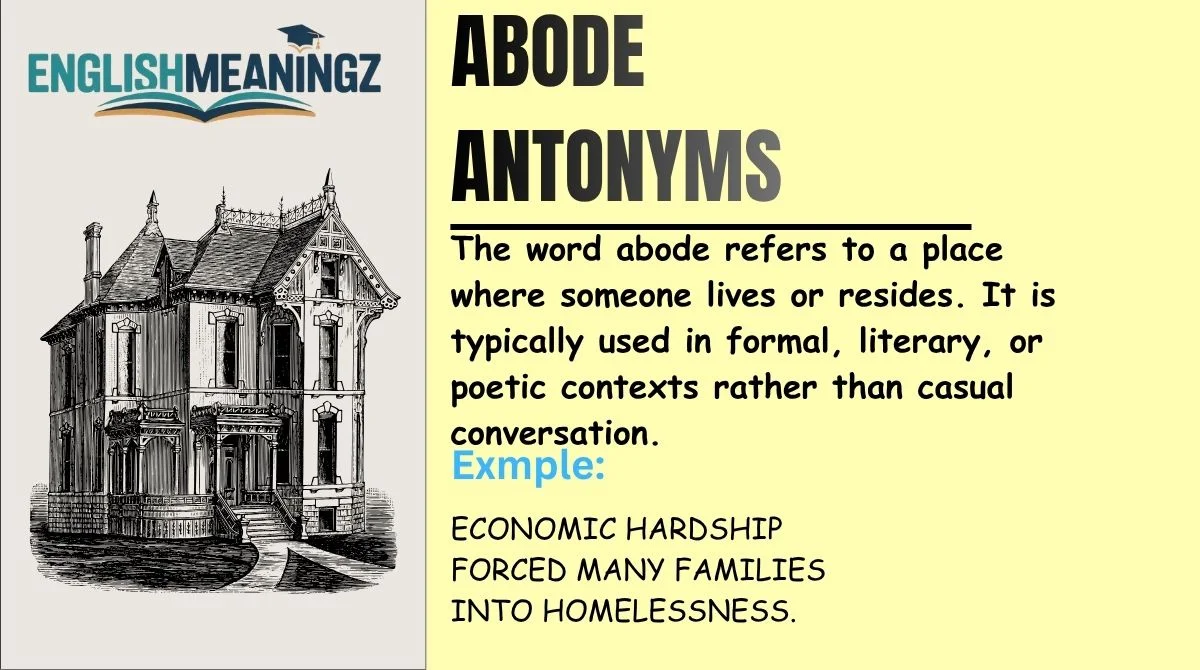
The word abode refers to a place where someone lives or resides. It is typically used in formal, literary, or poetic contexts rather than casual conversation.
In simple terms, an abode is a home, residence, or dwelling—a location where a person permanently or semi-permanently lives.
Definition
An abode is a fixed place where a person lives, stays, or resides.
Tone Explanation
The tone of the word abode is usually:
- Formal
- Literary
- Slightly old-fashioned
- Often used in legal or poetic writing
For example:
“The traveler finally returned to his humble abode after months on the road.”
Emotional or Action Intensity
The emotional tone of abode tends to suggest:
- Stability
- Permanence
- Belonging
- Settlement
Because of this meaning, antonyms usually refer to lack of residence, movement, displacement, or temporary presence.
12 Best Antonyms for “Abode”
Below are the most accurate opposites of abode, each explained with meaning, tone, and examples.
Departure
Meaning: The act of leaving a place.
Tone: Formal / Neutral
Example Sentence:
The sudden departure of the tenants left the house completely empty.
Why It Is an Opposite:
While abode implies staying or living in a place, departure represents leaving that place.
Homelessness
Meaning: The state of having no permanent home.
Tone: Emotional / Social
Example Sentence:
Economic hardship forced many families into homelessness.
Why It Is an Opposite:
Abode means having a home; homelessness represents the absence of one.
Vacancy
Meaning: An empty or unoccupied space.
Tone: Formal / Professional
Example Sentence:
The long-standing vacancy of the property attracted vandals.
Why It Is an Opposite:
An abode is inhabited, while a vacancy indicates that no one lives there.
Eviction
Meaning: Removal of someone from a property.
Tone: Legal / Formal
Example Sentence:
Failure to pay rent eventually led to eviction.
Why It Is an Opposite:
Abode implies residence; eviction removes that residence.
Displacement
Meaning: Being forced away from one’s home.
Tone: Academic / Emotional
Example Sentence:
Natural disasters caused widespread displacement across the region.
Why It Is an Opposite:
Displacement means losing one’s home or living place.
Nomadism
Meaning: A lifestyle of constant movement without permanent residence.
Tone: Academic / Cultural
Example Sentence:
Nomadism has been practiced for centuries in desert communities.
Why It Is an Opposite:
Nomadism rejects permanent settlement, while an abode represents a fixed dwelling.
Absence
Meaning: Being away from a place.
Tone: Neutral / Formal
Example Sentence:
During his long absence, the house remained locked and silent.
Why It Is an Opposite:
Abode implies presence at home; absence indicates not being there.
Transience
Meaning: Temporary or short-term presence.
Tone: Academic
Example Sentence:
The city’s growing transience makes it difficult to build stable communities.
Why It Is an Opposite:
Abode suggests permanence, while transience suggests temporary existence.
Wandering
Meaning: Traveling without a fixed destination or home.
Tone: Informal / Descriptive
Example Sentence:
Years of wandering kept him from settling down.
Why It Is an Opposite:
Wandering indicates the lack of a permanent residence.
Exile
Meaning: Forced removal from one’s home or country.
Tone: Formal / Historical
Example Sentence:
The political leader spent decades living in exile.
Why It Is an Opposite:
Exile separates a person from their abode.
Migration
Meaning: Movement from one place to another.
Tone: Academic / Neutral
Example Sentence:
Seasonal migration is common among agricultural workers.
Why It Is an Opposite:
Migration focuses on movement rather than residence.
Evacuation
Meaning: Leaving a place due to danger or emergency.
Tone: Formal / Urgent
Example Sentence:
Authorities ordered the evacuation of all homes near the wildfire.
Why It Is an Opposite:
Evacuation empties a place that once served as an abode.
Strong vs Mild Opposites
Not all antonyms carry the same intensity. Some strongly contradict the idea of an abode, while others only partially oppose it.
Strong Opposites
These directly oppose the concept of having a home.
Examples:
- Homelessness
- Eviction
- Exile
- Displacement
These words indicate loss of home or forced removal.
Moderate Opposites
These imply absence or lack of residence but not necessarily permanent loss.
Examples:
- Vacancy
- Absence
- Departure
Mild Opposites
These describe mobility rather than the absence of housing.
Examples:
- Wandering
- Migration
- Transience
Understanding these levels helps writers choose the most precise word.
Context-Based Opposites
Sometimes the correct antonym depends entirely on context. The opposite of abode may change depending on how the word is used.
Legal Context
In legal documents, abode refers to official residence.
Possible opposites:
- Eviction
- Vacancy
Example:
Legal notices were sent to the tenant’s last known abode.
Social Context
In discussions about poverty or housing issues:
Opposites include:
- Homelessness
- Displacement
Travel Context
When discussing mobility or lifestyle:
Opposites include:
- Nomadism
- Wandering
- Migration
Emergency Context
In disaster situations:
Opposite examples include:
- Evacuation
- Abandonment
Common Mistakes When Using Opposites
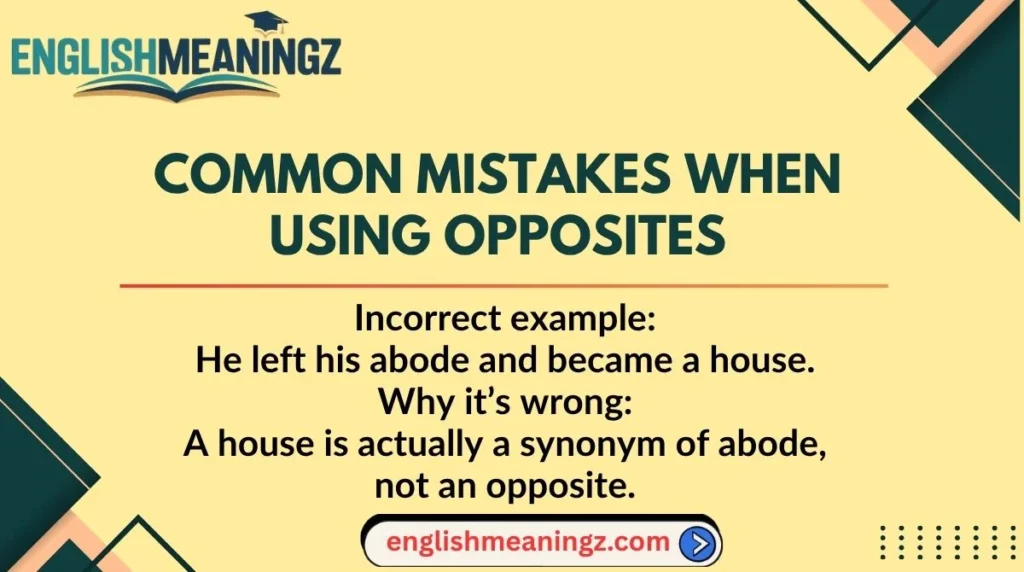
Even experienced writers sometimes misuse antonyms. Here are common mistakes to avoid.
Mistake 1: Using “house” as an antonym
Incorrect example:
He left his abode and became a house.
Why it’s wrong:
A house is actually a synonym of abode, not an opposite.
Correct idea:
Use words related to absence or lack of residence.
Mistake 2: Confusing temporary absence with homelessness
Incorrect example:
He went on vacation, so he experienced homelessness.
Why it’s wrong:
A temporary absence does not mean someone lacks a home.
Mistake 3: Using travel words incorrectly
Incorrect example:
His migration meant he no longer had a home.
Migration does not always mean losing a home; it simply means moving.
Mistake 4: Ignoring tone differences
Using a highly emotional antonym in a casual context can sound unnatural.
Example:
Too dramatic:
He stepped outside his abode and entered exile.
Correct usage:
He left his home for a short trip.
Sentence Transformation Examples
Below are five examples showing how antonyms can change the meaning of a sentence.
Example 1
Original:
The small cottage served as his peaceful abode.
Opposite Version:
After the storm, the cottage was left in complete vacancy.
Example 2
Original:
She returned to her family abode.
Opposite Version:
She was forced into exile far from her home.
Example 3
Original:
The mansion had been their ancestral abode for generations.
Opposite Version:
War caused the displacement of the entire family.
Example 4
Original:
The mountain cabin became their winter abode.
Opposite Version:
Continuous wandering prevented them from settling anywhere.
Example 5
Original:
The apartment remained his primary abode.
Opposite Version:
Eviction left him searching for a place to stay.
FAQs
What is the simplest antonym of abode?
The simplest conceptual opposite is homelessness, because it directly indicates the absence of a home.
Is “departure” a true opposite of abode?
Yes, in context. Abode means staying or living somewhere, while departure means leaving that place.
Is “nomad” the opposite of abode?
Not exactly, but it represents a lifestyle without a permanent home, which contrasts with the idea of an abode.
Can “vacancy” be an antonym of abode?
Yes. If an abode refers to an inhabited home, vacancy describes a place where no one lives.
What is the most formal opposite of abode?
Words like eviction, exile, and displacement are often used in formal or academic writing.
Is “absence” a weak antonym?
Yes. Absence only indicates being away temporarily, not losing a home permanently.
Why does context matter when choosing antonyms?
Because the meaning of abode can vary between legal residence, emotional home, or physical dwelling, the most accurate opposite depends on the situation.
Conclusion
The word abode represents a place of residence, stability, and belonging. Its antonyms therefore revolve around the opposite ideas—absence of home, forced removal, temporary living, or constant movement.
Understanding these opposites helps writers communicate more precisely. Words such as homelessness, eviction, displacement, wandering, vacancy, and exile capture different ways in which the concept of a home can be contrasted or removed.
When choosing an antonym, context is critical. Legal discussions might require words like eviction, while social discussions may use homelessness or displacement. Travel contexts might use wandering or migration.
By mastering these distinctions, writers can elevate their vocabulary, improve clarity, and communicate more effectively in both academic and professional settings.