Mastering opposites is one of the fastest ways to sharpen your language skills. When you understand antonyms deeply, your writing becomes more precise, expressive, and impactful.
Instead of repeating the same ideas, you gain the ability to contrast, refine, and elevate your message.
In academic and professional communication, clarity is everything. Using the right opposite word helps avoid ambiguity and strengthens arguments.
Whether you are writing essays, emails, reports, or creative content, knowing accurate antonyms allows you to communicate with confidence and authority.
This guide explores 24 carefully selected antonyms of the word “thick,” explained in a clear, human-friendly way—without fluff or repetition.
What Does “Thick” Mean?
The word “thick” is versatile and carries multiple meanings depending on context.
Core Definition:
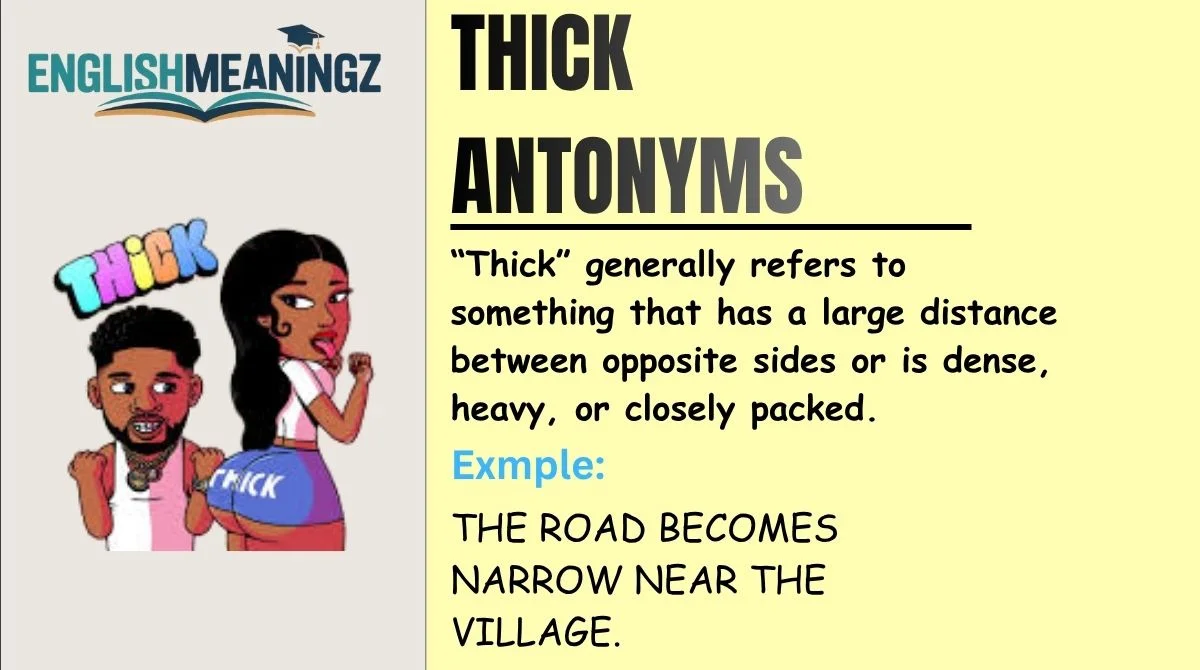
“Thick” generally refers to something that has a large distance between opposite sides or is dense, heavy, or closely packed.
Tone Explanation:
- Neutral in physical descriptions (e.g., thick book, thick wall)
- Can be informal or slightly negative when describing intelligence (e.g., “thick-headed”)
- Can also imply richness or intensity (e.g., thick fog, thick accent)
Intensity Insight:
“Thick” often suggests heaviness, density, or reduced clarity—whether physical (materials), visual (fog), or conceptual (understanding).
24 Best Antonyms for “Thick”
Thin
Meaning: Having a small distance between sides
Tone: Neutral / Academic
Example: The paper is too thin to handle ink.
Why Opposite: Direct physical contrast in width or density
Slim
Meaning: Gracefully thin or narrow
Tone: Positive / Informal
Example: She prefers slim notebooks for travel.
Why Opposite: Suggests elegance instead of heaviness
Narrow
Meaning: Limited in width
Tone: Neutral / Formal
Example: The road becomes narrow near the village.
Why Opposite: Opposes the broadness implied by “thick”
Sparse
Meaning: Thinly scattered or distributed
Tone: Academic
Example: Vegetation is sparse in the desert.
Why Opposite: Contrasts density and concentration
Light
Meaning: Not heavy or dense
Tone: Neutral
Example: Use a light fabric in summer.
Why Opposite: Opposes heaviness and density
Fine
Meaning: Very thin or delicate
Tone: Formal / Descriptive
Example: The artist used fine lines for detail.
Why Opposite: Represents precision and thinness
Sheer
Meaning: Extremely thin or transparent
Tone: Formal
Example: The curtains are sheer and elegant.
Why Opposite: Opposes opacity and thickness
Delicate
Meaning: Fragile or finely structured
Tone: Emotional / Formal
Example: The vase is delicate and easily broken.
Why Opposite: Contrasts heaviness and solidity
Clear
Meaning: Easy to see through or understand
Tone: Neutral
Example: The water is crystal clear.
Why Opposite: Opposes visual thickness like fog
Transparent
Meaning: Allowing light to pass through
Tone: Academic
Example: The glass is completely transparent.
Why Opposite: Contrasts opacity
Fluid
Meaning: Smooth and flowing
Tone: Academic
Example: The liquid is fluid and easy to pour.
Why Opposite: Opposes viscosity implied by thickness
Runny
Meaning: Not thick; watery
Tone: Informal
Example: The soup is too runny.
Why Opposite: Direct contrast in texture
Watery
Meaning: Diluted or lacking density
Tone: Informal
Example: The juice tastes watery.
Why Opposite: Opposes richness and thickness
Loose
Meaning: Not tightly packed
Tone: Neutral
Example: The soil is loose and easy to dig.
Why Opposite: Contrasts compact density
Open
Meaning: Not dense or crowded
Tone: Neutral
Example: The field is open and spacious.
Why Opposite: Opposes crowded thickness
Airy
Meaning: Light and spacious
Tone: Positive
Example: The room feels airy and comfortable.
Why Opposite: Opposes heaviness and density
Scattered
Meaning: Spread out irregularly
Tone: Neutral
Example: Leaves were scattered across the yard.
Why Opposite: Opposes concentration
Diluted
Meaning: Made weaker or thinner
Tone: Academic
Example: The solution was diluted with water.
Why Opposite: Opposes concentration
Weak
Meaning: Lacking strength or intensity
Tone: Neutral
Example: The signal is weak in this area.
Why Opposite: Opposes strong, dense intensity
Soft
Meaning: Not firm or hard
Tone: Neutral
Example: The pillow is soft and comfortable.
Why Opposite: Contrasts firmness often linked with thickness
Light-textured
Meaning: Not dense in structure
Tone: Descriptive
Example: This cake has a light-textured crumb.
Why Opposite: Opposes heaviness
Minimal
Meaning: Very small in amount
Tone: Academic
Example: The design uses minimal elements.
Why Opposite: Opposes abundance and density
Sparse-textured
Meaning: Having little density in structure
Tone: Academic
Example: The fabric feels sparse-textured.
Why Opposite: Directly contrasts density
Clear-cut
Meaning: Easy to understand
Tone: Formal
Example: The instructions are clear-cut.
Why Opposite: Opposes confusion implied by “thick”
Strong vs Mild Opposites
Not all antonyms carry the same intensity. Understanding this helps you choose the most precise word.
Strong Opposites (Direct Contrast):
- Thin
- Runny
- Watery
- Transparent
These words directly negate the meaning of “thick.”
Moderate Opposites (Contextual Contrast):
- Sparse
- Light
- Narrow
They oppose certain aspects, not all meanings.
Mild Opposites (Situational):
- Airy
- Minimal
- Soft
These suggest contrast indirectly depending on usage.
Key Insight:
Choose antonyms based on context and intensity, not just dictionary definitions.
Context-Based Opposites
“Thick” changes meaning depending on context, so its antonyms also vary.
Physical Objects:
- Thick book → Thin book
- Thick wall → Narrow wall
Liquids:
- Thick soup → Runny soup
- Thick sauce → Watery sauce
Visibility:
- Thick fog → Clear air
- Thick smoke → Transparent atmosphere
Understanding (Informal):
- Thick person → Sharp or intelligent person
Language Tip:
Always identify the context first, then choose the correct opposite.
Common Mistakes When Using Opposites
Mistake 1: Using the wrong context
Incorrect: The road is watery
Correct: The road is narrow
Mistake 2: Mixing physical and abstract meanings
Incorrect: His explanation was thin (if meaning unclear)
Better: His explanation was unclear
Mistake 3: Overusing “thin”
Not every “thick” becomes “thin.”
Example: Thick fog → Clear sky (not thin fog)
Mistake 4: Ignoring tone
“Runny” is informal and not suitable for academic writing.
Sentence Transformation Examples
Original: The soup is thick and heavy.
Rewritten: The soup is runny and light.
Original: The forest is thick with trees.
Rewritten: The forest is sparse and open.
Original: The fog is thick this morning.
Rewritten: The air is clear this morning.
Original: He used thick lines in the drawing.
Rewritten: He used fine lines in the drawing.
Original: The book is thick and hard to carry.
Rewritten: The book is slim and easy to carry.
FAQs
What is the most common antonym of “thick”?
The most direct and widely used antonym is “thin.”
Can “clear” be an antonym of “thick”?
Yes, especially when referring to fog, smoke, or understanding.
Is “light” always an opposite of “thick”?
Not always. It depends on whether “thick” refers to weight or density.
What is the best antonym for thick liquids?
“Runny” or “watery” are the most accurate.
Are all antonyms interchangeable?
No. Context determines the correct choice.
What antonym works for “thick accent”?
“Neutral” or “light accent” works better than “thin.”
Why is learning antonyms important?
It improves clarity, precision, and vocabulary depth in writing.
Conclusion
Understanding antonyms of “thick” goes far beyond memorizing a list. It requires recognizing context, tone, and intensity.
From direct opposites like “thin” and “runny” to situational contrasts like “clear” and “airy,” each word serves a unique purpose.
When used correctly, antonyms enhance clarity, strengthen communication, and elevate your writing quality.
Whether you are working on academic papers, professional communication, or creative writing, mastering these opposites will give you a noticeable edge.