Understanding opposites is one of the fastest ways to sharpen your writing. When you know not only what a word means but also what it doesn’t mean, your control over tone, precision, and clarity improves dramatically.
Opposites help you compare ideas, highlight contrasts, and express subtle differences that make your communication more engaging and impactful.
In academic and professional communication, using accurate antonyms is essential. Whether you’re writing essays, reports, or persuasive content, choosing the right opposite word allows you to present balanced arguments, avoid ambiguity, and sound more articulate.
This guide focuses on strong, meaningful antonyms of “unison” and shows you exactly how to use them effectively.
What Does “Unison” Mean?
Definition:
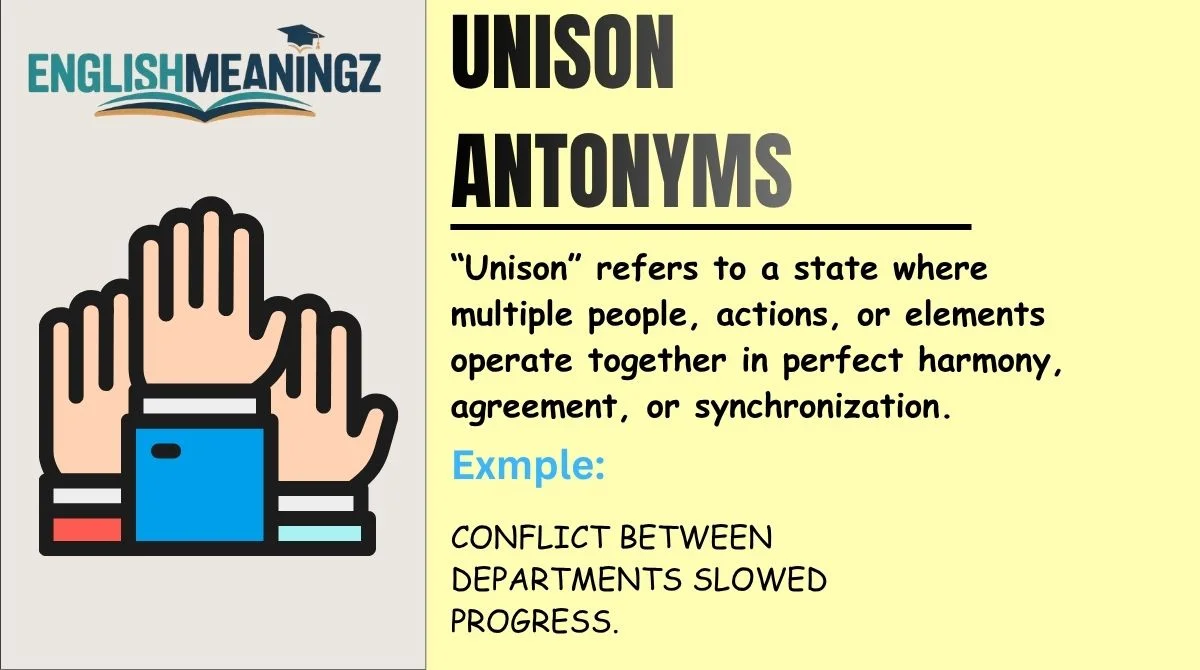
“Unison” refers to a state where multiple people, actions, or elements operate together in perfect harmony, agreement, or synchronization.
Tone Explanation:
The word carries a positive and cooperative tone, often associated with unity, coordination, and collective effort.
Emotional or Action Intensity:
“Unison” suggests high alignment and cohesion—everyone is acting as one, without conflict or variation.
13 Best Antonyms for “Unison”
Discord
Meaning: Lack of harmony or agreement
Tone: Emotional / Formal
Example: The meeting ended in discord rather than agreement.
Why It’s Opposite: Where unison reflects harmony, discord represents conflict and disagreement.
Disunity
Meaning: Absence of unity among people
Tone: Formal / Academic
Example: Disunity within the team led to poor performance.
Why It’s Opposite: Unison requires unity, while disunity directly breaks it.
Conflict
Meaning: A serious disagreement or clash
Tone: Formal / Emotional
Example: Conflict between departments slowed progress.
Why It’s Opposite: Unison implies agreement; conflict implies opposition.
Chaos
Meaning: Complete disorder and confusion
Tone: Informal / Emotional
Example: Without leadership, the project fell into chaos.
Why It’s Opposite: Unison is structured and aligned; chaos is disorganized and scattered.
Division
Meaning: Separation into parts or disagreement
Tone: Academic / Formal
Example: Political division weakened the organization.
Why It’s Opposite: Division breaks the unity that unison requires.
Disagreement
Meaning: Difference in opinions
Tone: Neutral / Formal
Example: There was strong disagreement over the proposal.
Why It’s Opposite: Unison means shared views; disagreement means differing ones.
Asynchrony
Meaning: Lack of timing coordination
Tone: Academic
Example: The dancers moved in asynchrony, ruining the performance.
Why It’s Opposite: Unison depends on perfect timing, while asynchrony lacks it.
Dissonance
Meaning: Lack of harmony, especially in sound or ideas
Tone: Academic / Emotional
Example: The speech created emotional dissonance among listeners.
Why It’s Opposite: Unison is harmonious; dissonance is jarring and mismatched.
Separation
Meaning: The act of moving apart
Tone: Neutral / Formal
Example: The separation of teams reduced collaboration.
Why It’s Opposite: Unison brings together; separation pulls apart.
Individualism
Meaning: Focus on individual actions rather than group unity
Tone: Academic
Example: Individualism sometimes hinders teamwork.
Why It’s Opposite: Unison emphasizes collective action; individualism emphasizes independence.
Disconnection
Meaning: Lack of relationship or coordination
Tone: Informal / Neutral
Example: There was a clear disconnection between management and staff.
Why It’s Opposite: Unison connects; disconnection breaks links.
Fragmentation
Meaning: Breaking into smaller, disconnected parts
Tone: Academic
Example: Fragmentation of efforts reduced efficiency.
Why It’s Opposite: Unison integrates; fragmentation divides.
Opposition
Meaning: Active resistance or contrast
Tone: Formal
Example: The plan faced strong opposition from stakeholders.
Why It’s Opposite: Unison aligns forces; opposition pushes against them.
Isolation
Meaning: Being alone or separated from others
Tone: Emotional / Formal
Example: Isolation prevented team collaboration.
Why It’s Opposite: Unison involves togetherness; isolation removes it.
Divergence
Meaning: Moving in different directions
Tone: Academic
Example: Their ideas showed clear divergence.
Why It’s Opposite: Unison aligns paths; divergence separates them.
Strong vs Mild Opposites
Not all antonyms carry the same intensity. Some are direct and powerful, while others are softer and context-dependent.
Strong Opposites:
- Chaos
- Discord
- Conflict
- Dissonance
These words completely break the idea of unity and suggest strong disruption.
Mild Opposites:
- Disagreement
- Separation
- Disconnection
- Divergence
These suggest partial or situational lack of unity rather than complete breakdown.
Understanding intensity helps you choose the right word depending on how dramatic or subtle your message needs to be.
Context-Based Opposites
Antonyms of “unison” can change depending on the context:
- Music: Dissonance, asynchrony
- Teamwork: Disunity, conflict, fragmentation
- Technology: Asynchrony, disconnection
- Social settings: Division, isolation, opposition
For example:
- In music, “dissonance” is the best opposite.
- In teamwork, “disunity” or “conflict” fits better.
Choosing context-appropriate antonyms ensures clarity and precision.
Common Mistakes When Using Opposites
Using weak opposites:
❌ “Silence” as an antonym of unison
✔ Correct: “Discord” or “dissonance”
Confusing difference with opposition:
❌ “Variety”
✔ Better: “Divergence” or “disagreement”
Ignoring context:
❌ Using “chaos” in a formal academic paper unnecessarily
✔ Use “disunity” or “fragmentation” for formal tone
Overusing one antonym:
Repeating “conflict” reduces vocabulary richness—use alternatives.
Sentence Transformation Examples
Original: The team worked in unison.
Rewritten: The team worked in conflict.
Original: The singers performed in unison.
Rewritten: The singers performed in dissonance.
Original: The departments acted in unison.
Rewritten: The departments showed division.
Original: The system operated in unison.
Rewritten: The system functioned in asynchrony.
Original: The group responded in unison.
Rewritten: The group responded with disagreement.
FAQs
What is the closest antonym of “unison”?
“Discord” is often considered the closest because it directly opposes harmony.
Can “chaos” be an antonym of unison?
Yes, but it is a strong and extreme opposite, best used in dramatic contexts.
Is “difference” an antonym of unison?
Not exactly. “Difference” is too broad; “divergence” or “disagreement” is more precise.
Which antonym is best for academic writing?
“Disunity,” “fragmentation,” and “divergence” are ideal for formal contexts.
Is “asynchrony” commonly used?
Yes, especially in technical, scientific, and performance-related contexts.
Can one word replace unison in every situation?
No. The best antonym depends on context—music, teamwork, or communication.
Why should I learn multiple antonyms?
It improves precision, avoids repetition, and enhances overall writing quality.
Conclusion
Mastering antonyms of “unison” gives you a powerful advantage in communication. Instead of relying on a single opposite, you can choose from a range of words like “discord,” “fragmentation,” or “divergence” depending on tone and context.
This flexibility allows you to express ideas more clearly, sound more professional, and write with greater impact.
The key is not just knowing these words—but understanding when and how to use them. With the right choice, your writing becomes sharper, more persuasive, and far more engaging.