A strong vocabulary is one of the most powerful tools for effective communication. Whether you are a student writing essays, a blogger creating engaging content, or a professional drafting reports, the words you choose directly influence clarity, credibility, and impact.
One simple yet highly effective strategy for improving writing quality is using appropriate synonyms.
Excessive repetition of a single word can weaken writing and reduce reader engagement. This is especially important in academic writing and standardized exams where lexical diversity is assessed.
For example, repeatedly using the word prodigy to describe a talented individual can make a paragraph sound monotonous. Replacing it with carefully selected alternatives can make writing more sophisticated and precise.
Synonyms allow writers to express subtle differences in meaning. Some words emphasize intelligence, others highlight exceptional talent, early achievement, or creative brilliance.
Understanding these distinctions helps writers choose the most accurate word for a specific context.
Students preparing for academic exams such as IELTS or university essays often benefit from expanding their vocabulary with well-understood alternatives.
Bloggers and content creators also rely on synonym variation to improve readability and SEO performance. Professionals use varied vocabulary to make reports and presentations more persuasive and engaging.
This article presents 24 powerful synonyms for the word “prodigy.” Each synonym is explained clearly with meaning, context, and example sentences so that readers can use them confidently.
The article also includes comparison tables, writing tips, common mistakes, and practice exercises to help you master these alternatives effectively.
By the end of this guide, you will not only know multiple replacements for prodigy but also understand when and how to use them appropriately in different types of writing.
Definition and Core Meaning of “Prodigy”
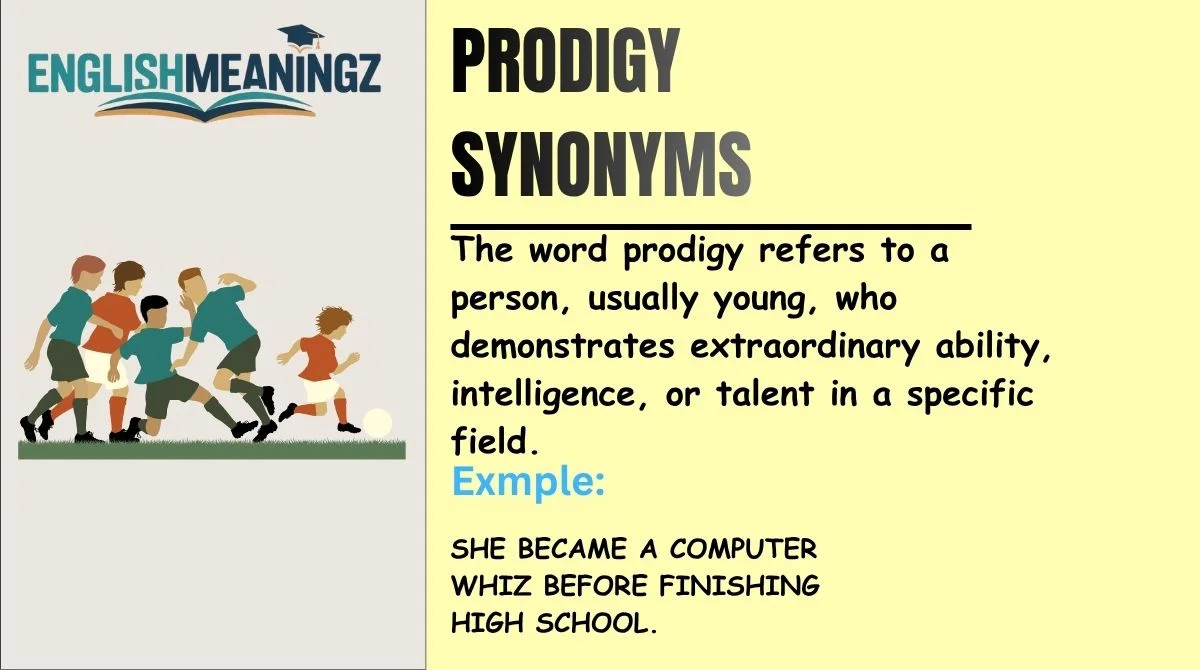
The word prodigy refers to a person, usually young, who demonstrates extraordinary ability, intelligence, or talent in a specific field.
A prodigy often shows skills far beyond what is expected for their age. These abilities may appear in areas such as music, mathematics, science, chess, art, or sports. The defining characteristic of a prodigy is exceptional performance at an unusually early age.
For example:
- A child who composes complex music at age eight may be called a musical prodigy.
- A teenager solving advanced mathematical problems typically studied at university level may be described as a math prodigy.
In academic contexts, the word can also refer more broadly to any individual who demonstrates remarkable intellectual or creative capacity. However, the strongest association of the term remains early and extraordinary talent.
Because prodigy carries a specific meaning, not every synonym perfectly matches it in every situation. Some alternatives emphasize intelligence, others highlight creativity or exceptional skill. Understanding these differences helps writers choose the most accurate term.
24 Synonyms Grouped by Context
General Use Synonyms
These words can replace prodigy in many everyday contexts.
Genius
Meaning: A person with exceptional intellectual ability or creativity.
Context: Often used in both academic and casual writing to describe remarkable intelligence.
Example:
The young mathematician was widely recognized as a genius after solving problems that challenged experienced researchers.
Wunderkind
Meaning: A young person who achieves extraordinary success or skill early in life.
Context: Often used in journalism or biographies to describe young achievers.
Example:
The technology company hired a teenage wunderkind who had already developed several successful apps.
Phenomenon
Meaning: Someone whose abilities are so impressive that they attract widespread attention.
Context: Suitable when emphasizing extraordinary public recognition.
Example:
The young chess player became an international phenomenon within just a few years.
Marvel
Meaning: A person whose talent or skill inspires admiration.
Context: Often used to highlight impressive accomplishments.
Example:
The child pianist was considered a marvel by critics and audiences alike.
Whiz
Meaning: Someone who is extremely skilled at a particular activity.
Context: Common in casual writing or journalism.
Example:
She became a computer whiz before finishing high school.
Formal & Academic Writing Synonyms
These alternatives are more appropriate for essays, academic papers, and professional contexts.
Virtuoso
Meaning: A person with exceptional technical skill in the arts, especially music.
Context: Commonly used in academic discussions of performance or artistic talent.
Example:
By the age of fifteen, the violinist had already become a celebrated virtuoso.
Savant
Meaning: A person with profound knowledge or extraordinary ability in a specific field.
Context: Often used in psychology, neuroscience, and academic writing.
Example:
The researcher described the boy as a mathematical savant capable of complex calculations.
Luminary
Meaning: An individual who inspires others through outstanding intellectual achievements.
Context: Common in academic and professional discussions.
Example:
She became a scientific luminary whose discoveries transformed modern medicine.
Polymath
Meaning: A person with knowledge across multiple disciplines.
Context: Used when someone demonstrates brilliance in several areas.
Example:
The Renaissance produced many polymaths who excelled in art, science, and philosophy.
Intellectual
Meaning: A person known for serious thought and scholarly achievements.
Context: Appropriate in academic essays.
Example:
Even as a teenager, he was recognized as a rising intellectual in the scientific community.
Informal Usage Synonyms
These alternatives appear frequently in casual writing or conversation.
Brainiac
Meaning: Someone who is extremely intelligent.
Context: Informal tone; often used in conversation.
Example:
Everyone in class knew she was the resident brainiac.
Star
Meaning: A person who performs exceptionally well.
Context: Often used in media and entertainment contexts.
Example:
The young actor quickly became a star in the film industry.
Wizard
Meaning: Someone who performs tasks with extraordinary skill.
Context: Informal but expressive.
Example:
He is a computer wizard capable of solving complex technical issues.
Ace
Meaning: A person who excels in a particular field.
Context: Casual language.
Example:
She is an ace at solving difficult chemistry problems.
Whizz-kid
Meaning: A young person with impressive talent or success.
Context: Common in business or technology discussions.
Example:
The finance firm recruited several young whizz-kids from top universities.
Technical or Subject-Specific Synonyms
These words emphasize specialized ability.
Mastermind
Meaning: A highly intelligent person responsible for complex achievements.
Context: Often used in strategic or leadership contexts.
Example:
The software system was created by a young programming mastermind.
Innovator
Meaning: Someone who introduces new ideas or methods.
Context: Common in technology, science, and business.
Example:
The teenage engineer was praised as an innovator in renewable energy technology.
Visionary
Meaning: A person capable of imagining groundbreaking ideas.
Context: Often used in leadership and creativity discussions.
Example:
The young entrepreneur was viewed as a visionary in digital design.
Protagonist of Talent (Emerging Talent)
Meaning: A rising individual whose ability is beginning to attract attention.
Context: Useful in developmental or academic discussions.
Example:
The institute supports emerging talents in mathematics and engineering.
Master
Meaning: A person with complete control or expertise in a skill.
Context: Used in both artistic and technical discussions.
Example:
Even at a young age, he appeared to be a master of classical piano.
Specialist
Meaning: Someone who focuses deeply on one field of expertise.
Context: Appropriate in professional settings.
Example:
The young researcher quickly became a specialist in artificial intelligence.
Rising Talent
Meaning: A promising individual who is beginning to achieve recognition.
Context: Often used in media or academic reports.
Example:
She is considered a rising talent in modern architecture.
Prodigious Talent
Meaning: Exceptional natural ability.
Context: Used when emphasizing extraordinary skill.
Example:
His prodigious talent in mathematics impressed professors worldwide.
Word Intensity and Tone Comparison
| Word | Formal Level | Emotional Strength | Typical Context |
|---|---|---|---|
| Genius | Medium | Strong | General writing |
| Wunderkind | Medium | Strong | Journalism |
| Virtuoso | High | Moderate | Arts and music |
| Savant | High | Moderate | Academic discussion |
| Luminary | High | Moderate | Professional writing |
| Brainiac | Low | Light | Informal conversation |
| Wizard | Low | Moderate | Casual description |
| Polymath | High | Strong | Academic or historical |
| Mastermind | Medium | Strong | Strategy or innovation |
| Innovator | High | Moderate | Technology and business |
This comparison helps writers select a word that matches both the tone and the context of their writing.
Common Mistakes When Using These Synonyms
Mistake 1: Using Informal Words in Academic Writing
Incorrect:
The scientist was a brainiac in physics.
Correct:
The scientist was a genius in theoretical physics.
Mistake 2: Ignoring Context
Incorrect:
The young violin player was a mastermind of music.
Correct:
The young violin player was a virtuoso.
Mistake 3: Overusing Synonyms Without Purpose
Incorrect:
He was a genius, prodigy, wizard, brainiac, and whiz.
Correct:
He was widely regarded as a genius in mathematics.
Using too many synonyms in one sentence can confuse readers.
Synonyms in Academic Writing
Example Paragraph 1
Early intellectual development has long fascinated psychologists and educators. Children who demonstrate exceptional abilities at a young age are often described as geniuses or wunderkinds. These individuals challenge traditional educational models because their learning pace often exceeds that of their peers.
Example Paragraph 2
Throughout history, societies have celebrated extraordinary thinkers and innovators. Figures recognized as polymaths or intellectual luminaries have made lasting contributions across multiple disciplines. Their achievements demonstrate how exceptional cognitive ability can transform both science and culture.
IELTS and Exam Writing Tips
Avoid Repetition
Using synonyms strategically can help improve lexical variety in exam essays.
Example:
Repeated:
The student was a prodigy. The prodigy impressed teachers.
Improved:
The student was a prodigy whose remarkable abilities impressed teachers.
Use Accurate Synonyms
Not every alternative fits every sentence. Choose words that match the context.
When Not to Replace the Word
Sometimes the original word is the most precise option. For example, when referring specifically to child prodigies, replacing the word may weaken accuracy.
Similar Words vs True Synonyms
Some words may appear similar but are not perfect replacements.
Genius vs Prodigy
A genius refers to exceptional intelligence at any age, while a prodigy usually refers to extraordinary ability at a young age.
Virtuoso vs Prodigy
A virtuoso is a master performer, typically in music. A prodigy may become a virtuoso later but is defined by early talent.
Polymath vs Prodigy
A polymath has expertise in many fields, whereas a prodigy may specialize in one area.
Understanding these differences ensures precise writing.
Practice Sentences
Fill in the blanks with the most suitable synonym.
- The young composer was considered a musical ______ by critics.
- By sixteen, she had become a technology ______ admired by investors.
- The mathematician was widely regarded as a ______ due to his extraordinary intelligence.
- The child chess champion quickly became an international ______.
- Leonardo da Vinci is often described as a Renaissance ______.
Answers can include: virtuoso, wunderkind, genius, phenomenon, polymath.
FAQs
What is the best synonym for prodigy?
The best synonym often depends on context, but genius, wunderkind, and virtuoso are among the closest alternatives.
Is genius the same as prodigy?
Not exactly. A genius can be any age, while a prodigy typically refers to someone who shows extraordinary talent at a young age.
Which synonym is best for academic writing?
Words such as luminary, polymath, savant, and virtuoso are more suitable for formal writing.
Can prodigy describe adults?
Yes, but it most commonly refers to individuals who displayed exceptional ability during childhood.
Why should writers learn synonyms for prodigy?
Using varied vocabulary improves clarity, avoids repetition, and strengthens writing quality in academic and professional contexts.
Conclusion
Vocabulary variety plays a crucial role in effective writing. Relying on a single word repeatedly can make even well-structured writing feel repetitive and less engaging. Learning alternatives allows writers to communicate ideas more precisely and express subtle differences in meaning.
The word prodigy describes exceptional talent, particularly at a young age, but it is only one of many powerful terms available to writers. Words such as genius, wunderkind, virtuoso, polymath, and luminary each highlight different aspects of extraordinary ability.
Students preparing for academic exams benefit from understanding these nuances because lexical diversity is an important factor in scoring high marks.
Bloggers and content creators can improve readability and search performance by varying vocabulary naturally. Professionals also gain credibility when they use precise and context-appropriate language.
Expanding vocabulary requires consistent practice. Reading widely, studying synonyms carefully, and using new words in writing exercises can significantly improve language skills over time.
By mastering the synonyms discussed in this article, you can enhance both the quality and sophistication of your writing.