A rich vocabulary is one of the most powerful tools in effective writing. Whether someone is drafting an academic essay, publishing a blog post, or preparing professional documents, the ability to use varied vocabulary improves clarity, credibility, and reader engagement.
One of the most common issues in writing is repetition. When the same word appears too frequently, the text can feel monotonous and less professional. Using appropriate synonyms helps maintain variety while preserving the original meaning.
Students preparing for language exams such as IELTS, bloggers who aim to create engaging content, and professionals writing reports or research papers can significantly improve their writing quality by expanding their vocabulary.
This article provides 24 useful synonyms of “mortar”, grouped by context and explained with meanings, usage guidance, and example sentences. The guide also explores tone differences, common mistakes, and exam writing strategies so readers can confidently apply these alternatives in different contexts.
Definition and Core Meaning of “Mortar”
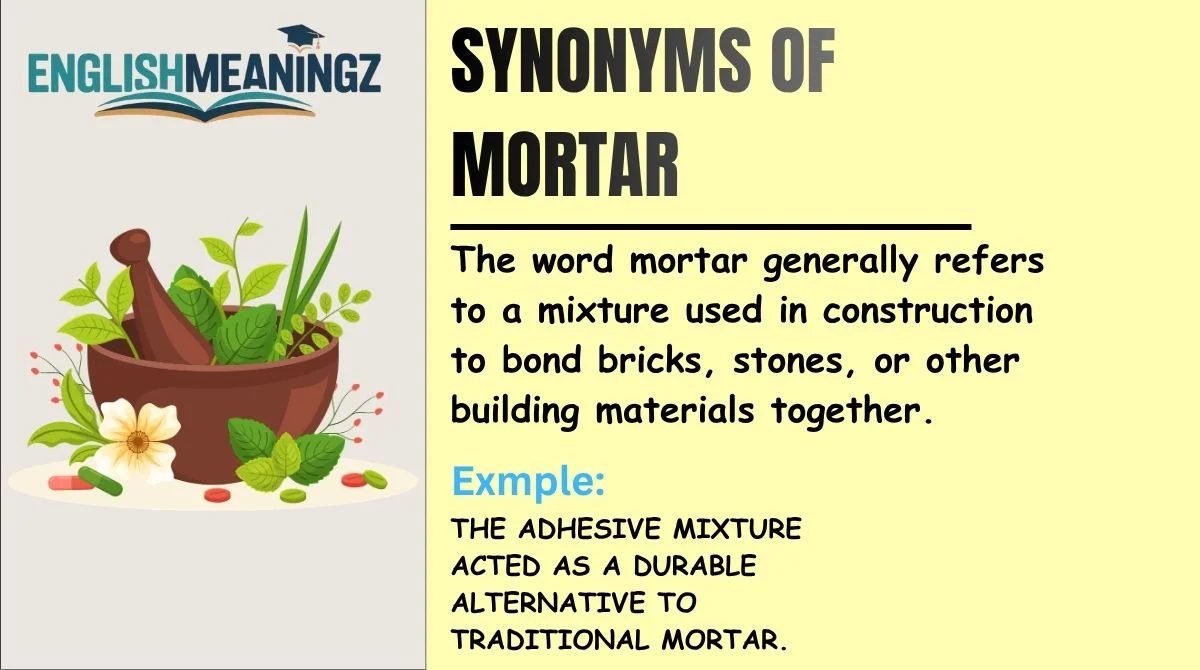
The word mortar generally refers to a mixture used in construction to bond bricks, stones, or other building materials together. It is typically composed of materials such as cement, sand, and water.
In a broader sense, mortar functions as a binding agent that strengthens structures and fills gaps between building elements.
Mortar has two main contexts:
- Construction Context – a paste used to hold bricks or stones together in walls and buildings.
- Military Context – a short, portable artillery weapon designed to fire explosive shells at high angles.
In everyday language, the construction meaning is the most commonly used.
Understanding the specific context is essential before choosing a synonym because some alternatives emphasize bonding, while others refer to mixtures or structural materials.
24 Synonyms Grouped by Context
General Use
These synonyms are commonly used when referring to binding or joining materials.
Binder
Meaning: A substance that holds materials together.
Context: Often used in construction, chemistry, and manufacturing.
Example sentence:
The mason applied a strong binder to ensure the bricks stayed firmly in place.
Adhesive
Meaning: A substance used to stick objects together.
Context: Used in both construction and everyday materials like glue.
Example sentence:
The adhesive mixture acted as a durable alternative to traditional mortar.
Cement
Meaning: A powder that forms a binding paste when mixed with water.
Context: Frequently used in construction as a component of mortar.
Example sentence:
The workers mixed cement carefully before applying it between the bricks.
Paste
Meaning: A thick, soft mixture used for bonding or coating.
Context: Informal or descriptive references to mortar-like substances.
Example sentence:
The builder spread the paste evenly across the stone surface.
Compound
Meaning: A mixture of different materials combined for a purpose.
Context: Used in technical descriptions of construction mixtures.
Example sentence:
The compound used in the wall structure ensured long-term durability.
Slurry
Meaning: A semi-liquid mixture of solid particles suspended in liquid.
Context: Often used in engineering and construction.
Example sentence:
A slurry of sand and cement filled the gaps between the stones.
Formal & Academic Writing
These synonyms are suitable for academic essays, research papers, or technical writing.
Bonding Agent
Meaning: A substance that strengthens adhesion between materials.
Context: Engineering, architecture, and materials science.
Example sentence:
The bonding agent improved the structural stability of the brickwork.
Binding Material
Meaning: A material used to hold elements together.
Context: Used in technical discussions of construction materials.
Example sentence:
The binding material ensured the masonry remained intact for decades.
Cementitious Material
Meaning: A substance with properties similar to cement.
Context: Scientific and engineering writing.
Example sentence:
Researchers studied the durability of the cementitious material in humid environments.
Grout
Meaning: A fluid mixture used to fill gaps between tiles or bricks.
Context: Construction and interior finishing.
Example sentence:
The technician applied grout to seal the spaces between the tiles.
Masonry Mix
Meaning: A prepared mixture used in masonry construction.
Context: Professional construction terminology.
Example sentence:
The masonry mix hardened quickly, strengthening the wall.
Binding Compound
Meaning: A specialized mixture used to connect construction materials.
Context: Academic and technical engineering texts.
Example sentence:
The binding compound improved resistance to environmental damage.
Informal Usage
These synonyms may appear in everyday descriptions or casual discussions.
Glue
Meaning: A substance used to stick materials together.
Context: Informal comparison to mortar.
Example sentence:
Mortar works like glue that holds the bricks in place.
Mud
Meaning: A soft mixture resembling wet soil.
Context: Informal description used by builders or laypersons.
Example sentence:
The workers mixed the mud before spreading it across the brick surface.
Mix
Meaning: A combination of ingredients blended together.
Context: Casual reference to mortar preparation.
Example sentence:
The construction team prepared a fresh mix before continuing the wall.
Goo
Meaning: A sticky or thick substance.
Context: Very informal or descriptive usage.
Example sentence:
The goo between the bricks eventually hardened into a solid bond.
Slop
Meaning: A wet, messy mixture.
Context: Casual language sometimes used by workers.
Example sentence:
They spread the slop between the stones to secure them.
Technical or Subject-Specific Use
These synonyms appear mainly in engineering, architecture, or specialized fields.
Plaster
Meaning: A smooth mixture used to coat walls and ceilings.
Context: Interior construction and finishing.
Example sentence:
The plaster provided a protective layer over the brick structure.
Render
Meaning: A coating applied to exterior walls.
Context: Architecture and building design.
Example sentence:
The render improved the wall’s weather resistance.
Concrete Paste
Meaning: The binding component of concrete composed of cement and water.
Context: Civil engineering discussions.
Example sentence:
Concrete paste acts as the primary bonding element within the structure.
Lime Mortar
Meaning: A traditional mortar made with lime instead of cement.
Context: Historic building restoration.
Example sentence:
Architects often use lime mortar when restoring ancient buildings.
Polymer Binder
Meaning: A modern bonding material used in advanced construction.
Context: Materials science and engineering.
Example sentence:
The polymer binder improved the flexibility of the masonry joints.
Structural Binder
Meaning: A material responsible for maintaining structural integrity.
Context: Technical engineering usage.
Example sentence:
The structural binder ensured the stability of the entire wall system.
Sealant Compound
Meaning: A mixture used to fill and seal gaps.
Context: Construction finishing and maintenance.
Example sentence:
The sealant compound prevented water from entering the joints.
Word Intensity & Tone Comparison Table
| Synonym | Formality Level | Strength of Meaning | Typical Context |
|---|---|---|---|
| Binder | Medium | Moderate | Construction |
| Adhesive | Medium | Moderate | General bonding |
| Cement | Medium | Strong | Construction |
| Bonding Agent | High | Strong | Engineering |
| Binding Material | High | Moderate | Academic |
| Grout | Medium | Specific | Tile installation |
| Glue | Low | Mild | Informal speech |
| Plaster | Medium | Moderate | Wall finishing |
| Render | Medium | Moderate | Exterior walls |
| Polymer Binder | High | Strong | Advanced materials |
Common Mistakes When Using These Synonyms
Mistake 1: Confusing Cement with Mortar
Incorrect:
The workers used cement to hold the bricks together.
Correct:
The workers used mortar, which contains cement, sand, and water.
Explanation:
Cement is an ingredient of mortar, not the complete mixture.
Mistake 2: Using Glue in Formal Writing
Incorrect:
The bricks were joined using glue.
Correct:
The bricks were joined using a bonding agent.
Explanation:
“Glue” sounds informal and is unsuitable for academic writing.
Mistake 3: Using Grout Incorrectly
Incorrect:
Grout was used to build the entire wall.
Correct:
Grout was used to fill small gaps between tiles.
Explanation:
Grout is typically used for finishing rather than structural bonding.
Synonyms in Academic Writing
Example Paragraph 1
In modern architecture, selecting the appropriate bonding agent is essential for maintaining structural durability. Traditional mortar mixtures are increasingly supplemented with advanced cementitious materials that improve strength and resistance to environmental damage. Researchers continue to develop innovative binding compounds to enhance construction sustainability.
Example Paragraph 2
Historical buildings often rely on lime mortar rather than modern cement-based mixtures. This traditional binding material allows walls to breathe and prevents structural cracking. As a result, conservation experts prefer lime-based masonry mixes when restoring heritage structures.
IELTS & Exam Writing Tips
Students preparing for academic exams often lose marks due to repetitive vocabulary. Replacing repeated words with appropriate synonyms can significantly improve writing scores.
How to Avoid Repetition
Instead of repeating “mortar,” writers can alternate with:
- bonding agent
- binding material
- masonry mix
- cementitious compound
When NOT to Replace the Word
Synonyms should only be used when they preserve the original meaning. For example:
- In technical engineering reports, “mortar” may be the most accurate term.
- Substituting with informal words like “goo” can reduce academic credibility.
The key strategy is precision over variety.
Similar Words vs True Synonyms
Many words appear similar to mortar but differ in meaning.
Cement vs Mortar
- Cement is a component.
- Mortar is the final mixture.
Concrete vs Mortar
- Concrete contains gravel or aggregate.
- Mortar does not include large aggregates.
Grout vs Mortar
- Grout fills gaps.
- Mortar bonds bricks or stones.
Understanding these distinctions prevents miscommunication in technical writing.
Practice Sentences
- The builder applied fresh ______ between the bricks to strengthen the wall.
- Engineers developed a new ______ agent to increase durability.
- The tiles were sealed using ______ to prevent water leakage.
- Conservation experts restored the old building using ______ mortar.
- The construction team mixed a fresh ______ before continuing the structure.
FAQs
What is the closest synonym for mortar in construction?
The closest synonym is bonding agent or binder, as both refer to substances used to hold materials together.
Is cement the same as mortar?
No. Cement is an ingredient used to create mortar. Mortar also contains sand and water.
What word can replace mortar in academic writing?
Academic alternatives include cementitious material, binding compound, or bonding agent.
Can grout be used as a synonym for mortar?
Not always. Grout fills gaps between tiles or stones but does not usually serve as the main structural binder.
Why is using synonyms important in writing?
Synonyms improve readability, reduce repetition, and demonstrate strong vocabulary skills, which is especially useful in academic and exam writing.
Conclusion
Expanding vocabulary is one of the most effective ways to strengthen writing skills. By learning multiple synonyms for commonly used words like mortar, writers can communicate ideas more clearly while avoiding repetition.
Students preparing for exams, bloggers creating engaging content, and professionals writing reports can benefit greatly from understanding how different synonyms function in specific contexts.
However, the most important principle is choosing the word that best fits the situation.
With consistent practice and careful attention to meaning and tone, anyone can develop a more versatile and powerful writing style.