Vocabulary variety is one of the most important factors in effective writing.
Whether you are a student preparing for academic exams, a blogger creating engaging articles, or a professional writing reports, using the same word repeatedly can weaken the quality of your work.
Replacing common words with appropriate synonyms improves clarity, style, and reader engagement.
The word “look” is extremely common in English. Writers often repeat it many times in essays, emails, and articles.
However, strong writers use alternative words to express slightly different meanings, tones, and contexts. This variety makes writing more professional and polished.
For students preparing for exams such as IELTS, TOEFL, or university assessments, vocabulary diversity can significantly improve writing scores.
Similarly, bloggers and content creators benefit from using synonyms because search engines reward natural and varied language.
This guide presents 16 powerful synonyms for the word “look”, explains when to use them, and provides practical examples for academic and professional writing.
Definition and Core Meaning of “Look”
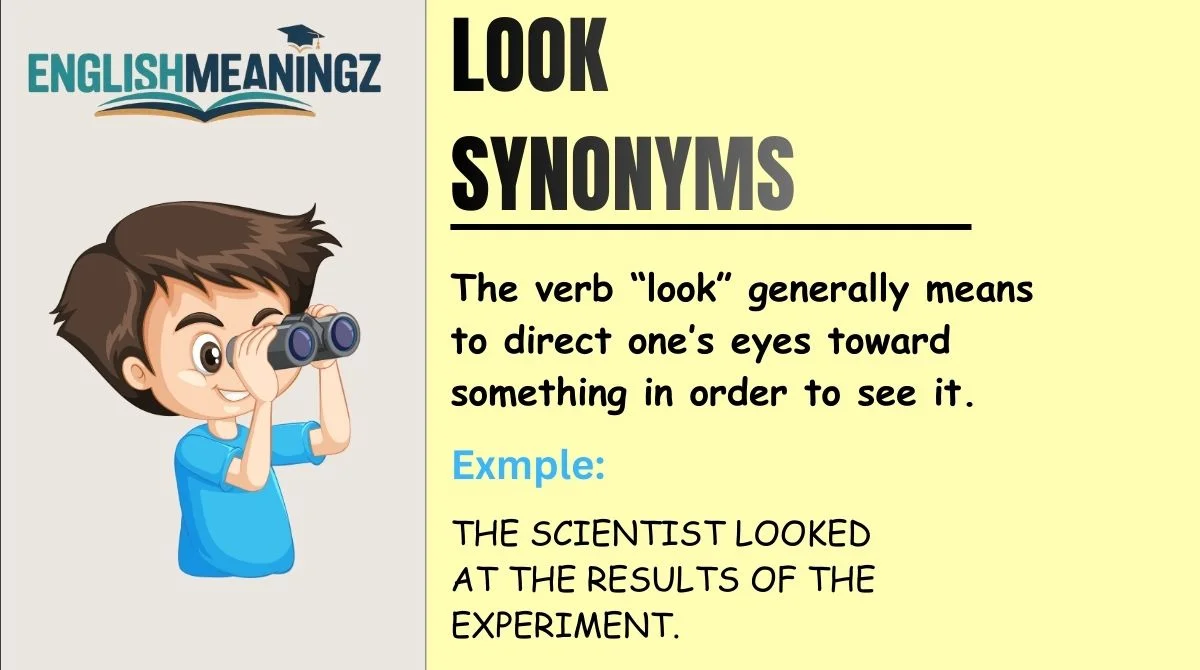
The verb “look” generally means to direct one’s eyes toward something in order to see it. It is used when someone intentionally observes, examines, or pays visual attention to an object, person, or situation.
In its simplest form, “look” describes the act of seeing with intention rather than simply noticing something. It can also be used figuratively to mean examining, searching, or evaluating something.
For example:
- She looked at the document carefully.
- Please look at the instructions before starting.
- The scientist looked at the results of the experiment.
However, depending on the context, “look” can imply different levels of attention. Sometimes the observation is quick and casual, while other times it is detailed and analytical. This is where synonyms become useful. Different alternatives communicate specific intentions, such as examining, observing, glancing, or studying.
16 Synonyms Grouped by Context
General Use
Observe
Meaning:
To watch or notice something carefully.
Context Explanation:
“Observe” is commonly used when someone is paying attention to something over time, often to understand behavior or patterns.
Example Sentence:
The researcher observed the animals in their natural habitat.
Watch
Meaning:
To look at something for a period of time, especially when something is moving or changing.
Context Explanation:
Often used when viewing events such as movies, sports, or performances.
Example Sentence:
They watched the sunset from the beach.
Notice
Meaning:
To become aware of something visually.
Context Explanation:
This word implies that the observation may be brief but meaningful.
Example Sentence:
She noticed a mistake in the report immediately.
View
Meaning:
To look at something deliberately, often with interest or purpose.
Context Explanation:
Common in formal contexts such as art, presentations, or data analysis.
Example Sentence:
Visitors viewed the paintings in the gallery.
Formal & Academic Writing
Examine
Meaning:
To inspect something carefully and in detail.
Context Explanation:
Frequently used in academic, medical, and research settings.
Example Sentence:
The scientist examined the sample under a microscope.
Analyze
Meaning:
To study something carefully in order to understand it.
Context Explanation:
Common in research papers and academic discussions.
Example Sentence:
The study analyzes the effects of climate change on agriculture.
Inspect
Meaning:
To look at something carefully to ensure quality or safety.
Context Explanation:
Often used in engineering, construction, or official evaluations.
Example Sentence:
The engineer inspected the bridge structure.
Review
Meaning:
To examine something again for evaluation.
Context Explanation:
Used when assessing documents, research, or performance.
Example Sentence:
The committee reviewed the project proposal.
Informal Usage
Glance
Meaning:
To look quickly at something.
Context Explanation:
Used when the observation lasts only a moment.
Example Sentence:
He glanced at his watch during the meeting.
Peek
Meaning:
To look quickly or secretly.
Context Explanation:
Often used in casual conversation or storytelling.
Example Sentence:
The child peeked through the door.
Stare
Meaning:
To look at something for a long time, often with surprise or curiosity.
Context Explanation:
Usually implies intense or sometimes impolite attention.
Example Sentence:
People stared at the unusual sculpture.
Gaze
Meaning:
To look steadily with admiration or deep thought.
Context Explanation:
Often used in descriptive or emotional writing.
Example Sentence:
She gazed at the stars in silence.
Technical or Subject-Specific Use
Scan
Meaning:
To look over something quickly to find specific information.
Context Explanation:
Common in academic reading and digital contexts.
Example Sentence:
Students scanned the article for key statistics.
Survey
Meaning:
To examine a large area or situation carefully.
Context Explanation:
Used in geography, research, and planning.
Example Sentence:
The team surveyed the construction site.
Scrutinize
Meaning:
To examine something extremely carefully.
Context Explanation:
Used when details are very important.
Example Sentence:
Auditors scrutinized the financial records.
Monitor
Meaning:
To observe something continuously to track changes.
Context Explanation:
Used in science, healthcare, and technology.
Example Sentence:
Doctors monitor the patient’s heart rate.
Word Intensity & Tone Comparison Table
| Word | Formal Level | Intensity | Typical Context |
|---|---|---|---|
| Look | Neutral | Low | Everyday use |
| Observe | Formal | Medium | Research, science |
| Examine | Very formal | High | Academic studies |
| Analyze | Very formal | Very high | Data evaluation |
| Watch | Neutral | Medium | Events, activities |
| Glance | Informal | Low | Quick observation |
| Stare | Informal | High | Strong attention |
| Scan | Formal | Medium | Reading, searching |
| Scrutinize | Very formal | Very high | Detailed inspection |
| Monitor | Formal | Continuous | Tracking changes |
This comparison helps writers select words that match both tone and level of analysis.
Common Mistakes When Using These Synonyms
Many learners assume that all synonyms can replace each other. However, each word carries specific nuances.
Mistake 1: Using “stare” in formal writing
Incorrect:
The researcher stared at the data.
Correct:
The researcher analyzed the data.
Explanation:
“Stare” sounds informal and emotional, while “analyze” is appropriate for academic writing.
Mistake 2: Confusing “scan” and “scrutinize”
Incorrect:
The auditor scanned every detail of the contract.
Correct:
The auditor scrutinized every detail of the contract.
Explanation:
“Scan” implies quick reading, while “scrutinize” suggests detailed examination.
Mistake 3: Using “watch” for static objects
Incorrect:
She watched the painting carefully.
Correct:
She examined the painting carefully.
Explanation:
“Watch” is typically used for movement or events.
Synonyms in Academic Writing
Example Paragraph 1
Modern researchers analyze environmental data to understand climate patterns. Scientists often observe natural ecosystems over long periods in order to identify changes in biodiversity. In addition, satellite technology allows experts to monitor environmental conditions across large geographic regions.
Example Paragraph 2
Economic analysts frequently examine financial indicators to evaluate market stability. By carefully reviewing historical trends, researchers can scrutinize the factors that influence economic growth and development.
These examples show how academic writing benefits from precise vocabulary rather than repeating “look.”
IELTS & Exam Writing Tips
Students preparing for English proficiency exams often lose marks because of repetitive vocabulary.
1. Use synonyms naturally
Instead of repeating “look,” vary your language depending on the context:
- observe trends
- examine evidence
- analyze results
2. Do not replace words blindly
Some sentences require the simple verb “look.” Overusing complex synonyms can make writing unnatural.
Example:
Correct:
Please look at the chart below.
Using “scrutinize” here would sound excessive.
3. Match the tone
Academic essays prefer formal verbs such as:
- analyze
- examine
- observe
- review
Avoid casual words like “peek” in exam essays.
Similar Words vs True Synonyms
Some words appear similar but carry different meanings.
Look vs See
“See” often happens automatically, while “look” is intentional.
Example:
I saw the bird.
I looked at the bird.
Look vs Watch
“Watch” is used for moving or ongoing actions.
Example:
They watched the football match.
Look vs Examine
“Examine” implies careful analysis.
Example:
The doctor examined the patient.
Understanding these distinctions helps writers choose the most precise word.
Practice Sentences
Fill in the blank with the most suitable synonym.
- The scientist carefully ______ the chemical reaction.
- She quickly ______ at her phone during the meeting.
- Engineers ______ the building for safety issues.
- Students should ______ the data before writing conclusions.
- The teacher asked the class to ______ the chart on the board.
- Auditors ______ financial records for accuracy.
- Visitors ______ the ancient artifacts in the museum.
- The manager ______ employee performance throughout the year.
Possible answers: observe, glance, inspect, analyze, look, scrutinize, view, monitor.
FAQs
What are the best synonyms for “look”?
Some of the most useful alternatives include observe, examine, analyze, glance, watch, inspect, review, and scrutinize. The best choice depends on context and level of formality.
Which synonym is best for academic writing?
Words like analyze, examine, observe, and review are ideal for academic essays and research papers.
Is “see” a synonym for “look”?
They are related but not identical. “See” usually happens automatically, while “look” requires intention.
What is a formal alternative to “look at”?
Formal alternatives include examine, analyze, inspect, review, and assess.
Why should writers use synonyms?
Using synonyms improves clarity, prevents repetition, and strengthens writing quality in essays, reports, and professional communication.
Conclusion
Expanding vocabulary is one of the most effective ways to improve writing quality. The word “look” is useful but extremely common, and relying on it too often can weaken both academic and professional writing.
By learning synonyms such as observe, examine, analyze, glance, scrutinize, and monitor, writers gain the ability to express more precise meanings and communicate ideas more clearly.
Students preparing for exams benefit from higher vocabulary scores, while bloggers and professionals produce more engaging and polished content.
Consistent vocabulary practice, reading diverse materials, and using new words in real sentences will gradually strengthen your language skills.
Over time, these improvements will make your writing more confident, persuasive, and effective.