Vocabulary diversity plays a critical role in strong academic and professional writing. Repeating the same word multiple times can weaken clarity, reduce engagement, and lower writing scores in academic assessments.
For students preparing for exams, bloggers creating informative content, and professionals writing reports, the ability to use accurate synonyms improves both readability and credibility.
One commonly used word in analytical and research writing is “discrepancy.” While it effectively describes a difference or inconsistency, relying on it too frequently can make writing appear repetitive.
Learning alternative words allows writers to convey subtle differences in tone, formality, and meaning.
This guide explores 26 discrepancy synonyms, explaining their meanings, contexts, and proper usage with examples.
By understanding when and how to use these alternatives, writers can strengthen essays, research papers, business documents, and examination responses.
Definition and Core Meaning of “Discrepancy”
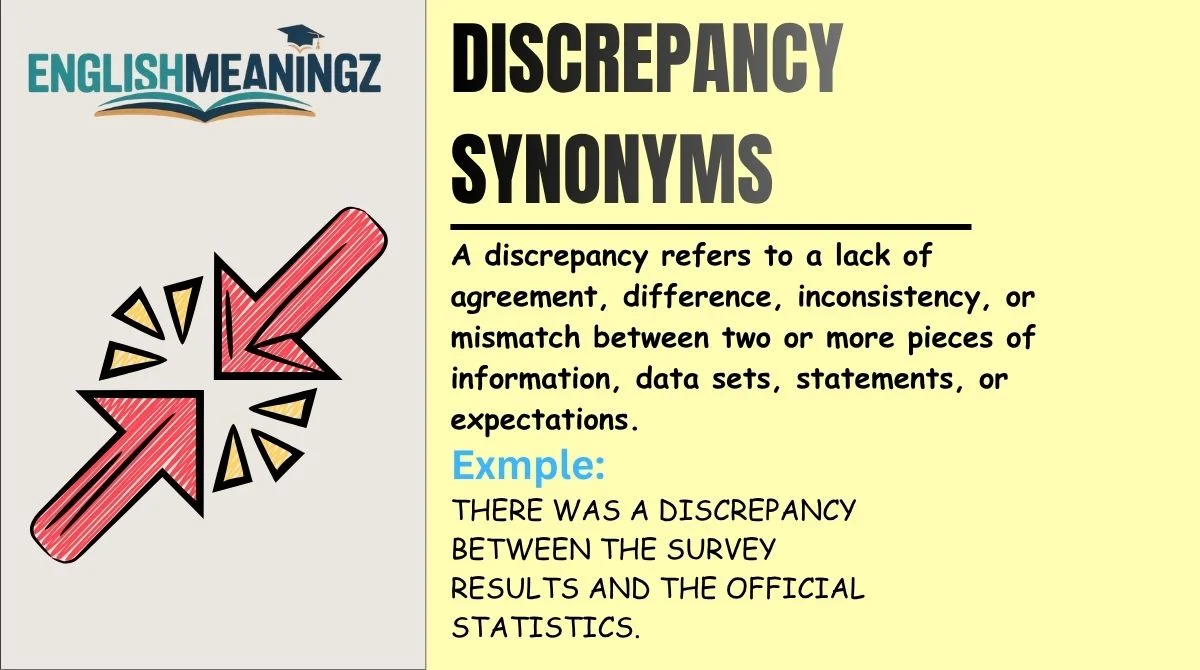
A discrepancy refers to a lack of agreement, difference, inconsistency, or mismatch between two or more pieces of information, data sets, statements, or expectations.
In academic and professional contexts, the word is often used to describe situations where:
- Data does not match expected results
- Two reports contain conflicting information
- Numbers or records differ from each other
- Observations contradict assumptions
For example:
There was a discrepancy between the survey results and the official statistics.
In research writing, identifying discrepancies is important because it helps researchers evaluate errors, refine theories, and improve accuracy.
26 Synonyms Grouped by Context
General Use
These synonyms can be used in everyday writing and general explanations.
Difference
Meaning: A distinction or lack of similarity between two things.
Context: Used broadly in everyday conversation and writing.
Example:
There was a noticeable difference between the two financial reports.
Inconsistency
Meaning: A lack of uniformity or logical agreement.
Context: Common in analytical or evaluative writing.
Example:
The auditor discovered an inconsistency in the company’s records.
Mismatch
Meaning: Two elements that do not correspond or fit together properly.
Context: Used when comparing data, expectations, or systems.
Example:
A mismatch between demand and supply caused market instability.
Gap
Meaning: A significant difference between two quantities or situations.
Context: Often used in economics, education, or policy discussions.
Example:
There is a growing gap between urban and rural income levels.
Variation
Meaning: A difference in condition, amount, or level.
Context: Frequently used in research and statistical analysis.
Example:
Minor variations were observed in the experimental results.
Imbalance
Meaning: A lack of balance or equality.
Context: Common in social sciences and economic discussions.
Example:
The policy created an economic imbalance between regions.
Divergence
Meaning: A separation or departure from a common point.
Context: Used when opinions, trends, or results move in different directions.
Example:
There was a clear divergence between theoretical predictions and actual outcomes.
Formal & Academic Writing
These synonyms are particularly suitable for essays, reports, and research papers.
Disparity
Meaning: A great inequality or noticeable difference.
Context: Often used in discussions of social, economic, or statistical inequality.
Example:
The study highlights a significant disparity in healthcare access.
Deviation
Meaning: A departure from a standard or expected value.
Context: Common in statistics and scientific research.
Example:
The experiment showed a slight deviation from the predicted results.
Contradiction
Meaning: A situation where two statements oppose each other.
Context: Used in logical analysis or argument evaluation.
Example:
The witness’s testimony contained a clear contradiction.
Anomaly
Meaning: Something that deviates from what is normal or expected.
Context: Often used in scientific studies.
Example:
Researchers identified an anomaly in the climate data.
Irregularity
Meaning: A departure from normal rules or patterns.
Context: Used in finance, auditing, and administrative reports.
Example:
The investigation uncovered financial irregularities.
Variance
Meaning: The degree of difference or spread between values.
Context: Common in statistics and data analysis.
Example:
The variance between the two datasets was minimal.
Incongruity
Meaning: Lack of harmony or compatibility.
Context: Used in formal writing, literature, and analysis.
Example:
The researcher noted an incongruity between theory and evidence.
Informal Usage
These synonyms are useful in casual writing or conversation.
Conflict
Meaning: A disagreement or clash between ideas or facts.
Example:
There is a conflict between the two reports.
Disagreement
Meaning: Lack of consensus or agreement.
Example:
The committee expressed disagreement over the findings.
Contrast
Meaning: A noticeable difference when compared.
Example:
The contrast between the two strategies is clear.
Offset
Meaning: A difference that balances or compensates for another.
Example:
Higher costs were offset by increased productivity.
Technical or Subject-Specific Use
These synonyms are often used in specialized fields such as statistics, research, or data analysis.
Error
Meaning: A mistake or inaccuracy in measurement or calculation.
Example:
A calculation error caused the discrepancy in totals.
Margin
Meaning: The amount by which one figure differs from another.
Example:
The results differed within a small margin of error.
Fluctuation
Meaning: Irregular movement or variation.
Example:
Price fluctuations affected the final figures.
Distortion
Meaning: Misrepresentation of information.
Example:
Data distortion can lead to incorrect conclusions.
Disproportion
Meaning: A lack of proper balance between elements.
Example:
There is a disproportion between funding and research output.
Departure
Meaning: A deviation from a standard pattern.
Example:
The results show a significant departure from expectations.
Disunity
Meaning: Lack of agreement or coherence.
Example:
The report revealed disunity among team findings.
Divergence (Technical Sense)
Meaning: Gradual separation between two trends or datasets.
Example:
Economic indicators show a divergence between inflation and wage growth.
Word Intensity & Tone Comparison Table
| Word | Formal Level | Emotional Strength | Typical Context |
|---|---|---|---|
| Difference | Neutral | Low | General writing |
| Gap | Neutral | Medium | Social or economic discussions |
| Disparity | Formal | Medium | Academic analysis |
| Inconsistency | Formal | Medium | Logical evaluation |
| Deviation | Highly formal | Low | Scientific research |
| Contradiction | Formal | High | Debate or argument |
| Anomaly | Formal | Medium | Scientific research |
| Error | Neutral | Low | Data or calculation |
| Conflict | Informal-neutral | Medium | General discussion |
| Distortion | Formal | High | Critical analysis |
This comparison helps writers choose synonyms that match the tone and context of their writing.
Common Mistakes When Using These Synonyms
Mistake 1: Using “Contradiction” Instead of “Difference”
Incorrect:
The survey results showed a contradiction between male and female preferences.
Correct:
The survey results showed a difference between male and female preferences.
Explanation:
“Contradiction” implies direct opposition, not just variation.
Mistake 2: Using “Error” in Analytical Discussion
Incorrect:
There is an error between the two economic models.
Correct:
There is a discrepancy between the two economic models.
Explanation:
“Error” suggests a mistake, while discrepancy indicates inconsistency.
Mistake 3: Overusing “Gap”
Incorrect:
The gap between theory and data suggests methodological issues.
Correct:
The divergence between theory and data suggests methodological issues.
Explanation:
More precise academic terms improve clarity.
Synonyms in Academic Writing
Example Paragraph 1
The research revealed a significant disparity between urban and rural education outcomes. While urban institutions demonstrated high performance indicators, rural schools showed limited access to resources and trained educators. This imbalance suggests that educational policy must focus on equitable distribution of funding and infrastructure.
Example Paragraph 2
During statistical analysis, researchers discovered a slight deviation between predicted and observed results. Although the variance remained within acceptable limits, the anomaly prompted further investigation into measurement techniques and data collection methods.
IELTS & Exam Writing Tips
Avoid Repetition
Instead of repeating one word, rotate synonyms carefully.
Example:
Weak writing:
There is a discrepancy in the results. This discrepancy shows a discrepancy in the data.
Improved writing:
There is a discrepancy in the results. This inconsistency highlights potential issues in the data.
Use Context-Appropriate Words
Different exam tasks require different tones.
- Essays → disparity, inconsistency, deviation
- Reports → variance, anomaly, irregularity
- General discussion → difference, gap
When NOT to Replace the Word
Sometimes the exact term discrepancy is the most accurate choice, particularly when referring to:
- Financial records
- Data comparison
- Audit reports
Replacing it unnecessarily can reduce clarity.
Similar Words vs True Synonyms
Many words appear similar to “discrepancy,” but they are not always interchangeable.
Difference vs Discrepancy
- Difference → general distinction
- Discrepancy → inconsistency or error between expected values
Error vs Discrepancy
- Error → definite mistake
- Discrepancy → unexplained mismatch
Contrast vs Discrepancy
- Contrast → visible difference
- Discrepancy → problematic inconsistency
Understanding these distinctions helps writers choose words accurately.
Practice Sentences
Fill in the blanks with suitable synonyms.
- Researchers observed a slight ______ between the predicted and actual values.
- The report revealed a financial ______ in the company’s accounts.
- There is a noticeable ______ between the two economic policies.
- Statistical ______ can affect the interpretation of results.
- The witness statements contained a clear ______.
Suggested answers: deviation, irregularity, difference, variance, contradiction.
FAQs
What is the best synonym for discrepancy in academic writing?
Common academic alternatives include disparity, inconsistency, deviation, variance, and anomaly.
Are discrepancy and difference the same?
Not exactly. Difference is a general distinction, while discrepancy usually refers to an unexpected inconsistency between two pieces of information.
Which synonym is best for research papers?
Words like variance, deviation, anomaly, and disparity are commonly used in research writing.
Can discrepancy mean an error?
Sometimes. A discrepancy may indicate a possible error, but it does not always mean a mistake has occurred.
How can I avoid repeating the word discrepancy?
Use context-specific alternatives such as difference, inconsistency, gap, variance, or divergence depending on the topic.
Conclusion
Developing a strong vocabulary is essential for effective academic and professional communication. Words like discrepancy are valuable for analytical writing, but relying on a single term repeatedly can weaken clarity and style.
By understanding and applying the 26 discrepancy synonyms presented in this guide, writers can:
- Improve essay and research quality
- Avoid repetition
- Express ideas more precisely
- Strengthen professional communication
Consistent vocabulary practice allows students, bloggers, and professionals to produce more engaging and authoritative writing.