Understanding opposites is one of the fastest ways to elevate your writing from average to authoritative. When you learn how to replace a word with its conceptual opposite, you gain precision, flexibility, and stylistic control.
This is especially important in modern communication, where clarity and tone can influence how your message is received across digital platforms.
In academic and professional contexts, using the right antonym can completely shift meaning, strengthen arguments, and improve readability.
Writers, marketers, and educators frequently rely on contrast to explain ideas—making antonyms not just vocabulary tools, but strategic communication assets.
This article explores powerful alternatives to the word “infographic,” helping you understand not just what the opposites are, but when and why to use them effectively.
What Does “Infographic” Mean?
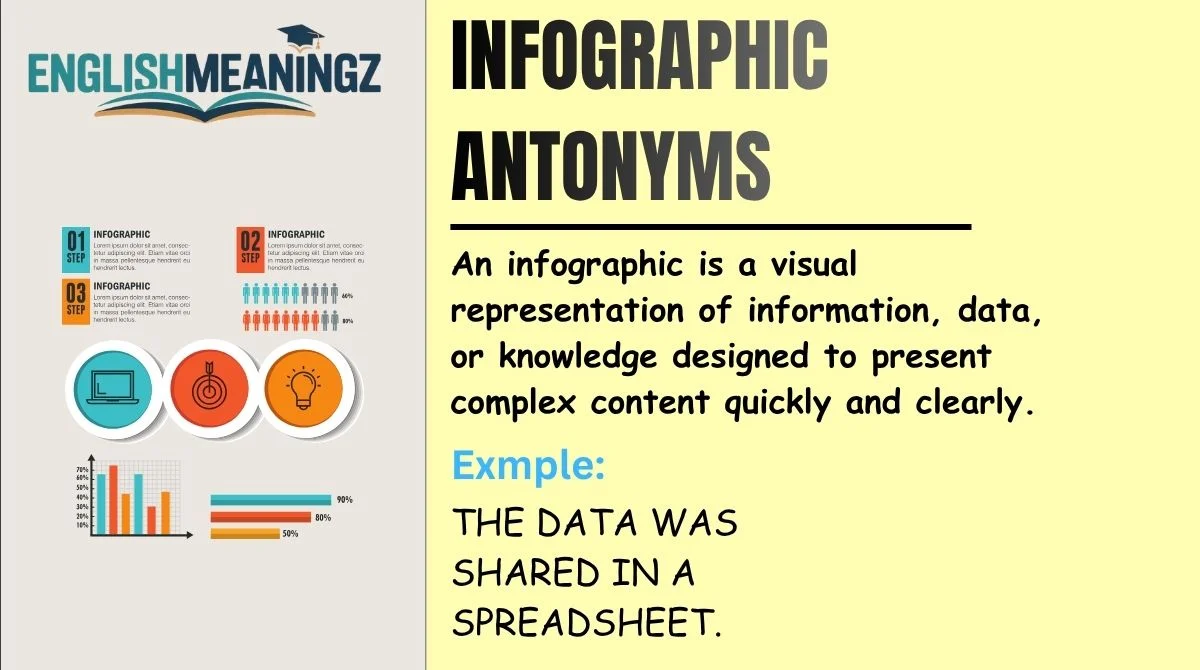
An infographic is a visual representation of information, data, or knowledge designed to present complex content quickly and clearly. It combines graphics, charts, icons, and minimal text to enhance understanding.
Tone Explanation
The tone of “infographic” is typically informative, modern, and visual-driven. It suggests efficiency, clarity, and accessibility.
Emotional or Action Intensity
Infographics carry a high-impact, low-effort perception—they simplify complex ideas into digestible visuals, reducing cognitive load and speeding up comprehension.
22 Best Antonyms for “Infographic”
1. Text-heavy document
Meaning: Content dominated by written words
Tone: Academic
Example: The report was a text-heavy document with no visuals.
Why Opposite: Infographics minimize text, while this maximizes it.
2. Plain text
Meaning: Unformatted written content
Tone: Neutral
Example: The instructions were given in plain text.
Why Opposite: Lacks visual elements entirely.
3. Narrative essay
Meaning: A detailed written story or explanation
Tone: Academic
Example: She explained the concept through a narrative essay.
Why Opposite: Focuses on storytelling rather than visual summarization.
4. Raw data
Meaning: Unprocessed numbers or facts
Tone: Technical
Example: The analyst presented raw data without visuals.
Why Opposite: Infographics interpret data; raw data does not.
5. Verbal explanation
Meaning: Spoken or written explanation
Tone: Formal
Example: The teacher gave a verbal explanation instead of visuals.
Why Opposite: Relies on words instead of visuals.
6. Detailed report
Meaning: In-depth written analysis
Tone: Professional
Example: The company released a detailed report on performance.
Why Opposite: Reports are lengthy; infographics are concise.
7. Spreadsheet
Meaning: Organized numerical data in rows and columns
Tone: Technical
Example: The data was shared in a spreadsheet.
Why Opposite: Functional, not visually engaging.
8. Manuscript
Meaning: Written draft or document
Tone: Formal
Example: The manuscript lacked any graphical representation.
Why Opposite: Purely textual format.
9. Lecture notes
Meaning: Written summaries from a lecture
Tone: Academic
Example: Students relied on lecture notes instead of visuals.
Why Opposite: Linear and text-based.
10. Plain report
Meaning: Simple written document without visuals
Tone: Formal
Example: The findings were presented in a plain report.
Why Opposite: No design or visual storytelling.
11. Data dump
Meaning: Large amount of unorganized data
Tone: Informal
Example: The presentation felt like a data dump.
Why Opposite: Overwhelming vs simplified.
12. Prose content
Meaning: Continuous written text
Tone: Academic
Example: The article was written in prose content only.
Why Opposite: No visual breakdown.
13. Written summary
Meaning: Brief text-based overview
Tone: Neutral
Example: He provided a written summary instead.
Why Opposite: Uses words instead of visuals.
14. Analytical paper
Meaning: Detailed academic writing
Tone: Academic
Example: The research was published as an analytical paper.
Why Opposite: Deep analysis vs quick visual insight.
15. Textual explanation
Meaning: Explanation using only text
Tone: Formal
Example: The guide relied on textual explanation.
Why Opposite: No visual support.
16. Documentation
Meaning: Recorded written information
Tone: Professional
Example: The process was explained in documentation.
Why Opposite: Functional, not visual.
17. Essay
Meaning: Structured written composition
Tone: Academic
Example: The topic was explored in an essay.
Why Opposite: Long-form writing vs visual summary.
18. White paper
Meaning: Authoritative report or guide
Tone: Professional
Example: The company released a white paper.
Why Opposite: Detailed and text-heavy.
19. Paragraph block
Meaning: Dense chunk of text
Tone: Informal
Example: The page had a large paragraph block.
Why Opposite: Hard to scan vs easy to scan.
20. Script
Meaning: Written dialogue or narration
Tone: Creative
Example: The explanation was written as a script.
Why Opposite: Sequential text vs visual structure.
21. Journal article
Meaning: Scholarly written work
Tone: Academic
Example: The findings appeared in a journal article.
Why Opposite: Research-focused, text-dense.
22. Textual data presentation
Meaning: Data shown in written format
Tone: Technical
Example: The results were shown as textual data presentation.
Why Opposite: No visual simplification.
Strong vs Mild Opposites
Not all antonyms carry the same level of contrast. Some are direct opposites, while others are partial or contextual.
Strong Opposites:
- Raw data
- Data dump
- Spreadsheet
These completely remove the visual and simplified nature of infographics.
Mild Opposites:
- Written summary
- Essay
- Documentation
These still communicate information but lack visual enhancement.
Understanding intensity helps you choose the right word based on how sharply you want to contrast your message.
Context-Based Opposites
Antonyms change depending on context. “Infographic” can have different opposites depending on usage:
- In marketing: “Text-heavy blog post”
- In education: “Lecture notes”
- In data science: “Raw dataset”
- In presentations: “Verbal briefing”
This shows that antonyms are not always fixed—they adapt to the situation.
Common Mistakes When Using Opposites
1. Confusing format with meaning
Wrong: Using “video” as an antonym
Correct: Focus on text vs visual simplification
2. Choosing weak contrasts
Wrong: “Short article”
Correct: “Data dump” or “raw data”
3. Ignoring tone
Wrong: Using informal antonyms in academic writing
Correct: Use “analytical paper” or “journal article”
4. Overgeneralizing
Wrong: Assuming all text is opposite
Correct: Some text formats still simplify information
Sentence Transformation Examples
Original → With Antonym
- The infographic made the data easy to understand.
→ The raw data made the information difficult to interpret. - She designed an infographic for the presentation.
→ She prepared a detailed report for the presentation. - The infographic summarized the research.
→ The analytical paper explored the research in depth. - The infographic simplified complex statistics.
→ The spreadsheet displayed complex statistics without simplification. - The infographic helped visualize trends.
→ The text-heavy document described trends without visuals.
FAQs
What is the direct opposite of an infographic?
A direct opposite would be raw data or a data dump, where no visual simplification is applied.
Are antonyms always exact opposites?
No, many antonyms are context-based and vary depending on usage.
Why is “text-heavy document” an antonym?
Because it relies entirely on written content instead of visuals.
Can a report be an antonym of infographic?
Yes, especially if it is detailed and lacks visual elements.
Is a video an antonym of infographic?
No, both are visual formats, so they are not opposites.
Why should writers learn antonyms?
They improve clarity, contrast, and expressive power in writing.
How many antonyms should I use in writing?
Use them strategically, not excessively—focus on clarity and purpose.
Conclusion
Mastering antonyms for “infographic” is more than a vocabulary exercise—it’s a communication upgrade. By understanding how different formats contrast with visual storytelling, you gain the ability to choose the right medium for your message.
Whether you’re writing academically, creating content, or presenting data, knowing when to use a text-heavy alternative instead of an infographic helps you control tone, depth, and audience engagement. In 2K26, precision in language is no longer optional—it’s essential.