Understanding opposites is one of the most underrated skills in advanced writing. While most writers focus on synonyms to expand expression, antonyms create contrast—and contrast is what makes language vivid, persuasive, and intellectually sharp.
When you know how to replace or counter a word like dialogue, you gain the ability to control tone, shift emotional weight, and communicate more precisely.
This is especially important in academic, professional, and creative writing, where clarity and nuance define quality.
In professional communication, choosing the correct opposite can determine whether your message sounds collaborative or isolated, open or rigid, engaging or distant.
In academic writing, it strengthens argument structure by highlighting contrast and opposition effectively.
This guide delivers a complete, SEO-optimized breakdown of 26 antonyms for dialogue, along with meanings, tone insights, and practical examples.
What Does “Dialogue” Mean?
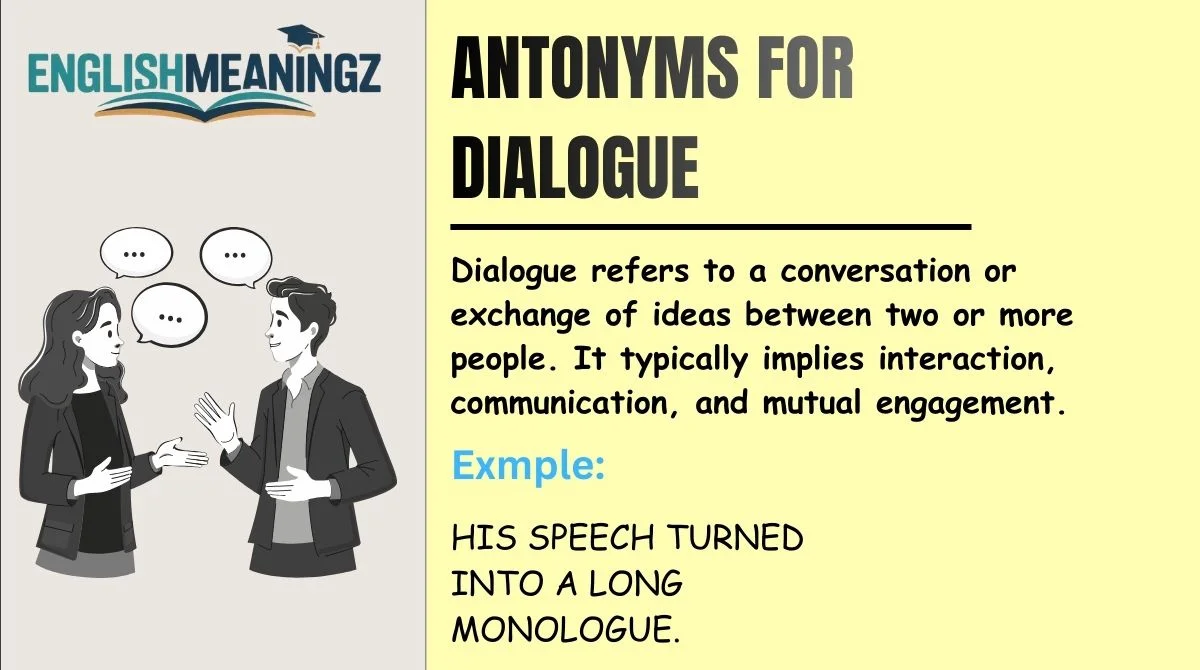
Dialogue refers to a conversation or exchange of ideas between two or more people. It typically implies interaction, communication, and mutual engagement.
Tone Explanation
The word carries a neutral to positive tone, often associated with cooperation, understanding, and discussion.
Emotional / Action Intensity
Dialogue suggests:
- Active participation
- Openness to ideas
- Two-way communication
It is often used in:
- Literature (character conversations)
- Diplomacy (negotiations between parties)
- Everyday communication
26 Best Antonyms for “Dialogue”
Silence
Meaning: Complete absence of sound or speech
Tone: Neutral / Emotional
Example: The room fell into silence after the announcement.
Why Opposite: Dialogue requires speech; silence removes it entirely.
Monologue
Meaning: One-sided speech
Tone: Formal / Literary
Example: His speech turned into a long monologue.
Why Opposite: Dialogue involves interaction; monologue lacks response.
Isolation
Meaning: State of being separated from others
Tone: Academic
Example: Isolation limited meaningful communication.
Why Opposite: Dialogue depends on connection, not separation.
Solitude
Meaning: Being alone
Tone: Neutral / Emotional
Example: She preferred solitude over conversation.
Why Opposite: Dialogue requires at least two participants.
Secrecy
Meaning: Keeping information hidden
Tone: Formal
Example: The deal was made in secrecy.
Why Opposite: Dialogue is open exchange; secrecy restricts it.
Suppression
Meaning: Preventing expression
Tone: Academic
Example: Suppression of ideas weakens communication.
Why Opposite: Dialogue encourages expression.
Ignorance
Meaning: Lack of knowledge or awareness
Tone: Neutral
Example: Ignorance often replaces meaningful discussion.
Why Opposite: Dialogue promotes understanding.
Avoidance
Meaning: Evading interaction
Tone: Neutral
Example: His avoidance ended any chance of discussion.
Why Opposite: Dialogue requires engagement.
Disconnection
Meaning: Lack of communication link
Tone: Academic
Example: Disconnection between teams reduced efficiency.
Why Opposite: Dialogue builds connection.
Conflict
Meaning: Disagreement or clash
Tone: Emotional
Example: Conflict replaced constructive dialogue.
Why Opposite: Dialogue aims to resolve conflict.
Argument
Meaning: Heated disagreement
Tone: Emotional
Example: The meeting turned into an argument.
Why Opposite: Dialogue is cooperative; argument is confrontational.
Silence Treatment
Meaning: Intentional refusal to speak
Tone: Informal / Emotional
Example: He gave her the silent treatment.
Why Opposite: It blocks communication completely.
Withdrawal
Meaning: Pulling away from interaction
Tone: Formal
Example: His withdrawal ended all discussion.
Why Opposite: Dialogue requires presence.
Neglect
Meaning: Ignoring communication
Tone: Neutral
Example: Neglect of feedback harms relationships.
Why Opposite: Dialogue values exchange.
Muteness
Meaning: Inability or refusal to speak
Tone: Neutral
Example: His muteness created tension.
Why Opposite: Dialogue depends on speech.
Rejection
Meaning: Refusal to accept or engage
Tone: Emotional
Example: Rejection of ideas stops communication.
Why Opposite: Dialogue invites ideas.
Silence Barrier
Meaning: Communication blockage
Tone: Academic
Example: Cultural gaps created a silence barrier.
Why Opposite: Dialogue removes barriers.
Noncommunication
Meaning: Lack of communication
Tone: Academic
Example: Noncommunication caused confusion.
Why Opposite: Dialogue is communication itself.
Detachment
Meaning: Emotional or communicative distance
Tone: Formal
Example: Detachment weakened collaboration.
Why Opposite: Dialogue requires engagement.
Exclusion
Meaning: Leaving someone out
Tone: Formal
Example: Exclusion prevents meaningful exchange.
Why Opposite: Dialogue includes participants.
Refusal
Meaning: Declining to engage
Tone: Neutral
Example: His refusal blocked discussion.
Why Opposite: Dialogue requires willingness.
Silence Policy
Meaning: Rule against speaking
Tone: Formal
Example: The silence policy discouraged feedback.
Why Opposite: Dialogue encourages speaking.
Isolationism
Meaning: Avoiding interaction with others
Tone: Academic
Example: Isolationism limits cooperation.
Why Opposite: Dialogue promotes collaboration.
Closed-mindedness
Meaning: Unwillingness to consider ideas
Tone: Emotional
Example: Closed-mindedness prevents dialogue.
Why Opposite: Dialogue needs openness.
Inaction
Meaning: Lack of response
Tone: Neutral
Example: Inaction replaced discussion.
Why Opposite: Dialogue requires active exchange.
Disregard
Meaning: Ignoring input
Tone: Formal
Example: Disregard for opinions halts communication.
Why Opposite: Dialogue values listening.
Strong vs Mild Opposites
Not all antonyms carry equal intensity. Some completely eliminate dialogue, while others only weaken it.
Strong Opposites
- Silence
- Muteness
- Noncommunication
- Isolation
These represent complete absence of dialogue.
Moderate Opposites
- Conflict
- Argument
- Rejection
- Avoidance
These involve communication but distort or oppose its purpose.
Mild Opposites
- Detachment
- Neglect
- Disregard
These weaken dialogue without fully removing it.
Understanding this scale helps you choose the most accurate word depending on context.
Context-Based Opposites
Antonyms change based on usage:
- In literature:
Dialogue ↔ Monologue - In diplomacy:
Dialogue ↔ Conflict / Refusal - In psychology:
Dialogue ↔ Isolation / Withdrawal - In workplace communication:
Dialogue ↔ Noncommunication / Disconnection
Choosing the right opposite depends on situation, tone, and purpose.
Common Mistakes When Using Opposites
Confusing Argument with Dialogue
❌ The dialogue became aggressive.
✔ The argument became aggressive.
Using Silence incorrectly
❌ They had silence about the issue.
✔ They maintained silence on the issue.
Misusing Monologue
❌ They engaged in a monologue together.
✔ They engaged in dialogue.
Overusing General Opposites
Writers often use vague words like no communication instead of precise terms like noncommunication or disconnection.
Ignoring Tone
Using conflict instead of silence changes emotional meaning significantly.
Sentence Transformation Examples
Original → Revised
- The team engaged in productive dialogue.
→ The team fell into silence. - Their dialogue solved the issue.
→ Their conflict worsened the issue. - The meeting encouraged dialogue.
→ The meeting resulted in noncommunication. - Open dialogue builds trust.
→ Secrecy destroys trust. - Dialogue improved understanding.
→ Ignorance reduced understanding.
FAQs
What is the exact opposite of dialogue?
The closest direct opposite is silence, as it completely removes communication.
Is argument an antonym of dialogue?
Yes, but partially. Argument involves communication, but in a conflicting form.
Can monologue be considered an antonym?
Yes. It represents one-sided communication, unlike dialogue.
Why are there multiple antonyms?
Because dialogue has multiple dimensions: interaction, openness, and communication.
Which antonym is best for academic writing?
Noncommunication, isolation, and suppression are more formal choices.
Is silence always negative?
Not always. It can be neutral, but in contrast to dialogue, it indicates absence.
How do I choose the right antonym?
Focus on:
- Context
- Tone
- Degree of opposition
Conclusion
Mastering antonyms for dialogue gives you a powerful linguistic advantage. It allows you to express contrast, refine arguments, and control tone with precision.
Whether you are writing academically, professionally, or creatively, choosing the right opposite enhances clarity and impact.
Instead of relying on basic opposites, use nuanced alternatives like noncommunication, detachment, or suppression to elevate your writing. The key is not just knowing words—but understanding when and how to use them effectively.