Understanding opposites is one of the fastest ways to sharpen your writing. When you know not only what a word means but also what it does not mean, your ability to express nuance improves dramatically.
This is especially true for sophisticated words like “presage,” which often appear in academic, literary, and professional contexts.
Using antonyms strategically allows you to control tone, contrast ideas, and create clarity. Whether you’re writing essays, reports, or creative pieces, knowing precise opposites helps you avoid vagueness and redundancy.
In academic and professional communication, precision is everything. A well-chosen antonym can completely shift the meaning of a sentence, making your argument stronger and your message clearer.
This guide explores 26 carefully selected antonyms of “presage,” each explained in a way that enhances both your vocabulary and your writing skills.
What Does “Presage” Mean?
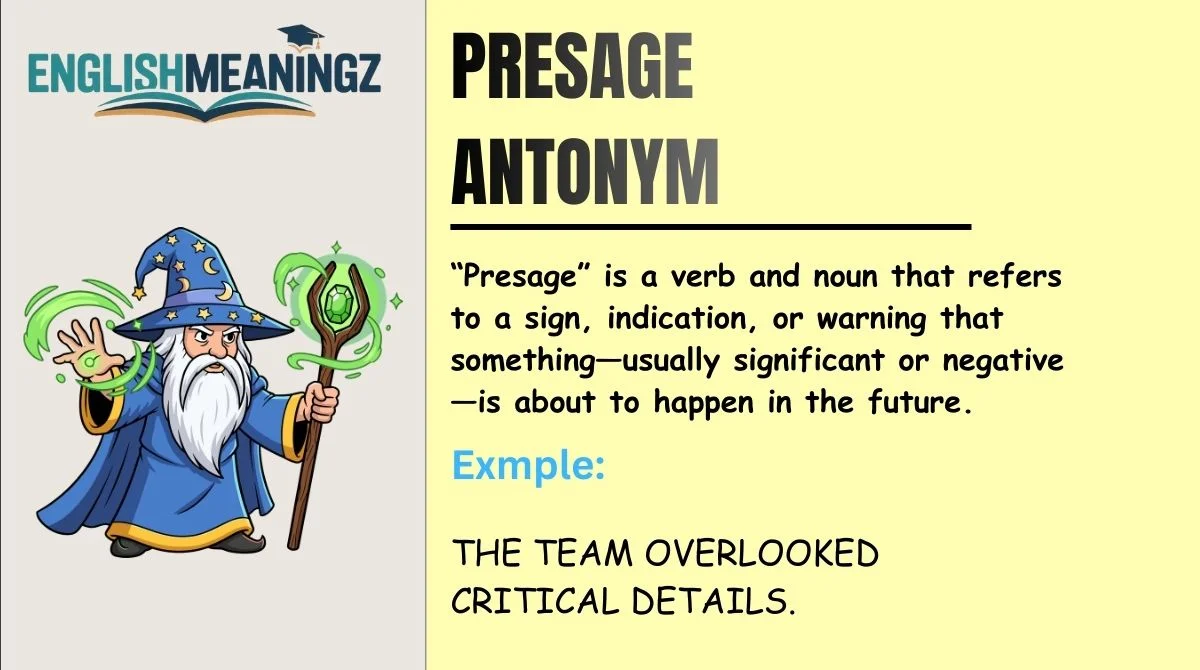
“Presage” is a verb and noun that refers to a sign, indication, or warning that something—usually significant or negative—is about to happen in the future.
Core meaning:
To foreshadow, predict, or signal an upcoming event.
Tone explanation:
The word carries a slightly formal and often ominous tone. It is commonly used in literature, analysis, and formal discussions.
Emotional and action intensity:
“Presage” suggests anticipation with a sense of seriousness. It often implies that the future event is important, sometimes negative, and already hinted at through subtle signs.
26 Best Antonyms for “Presage”
1. Ignore
Meaning: To deliberately pay no attention
Tone: Informal
Example: He chose to ignore the warning signs.
Why it’s opposite: Presage involves noticing signs; ignore means overlooking them completely.
2. Overlook
Meaning: To fail to notice something
Tone: Formal
Example: The team overlooked critical details.
Why it’s opposite: Instead of recognizing future implications, it dismisses them.
3. Disregard
Meaning: To treat something as unimportant
Tone: Formal
Example: She disregarded the early symptoms.
Why it’s opposite: Presage values signals; disregard dismisses them.
4. Doubt
Meaning: To feel uncertain about something
Tone: Neutral
Example: He doubted the prediction entirely.
Why it’s opposite: Presage implies belief in signs, while doubt rejects them.
5. Misinterpret
Meaning: To understand something incorrectly
Tone: Academic
Example: The data was misinterpreted by analysts.
Why it’s opposite: Instead of correctly foreseeing, it leads to wrong conclusions.
6. Conceal
Meaning: To hide something
Tone: Formal
Example: The evidence was concealed from the public.
Why it’s opposite: Presage reveals future hints; conceal hides them.
7. Suppress
Meaning: To prevent something from being expressed
Tone: Formal
Example: Authorities suppressed early reports.
Why it’s opposite: It blocks signals rather than highlighting them.
8. Deny
Meaning: To refuse to accept truth
Tone: Neutral
Example: He denied the obvious risks.
Why it’s opposite: Presage acknowledges signs; denial rejects them.
9. Distract
Meaning: To divert attention
Tone: Informal
Example: Noise distracted her from noticing the issue.
Why it’s opposite: It prevents recognition of future implications.
10. Mislead
Meaning: To give false direction
Tone: Neutral
Example: The report misled investors.
Why it’s opposite: Presage clarifies the future; mislead distorts it.
11. Obscure
Meaning: To make unclear
Tone: Formal
Example: Details were obscured by poor communication.
Why it’s opposite: Presage highlights meaning; obscure hides it.
12. Disprove
Meaning: To show something is false
Tone: Academic
Example: The theory was disproved by evidence.
Why it’s opposite: Presage anticipates truth; disprove eliminates it.
13. Refute
Meaning: To prove wrong
Tone: Formal
Example: Scientists refuted the claim.
Why it’s opposite: It cancels predictive implications.
14. Contradict
Meaning: To assert the opposite
Tone: Neutral
Example: The findings contradict earlier assumptions.
Why it’s opposite: Instead of supporting signs, it opposes them.
15. Neglect
Meaning: To fail to care for or notice
Tone: Neutral
Example: He neglected early warnings.
Why it’s opposite: Presage involves attention; neglect avoids it.
16. Dismiss
Meaning: To treat as unworthy
Tone: Formal
Example: She dismissed the concerns too quickly.
Why it’s opposite: It rejects signs instead of recognizing them.
17. Reject
Meaning: To refuse to accept
Tone: Neutral
Example: They rejected the forecast.
Why it’s opposite: It opposes belief in predictive signals.
18. Hide
Meaning: To keep out of sight
Tone: Informal
Example: The truth was hidden from view.
Why it’s opposite: Presage reveals hints; hide removes them.
19. Mask
Meaning: To cover or disguise
Tone: Formal
Example: The problem was masked by success.
Why it’s opposite: It prevents future insight.
20. Misjudge
Meaning: To form an incorrect opinion
Tone: Neutral
Example: He misjudged the situation.
Why it’s opposite: It replaces accurate foresight with error.
21. Overestimate
Meaning: To assess too highly
Tone: Neutral
Example: They overestimated the outcome.
Why it’s opposite: It distorts prediction rather than signaling truth.
22. Underestimate
Meaning: To assess too low
Tone: Neutral
Example: She underestimated the risks.
Why it’s opposite: It fails to recognize warning signs.
23. Discredit
Meaning: To harm credibility
Tone: Formal
Example: The claim was discredited quickly.
Why it’s opposite: It removes trust in predictive meaning.
24. Block
Meaning: To prevent progress or visibility
Tone: Informal
Example: Obstacles blocked clear understanding.
Why it’s opposite: Presage opens insight; block restricts it.
25. Interrupt
Meaning: To break continuity
Tone: Neutral
Example: The signal was interrupted unexpectedly.
Why it’s opposite: It disrupts the process of recognizing signs.
26. Silence
Meaning: To stop expression
Tone: Emotional
Example: Critics were silenced by authority.
Why it’s opposite: It eliminates the communication of future warnings.
Strong vs Mild Opposites
Not all antonyms function at the same intensity level. Some directly oppose the core meaning of “presage,” while others only weaken its effect.
Strong opposites:
Words like deny, refute, contradict, and disprove completely negate the idea of predicting or signaling the future. They actively oppose the concept.
Moderate opposites:
Words like ignore, overlook, and neglect reduce awareness rather than directly contradicting it.
Mild opposites:
Terms like distract or interrupt do not directly oppose prediction but interfere with the process of recognizing signs.
Understanding this scale helps you choose the most precise word based on context and tone.
Context-Based Opposites
Antonyms are not always fixed—they can depend on context.
- In academic writing, “refute” or “disprove” may serve as stronger opposites.
- In casual conversation, “ignore” or “miss” works better.
- In emotional storytelling, words like “deny” or “silence” carry deeper impact.
For example:
- “The clouds presaged a storm.” → Opposite: “He ignored the clouds.”
- “Her tone presaged conflict.” → Opposite: “She dismissed the tension.”
Choosing the right antonym depends on what aspect of “presage” you want to counter: awareness, prediction, or emotional weight.
Common Mistakes When Using Opposites
Mistake 1: Using unrelated words
Incorrect: “Presage vs celebrate”
These are not true opposites.
Mistake 2: Confusing contrast with contradiction
Incorrect: “Presage vs delay”
Delay affects timing, not prediction.
Mistake 3: Overusing weak antonyms
Using “ignore” in formal writing may reduce clarity when “refute” is more precise.
Mistake 4: Context mismatch
Using informal antonyms in academic writing weakens credibility.
Sentence Transformation Examples
Original: The dark sky presaged a storm.
Rewritten: He ignored the dark sky completely.
Original: Her behavior presaged trouble.
Rewritten: She dismissed any possibility of trouble.
Original: The signs presaged failure.
Rewritten: The team overlooked the signs entirely.
Original: The data presaged economic decline.
Rewritten: Analysts misinterpreted the data.
Original: His tone presaged conflict.
Rewritten: His concerns were dismissed by others.
FAQs
What is the simplest antonym of “presage”?
“Ignore” is the simplest and most commonly used opposite.
Is “deny” a strong antonym?
Yes, it strongly opposes the acceptance of predictive signs.
Can “overlook” be used in academic writing?
Yes, but more formal alternatives like “disregard” are often preferred.
Are all antonyms direct opposites?
No, some only partially oppose the meaning depending on context.
Which antonym is best for formal essays?
Words like “refute,” “disprove,” and “contradict” are ideal.
Does “presage” always imply something negative?
Not always, but it often carries a serious or ominous tone.
How can I remember antonyms easily?
Group them by intensity and context rather than memorizing randomly.
Conclusion
Mastering antonyms like those of “presage” is not just about vocabulary—it’s about precision, clarity, and impact.
By understanding how different opposites function across contexts and intensity levels, you gain the ability to express ideas more effectively in both academic and professional writing.
Whether you are crafting essays, reports, or creative content, choosing the right antonym can transform your message. Use this list as a practical reference to elevate your language and communicate with confidence.