Understanding opposites is one of the fastest ways to sharpen your writing and thinking. When you know not just what a word means but also what it does not mean, your language becomes more precise, expressive, and impactful.
Antonyms allow you to create contrast, build arguments, and communicate subtle emotional shifts that basic vocabulary cannot handle.
In academic and professional communication, clarity and tone control are essential. Whether you’re writing essays, reports, or persuasive content, choosing the right opposite word can completely change the meaning and reception of your message.
That’s why mastering antonyms of strong action words like “assail” is particularly valuable—they help you move between aggression and calm, conflict and cooperation, attack and support.
What Does “Assail” Mean?
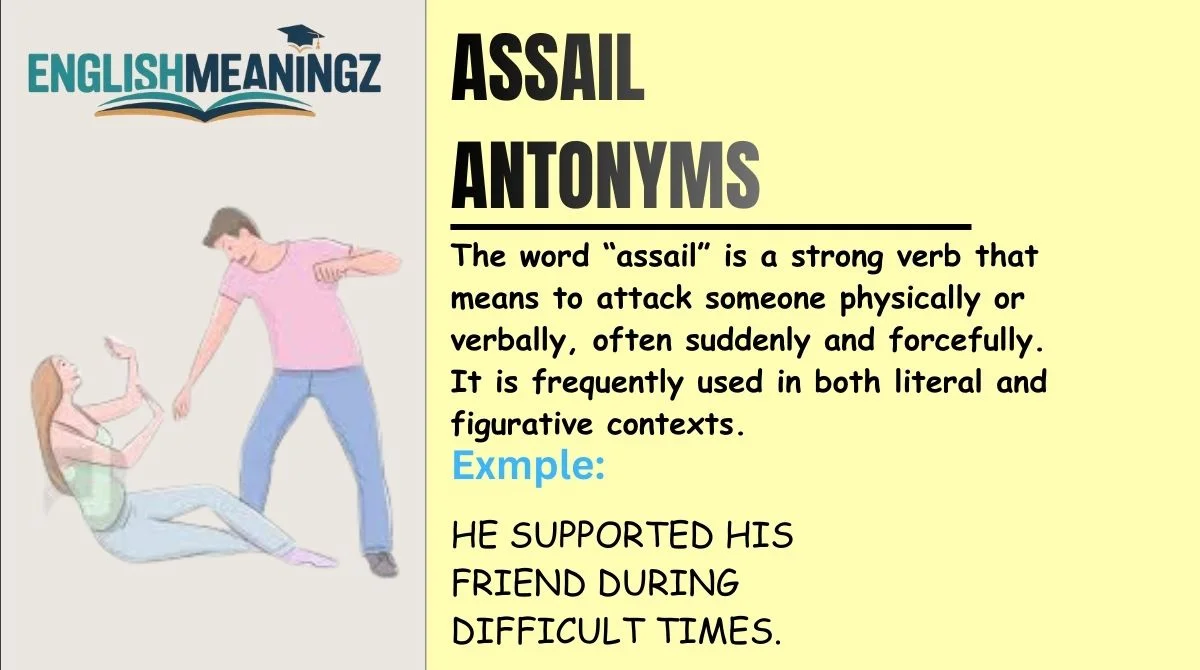
The word “assail” is a strong verb that means to attack someone physically or verbally, often suddenly and forcefully. It is frequently used in both literal and figurative contexts.
Definition:
To attack violently or aggressively, either with physical force or intense verbal criticism.
Tone Explanation:
“Assail” carries a highly negative and forceful tone. It suggests hostility, confrontation, and sometimes overwhelming pressure.
Emotional and Action Intensity:
This word reflects high intensity. It implies deliberate aggression, often repeated or overwhelming in nature. It is not mild disagreement—it is a strong, active form of attack.
26 Best Antonyms for “Assail”
Defend
Meaning: Protect from harm or attack
Tone: Formal / Academic
Example: She defended her colleague against unfair accusations.
Why Opposite: Instead of attacking, it focuses on protection.
Protect
Meaning: Keep safe from danger
Tone: Neutral
Example: Parents protect their children from harm.
Why Opposite: It prevents harm rather than causing it.
Support
Meaning: Give assistance or encouragement
Tone: Neutral
Example: He supported his friend during difficult times.
Why Opposite: It uplifts instead of attacking.
Praise
Meaning: Express approval or admiration
Tone: Emotional / Formal
Example: The teacher praised her student’s effort.
Why Opposite: Positive recognition replaces criticism.
Compliment
Meaning: Say something nice about someone
Tone: Informal
Example: She complimented his presentation skills.
Why Opposite: It builds confidence instead of damaging it.
Encourage
Meaning: Give confidence or hope
Tone: Emotional
Example: The coach encouraged the team to keep going.
Why Opposite: It motivates instead of discouraging.
Assist
Meaning: Help someone
Tone: Formal
Example: The nurse assisted the patient.
Why Opposite: It provides help instead of harm.
Aid
Meaning: Provide support or help
Tone: Academic
Example: Relief organizations aided the victims.
Why Opposite: Focuses on recovery rather than attack.
Comfort
Meaning: Ease someone’s distress
Tone: Emotional
Example: She comforted her friend after the loss.
Why Opposite: Reduces pain instead of causing it.
Defend Verbally
Meaning: Speak in favor of someone
Tone: Formal
Example: He defended his position calmly.
Why Opposite: Counters verbal attack with support.
Shield
Meaning: Protect from danger
Tone: Formal
Example: The policy shields employees from exploitation.
Why Opposite: Acts as a barrier rather than an aggressor.
Safeguard
Meaning: Protect from risk
Tone: Academic
Example: Laws safeguard citizens’ rights.
Why Opposite: Ensures safety instead of threat.
Console
Meaning: Comfort someone in distress
Tone: Emotional
Example: She consoled him after the failure.
Why Opposite: Replaces emotional attack with empathy.
Appreciate
Meaning: Recognize value
Tone: Formal
Example: Managers should appreciate their employees.
Why Opposite: Promotes positivity over negativity.
Respect
Meaning: Show regard or honor
Tone: Formal
Example: We must respect different opinions.
Why Opposite: Encourages dignity rather than hostility.
Admire
Meaning: Look up to someone
Tone: Emotional
Example: Many admire her dedication.
Why Opposite: Expresses admiration instead of criticism.
Approve
Meaning: Accept or agree
Tone: Formal
Example: The committee approved the proposal.
Why Opposite: Agreement contrasts with attack.
Endorse
Meaning: Publicly support
Tone: Formal
Example: The leader endorsed the initiative.
Why Opposite: Promotes rather than opposes.
Uplift
Meaning: Raise emotionally or morally
Tone: Emotional
Example: Positive words can uplift others.
Why Opposite: Enhances instead of harming.
Reassure
Meaning: Remove doubts or fears
Tone: Emotional
Example: She reassured him everything was fine.
Why Opposite: Calms instead of intensifying conflict.
Help
Meaning: Make things easier
Tone: Neutral
Example: He helped his neighbor fix the car.
Why Opposite: Facilitates instead of attacking.
Befriend
Meaning: Become friends with
Tone: Informal
Example: She befriended her new classmates.
Why Opposite: Builds relationships rather than destroying them.
Care For
Meaning: Look after someone
Tone: Emotional
Example: Nurses care for patients daily.
Why Opposite: Focuses on nurturing.
Value
Meaning: Consider important
Tone: Formal
Example: Good leaders value feedback.
Why Opposite: Shows appreciation instead of hostility.
Praise Highly
Meaning: Strongly admire
Tone: Formal
Example: Critics praised the film highly.
Why Opposite: Strong admiration replaces strong attack.
Defend Strongly
Meaning: Protect with intensity
Tone: Formal
Example: He strongly defended his beliefs.
Why Opposite: Equal intensity, but opposite direction.
Strong vs Mild Opposites
Not all antonyms carry the same level of intensity. Some directly counter the aggression of “assail,” while others provide softer alternatives.
Strong Opposites:
Words like defend, shield, safeguard, and protect directly oppose the action of attacking. They involve active resistance against harm.
Moderate Opposites:
Words like support, assist, and aid shift the tone from aggression to cooperation without strong emotional weight.
Mild Opposites:
Words like compliment, appreciate, and respect counter verbal or emotional aggression in a softer, more social way.
Understanding this scale helps you choose the right word depending on context. For formal debates, strong opposites are better. For everyday communication, mild antonyms are often more appropriate.
Context-Based Opposites
Antonyms depend heavily on context. “Assail” can be used physically, verbally, or emotionally, and each context changes the best opposite.
Physical Context:
Assail → Protect / Defend
Verbal Context:
Assail → Praise / Compliment
Emotional Context:
Assail → Comfort / Reassure
Professional Context:
Assail → Support / Endorse
Using the wrong antonym in the wrong context can weaken your writing. Always match the opposite word to the situation, not just the dictionary meaning.
Common Mistakes When Using Opposites
Mistake 1: Using weak opposites
Incorrect: He assailed her, but she “liked” him.
Correct: He assailed her, but she defended herself.
Mistake 2: Ignoring tone
Incorrect: The manager assailed the employee, then casually helped him.
Correct: The manager criticized the employee but later supported him.
Mistake 3: Mixing emotional levels
Incorrect: She assailed him, and he simply smiled.
Correct: She assailed him, but he responded calmly and respectfully.
Mistake 4: Context mismatch
Incorrect: The soldier assailed the enemy, while the other complimented them.
Correct: The soldier assailed the enemy, while the other defended their position.
Sentence Transformation Examples
- Original: The critic assailed the artist’s work.
Rewritten: The critic praised the artist’s work. - Original: He assailed his opponent during the debate.
Rewritten: He respected his opponent during the debate. - Original: The media assailed the politician.
Rewritten: The media supported the politician. - Original: She felt assailed by harsh comments.
Rewritten: She felt comforted by kind words. - Original: The lawyer assailed the witness.
Rewritten: The lawyer defended the witness.
FAQs
What is the simplest antonym of “assail”?
The simplest antonym is “defend,” as it directly opposes the idea of attacking.
Can “support” be used as an antonym of “assail”?
Yes, especially in emotional or professional contexts where attack is replaced by encouragement.
Is “praise” always an opposite of “assail”?
Only in verbal or emotional contexts. It does not apply to physical situations.
What is a formal antonym of “assail”?
Words like “defend,” “endorse,” and “safeguard” are suitable in formal writing.
Are all antonyms exact opposites?
No. Some are contextual or partial opposites depending on usage.
Why is tone important when choosing antonyms?
Tone ensures your message fits the situation—formal, emotional, or neutral.
How can I remember antonyms easily?
Learn them in context, use them in sentences, and group them by intensity.
Conclusion
Mastering antonyms of powerful words like “assail” gives you greater control over tone, clarity, and impact.
Instead of relying on simple vocabulary, you can choose precise opposites that match the situation—whether you need to express protection, support, admiration, or calmness.
From strong defenders like “shield” and “safeguard” to softer alternatives like “compliment” and “encourage,” each antonym adds a unique dimension to your language.
The key is not just memorizing words but understanding when and how to use them. Once you do, your writing will become more persuasive, balanced, and professionally refined.