Understanding opposites is one of the fastest ways to sharpen your language skills. When you know how to express contrast effectively, your writing becomes clearer, more dynamic, and more persuasive.
Whether you’re crafting an academic essay, writing business emails, or building SEO content, antonyms help you present balanced arguments and nuanced ideas.
Opposites are not just vocabulary tools—they are cognitive tools. They allow you to define meaning through contrast, highlight differences, and guide readers toward precise interpretations.
In academic and professional communication, the ability to use accurate antonyms reflects depth of understanding and linguistic maturity. It also prevents ambiguity, which is essential in formal contexts.
This guide focuses on “two antonyms”—a concept that involves identifying at least two opposite meanings for a word depending on context.
You’ll learn how to use them strategically, avoid common mistakes, and apply them in real-world writing.
What Does “Two Antonyms” Mean?
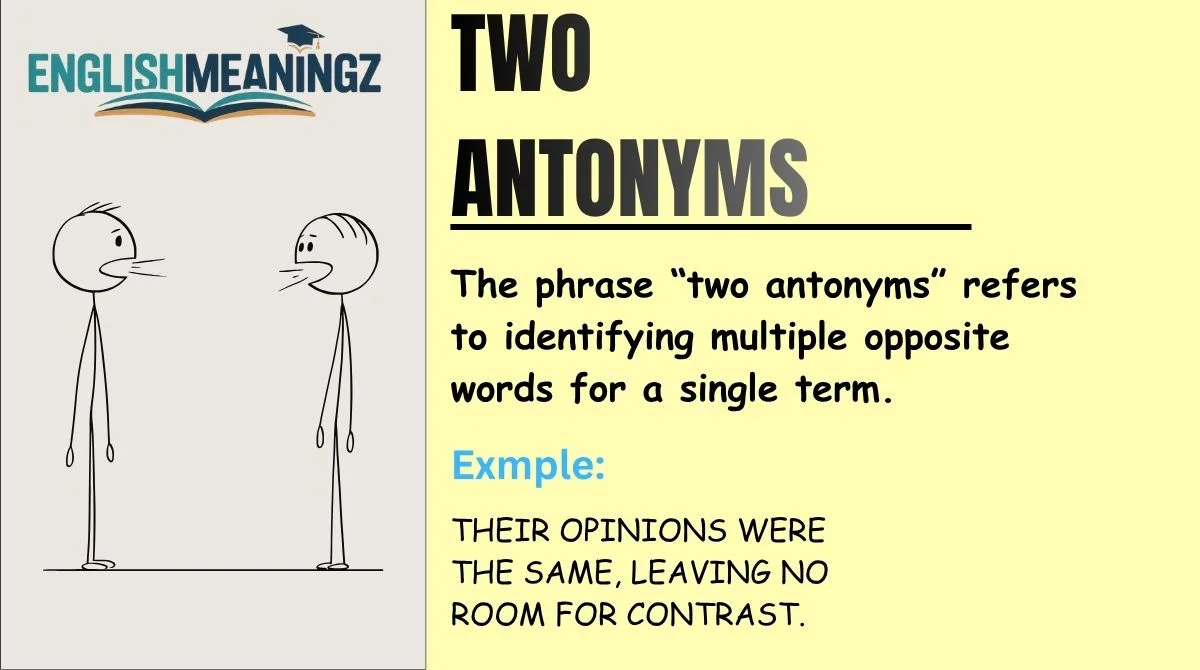
The phrase “two antonyms” refers to identifying multiple opposite words for a single term. Since many words carry more than one meaning or emotional tone, they can have different opposites depending on context.
Definition:
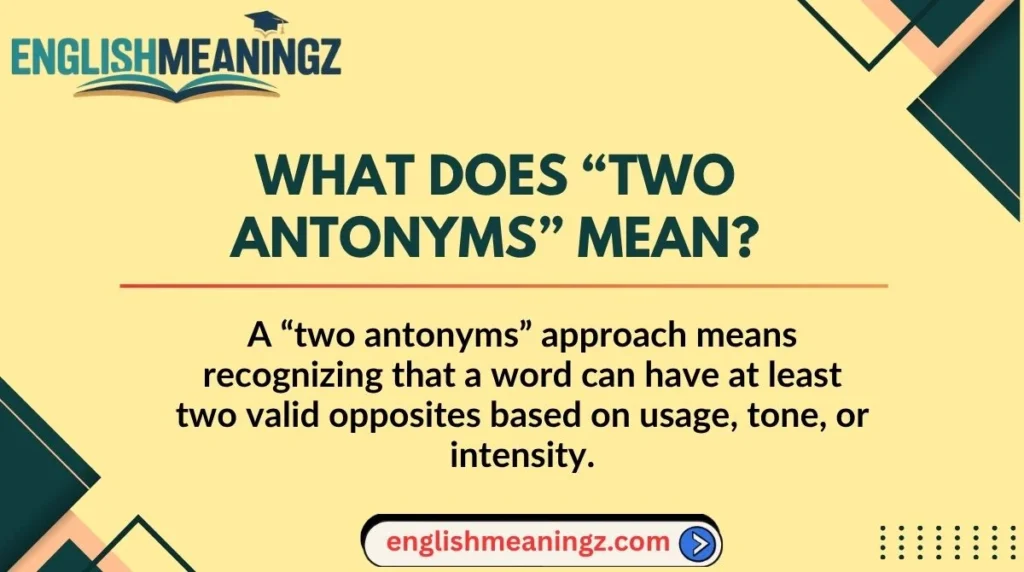
A “two antonyms” approach means recognizing that a word can have at least two valid opposites based on usage, tone, or intensity.
Tone Explanation:
Words vary in tone—some are formal (e.g., constructive), while others are informal (e.g., helpful). Their antonyms must match the tone to maintain consistency in communication.
Emotional or Action Intensity:
Some words express strong emotions (furious), while others are mild (annoyed). Their opposites differ in intensity as well. For example:
- Furious → calm, pleased
- Annoyed → satisfied, content
This is why understanding multiple antonyms is essential—you choose based on context, tone, and intensity.
14 Best Antonyms for “Two Antonyms”
Below are 14 carefully selected antonyms representing different contexts where contrast is essential.
Single
Meaning: One only; not multiple
Tone: Neutral
Example: She focused on a single idea instead of exploring multiple perspectives.
Why It’s an Opposite: “Two antonyms” implies plurality, while “single” emphasizes singularity.
Same
Meaning: Identical; not different
Tone: Informal
Example: Their opinions were the same, leaving no room for contrast.
Why It’s an Opposite: Antonyms rely on difference, while “same” removes contrast.
Similar
Meaning: Nearly alike
Tone: Neutral
Example: The two theories are similar rather than opposite.
Why It’s an Opposite: Opposites highlight contrast, whereas “similar” suggests resemblance.
Identical
Meaning: Exactly the same
Tone: Formal
Example: The results were identical across both experiments.
Why It’s an Opposite: Eliminates any form of opposition or variation.
Aligned
Meaning: In agreement or harmony
Tone: Professional
Example: Their strategies were aligned instead of conflicting.
Why It’s an Opposite: Opposites imply disagreement; alignment suggests unity.
Consistent
Meaning: Uniform and steady
Tone: Academic
Example: His arguments remained consistent throughout the paper.
Why It’s an Opposite: Antonyms introduce variation; consistency removes it.
Matching
Meaning: Corresponding or fitting together
Tone: Informal
Example: The colors were matching rather than contrasting.
Why It’s an Opposite: Opposites create contrast; matching creates harmony.
Parallel
Meaning: Running side by side without intersecting
Tone: Academic
Example: Their ideas developed in parallel, not in opposition.
Why It’s an Opposite: Suggests similarity rather than contrast.
Unified
Meaning: Joined as one
Tone: Formal
Example: The team presented a unified response.
Why It’s an Opposite: Opposites divide ideas; unity merges them.
Equivalent
Meaning: Equal in value or meaning
Tone: Academic
Example: These terms are equivalent, not contrasting.
Why It’s an Opposite: Opposites differ; equivalence implies sameness.
Compatible
Meaning: Able to coexist without conflict
Tone: Professional
Example: Their approaches were compatible rather than opposing.
Why It’s an Opposite: Opposites suggest incompatibility.
Harmonious
Meaning: Forming a pleasing whole
Tone: Emotional
Example: Their relationship was harmonious instead of conflicting.
Why It’s an Opposite: Opposites create tension; harmony removes it.
Agreeing
Meaning: Having the same opinion
Tone: Informal
Example: Both parties were agreeing on the solution.
Why It’s an Opposite: Opposites indicate disagreement.
Balanced
Meaning: Evenly distributed
Tone: Academic
Example: The discussion was balanced, not polarized.
Why It’s an Opposite: Opposites often create imbalance or extremes.
Strong vs Mild Opposites
Not all antonyms carry the same strength. Some create sharp contrast, while others suggest only slight difference.
Strong Opposites:
- Completely eliminate similarity
- Example: identical vs opposite
Mild Opposites:
- Suggest partial contrast
- Example: similar vs different
Intensity Scale Example:
- Identical → Similar → Different → Opposite
Choosing the right level of intensity is crucial. In academic writing, mild antonyms are often preferred for nuanced arguments, while strong antonyms are useful for emphasis.
Context-Based Opposites
Antonyms are not fixed—they change based on context.
Example 1:
Word: Light
- Opposite (weight): heavy
- Opposite (brightness): dark
Example 2:
Word: Fast
- Opposite (speed): slow
- Opposite (abstinence): feast
Example 3:
Word: Hard
- Opposite (difficulty): easy
- Opposite (texture): soft
This demonstrates why understanding “two antonyms” is essential. A single word can have multiple opposites depending on meaning.
Common Mistakes When Using Opposites
1. Using the wrong context
Incorrect: The opposite of “light” is “heavy” (when referring to brightness).
Correct: The opposite of “light” (brightness) is “dark.”
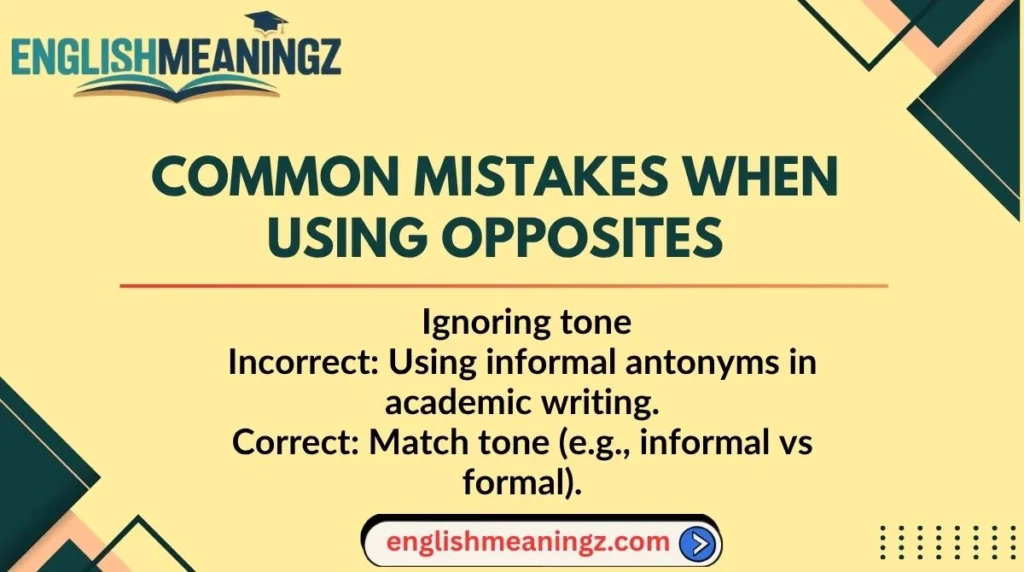
2. Ignoring tone
Incorrect: Using informal antonyms in academic writing.
Correct: Match tone (e.g., informal vs formal).
3. Overusing extreme opposites
Incorrect: Everything is either “perfect” or “terrible.”
Correct: Use moderate contrasts when needed.
4. Assuming one antonym fits all meanings
Incorrect: Believing every word has only one opposite.
Correct: Consider multiple meanings.
Sentence Transformation Examples
Original: The ideas are different.
Rewritten: The ideas are similar.
Original: His approach was aggressive.
Rewritten: His approach was calm.
Original: The results were inconsistent.
Rewritten: The results were consistent.
Original: Their opinions conflict.
Rewritten: Their opinions align.
Original: The design is complex.
Rewritten: The design is simple.
FAQs
What are antonyms?
Antonyms are words with opposite meanings used to create contrast in language.
Can a word have more than one antonym?
Yes, many words have multiple antonyms depending on context and tone.
Why are antonyms important in writing?
They improve clarity, enhance contrast, and make communication more precise.
What is the difference between strong and weak antonyms?
Strong antonyms create absolute contrast, while weak antonyms show partial difference.
How do I choose the correct antonym?
Consider context, tone, and intensity before selecting an opposite.
Are antonyms used in SEO writing?
Yes, they improve keyword variation and semantic richness.
Can antonyms change meaning in different fields?
Yes, technical, academic, and casual contexts may require different opposites.
Conclusion
Mastering “two antonyms” is more than a vocabulary exercise—it’s a strategic skill that transforms how you communicate.
By understanding that words can have multiple opposites depending on context, tone, and intensity, you gain flexibility and precision in writing.
Whether you’re writing academically, professionally, or creatively, using the right antonym at the right time enhances clarity and impact.
Instead of relying on basic opposites, expand your vocabulary and choose words that match your intent perfectly.
The result? Stronger arguments, clearer communication, and writing that stands out in 2k26 and beyond.