Understanding opposites is one of the fastest ways to sharpen your language skills.
When you know both a word and its antonyms, you gain precision—the ability to express subtle differences in tone, mood, and meaning.
This is especially valuable in academic writing, where clarity and nuance are essential, and in professional communication, where word choice can influence perception, authority, and emotional impact.
Learning antonyms of a common word like “relaxed” expands your expressive range.
Instead of repeating basic vocabulary, you can adapt your language to fit formal reports, persuasive essays, or everyday conversations.
In this guide, you’ll explore powerful, context-aware antonyms of “relaxed” that elevate both your writing and speaking.
What Does “Relaxed” Mean?
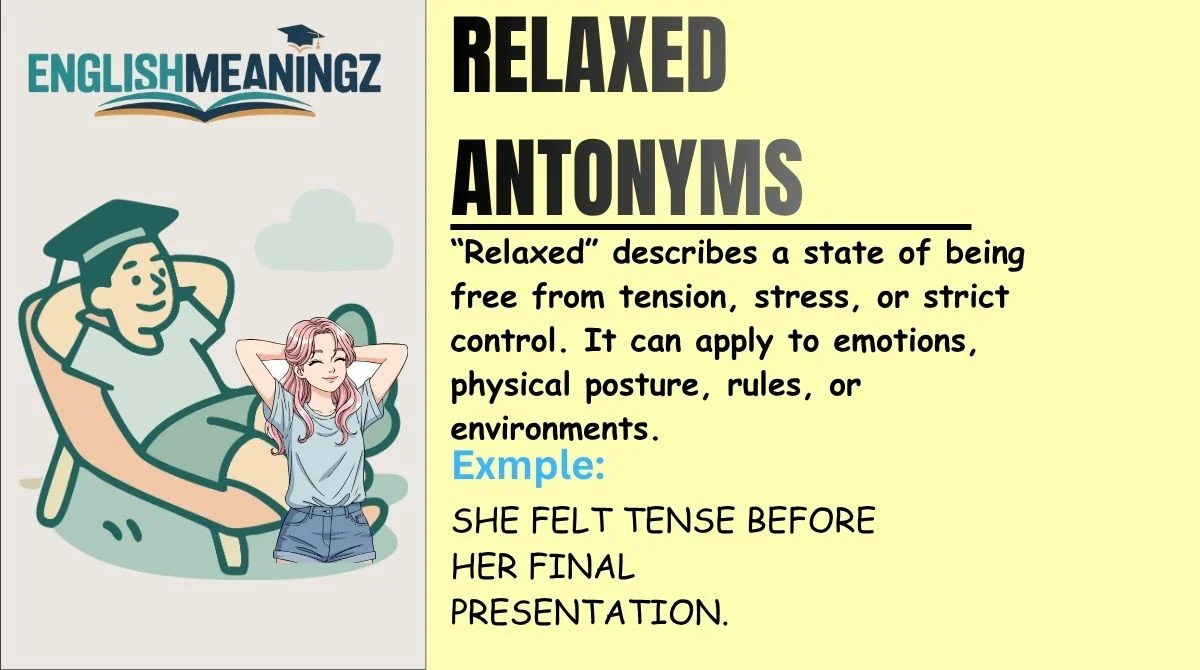
“Relaxed” describes a state of being free from tension, stress, or strict control. It can apply to emotions, physical posture, rules, or environments.
Tone explanation:
The word carries a calm, easygoing, and informal tone. It often suggests comfort, flexibility, and lack of pressure.
Emotional or action intensity:
“Relaxed” indicates low intensity—minimal stress, low urgency, and a peaceful or laid-back state. Its antonyms, therefore, typically reflect higher tension, pressure, strictness, or emotional strain.
13 Best Antonyms for “Relaxed”
Tense
Meaning: Experiencing stress or nervous strain
Tone: Emotional / Neutral
Example: She felt tense before her final presentation.
Why it’s opposite: While relaxed implies calmness, tense reflects mental or physical tightness and anxiety.
Anxious
Meaning: Worried or uneasy about something uncertain
Tone: Emotional
Example: He grew anxious as the deadline approached.
Why it’s opposite: Relaxed suggests peace, whereas anxious signals worry and anticipation.
Stressed
Meaning: Under mental or emotional pressure
Tone: Informal / Emotional
Example: She has been stressed all week due to workload.
Why it’s opposite: Stress directly contradicts the calm nature of being relaxed.
Agitated
Meaning: Disturbed, restless, or upset
Tone: Emotional
Example: The loud noise made him agitated.
Why it’s opposite: Relaxed is steady and calm; agitated is unsettled and restless.
Rigid
Meaning: Stiff, strict, or inflexible
Tone: Formal / Academic
Example: The company follows rigid policies.
Why it’s opposite: Relaxed implies flexibility; rigid suggests strict control.
Strict
Meaning: Enforcing rules firmly
Tone: Formal
Example: The teacher is strict about deadlines.
Why it’s opposite: A relaxed environment is lenient; a strict one is controlled and disciplined.
Nervous
Meaning: Easily agitated or lacking confidence
Tone: Informal / Emotional
Example: He felt nervous before the interview.
Why it’s opposite: Nervousness disrupts calmness, making it the opposite of relaxed.
Pressured
Meaning: Feeling forced or stressed to act
Tone: Professional
Example: She felt pressured to complete the task quickly.
Why it’s opposite: Relaxation lacks urgency; pressure introduces urgency and stress.
Restless
Meaning: Unable to relax or stay still
Tone: Emotional
Example: He became restless during the long meeting.
Why it’s opposite: Relaxed implies stillness and ease; restless indicates discomfort and movement.
Intense
Meaning: High in emotional or mental strength
Tone: Academic / Emotional
Example: The debate became intense quickly.
Why it’s opposite: Relaxed is mild and calm, while intense is strong and overwhelming.
Formal
Meaning: Following strict rules or conventions
Tone: Academic
Example: The event had a formal atmosphere.
Why it’s opposite: Relaxed settings are casual; formal ones are structured and controlled.
High-strung
Meaning: Easily stressed or nervous
Tone: Informal
Example: She is naturally high-strung under pressure.
Why it’s opposite: High-strung behavior reflects constant tension, unlike relaxed composure.
Uptight
Meaning: Tense and unable to relax
Tone: Informal
Example: He seemed uptight during the conversation.
Why it’s opposite: Uptight directly contrasts the ease and looseness of being relaxed.
Overworked
Meaning: Exhausted from excessive work
Tone: Professional
Example: Many employees feel overworked during peak season.
Why it’s opposite: Relaxed implies rest; overworked suggests fatigue and strain.
Constrained
Meaning: Restricted or limited
Tone: Academic
Example: His movements were constrained by injury.
Why it’s opposite: Relaxed allows freedom; constrained limits it.
Strong vs Mild Opposites
Not all antonyms carry the same intensity. Some are mild contrasts, while others are extreme.
Mild opposites:
Words like formal or strict oppose relaxed in terms of structure but don’t always imply emotional stress.
Moderate opposites:
Terms such as tense, nervous, and restless introduce noticeable emotional discomfort.
Strong opposites:
Words like stressed, agitated, and high-strung represent intense psychological pressure and are the furthest from relaxed.
Understanding this scale helps you choose the right word based on context. For subtle contrast, use mild antonyms. For dramatic emphasis, select stronger ones.
Context-Based Opposites
Antonyms change depending on how “relaxed” is used.
In emotional context:
Relaxed → anxious, tense, stressed
In rules or systems:
Relaxed → strict, rigid, formal
In physical state:
Relaxed → tense, stiff, constrained
In environment or atmosphere:
Relaxed → intense, pressured, serious
Choosing the correct antonym depends on whether you’re describing feelings, behavior, systems, or environments.
Common Mistakes When Using Opposites
Using unrelated contrasts
Incorrect: “Relaxed vs tired”
Correct: “Relaxed vs stressed”
Tired is not the direct opposite of relaxed.
Confusing tone levels
Incorrect: “Relaxed vs aggressive”
Correct: “Relaxed vs tense”
Aggressive implies hostility, not just lack of relaxation.
Mixing context
Incorrect: “Relaxed rules vs nervous rules”
Correct: “Relaxed rules vs strict rules”
Match the antonym to the correct context.
Overusing basic antonyms
Relying only on “stressed” limits vocabulary. Use varied options like agitated, rigid, or uptight.
Sentence Transformation Examples
Original: She felt relaxed after the exam.
Rewritten: She felt tense after the exam.
Original: The environment was relaxed and friendly.
Rewritten: The environment was formal and controlled.
Original: He remained relaxed during the meeting.
Rewritten: He remained nervous during the meeting.
Original: The rules are relaxed here.
Rewritten: The rules are strict here.
Original: She looked relaxed on stage.
Rewritten: She looked anxious on stage.
FAQs
What is the most common antonym of relaxed?
“Stressed” is the most widely used antonym because it directly reflects the opposite emotional state.
Are all antonyms of relaxed emotional words?
No. Some antonyms describe structure or rules, such as “strict” or “rigid.”
Can “formal” really be an antonym of relaxed?
Yes, in context. A relaxed setting is casual, while a formal one follows rules and structure.
Which antonym is strongest?
“Agitated” and “high-strung” are among the strongest because they indicate intense emotional disturbance.
Is “busy” an antonym of relaxed?
Not exactly. Someone can be busy but still relaxed. “Stressed” is a more accurate opposite.
How can I choose the right antonym?
Focus on context—whether you’re describing emotion, behavior, environment, or rules.
Why should I learn multiple antonyms instead of one?
Using varied antonyms improves clarity, avoids repetition, and enhances writing quality.
Conclusion
Mastering antonyms of “relaxed” gives you more control over your language. Instead of relying on basic vocabulary, you can express precise emotions, describe environments accurately, and adapt your tone to different situations.
Whether you’re writing academically or communicating professionally, understanding these opposites helps you sound more articulate, confident, and impactful.
The key is not just memorizing words, but knowing when and how to use them effectively.