Understanding opposites is one of the fastest ways to sharpen your vocabulary and elevate your writing. When you know not just what a word means—but also what it doesn’t mean—you gain precision, clarity, and stylistic control.
This is especially important for descriptive words that convey emotion, appearance, and tone.
In academic and professional communication, choosing the right antonym can completely transform a sentence. It helps you avoid vague language, strengthens arguments, and makes your writing more engaging.
In this guide, you’ll master the most effective pallor antonyms, understand their nuances, and learn how to use them naturally.
What Does “Pallor” Mean?
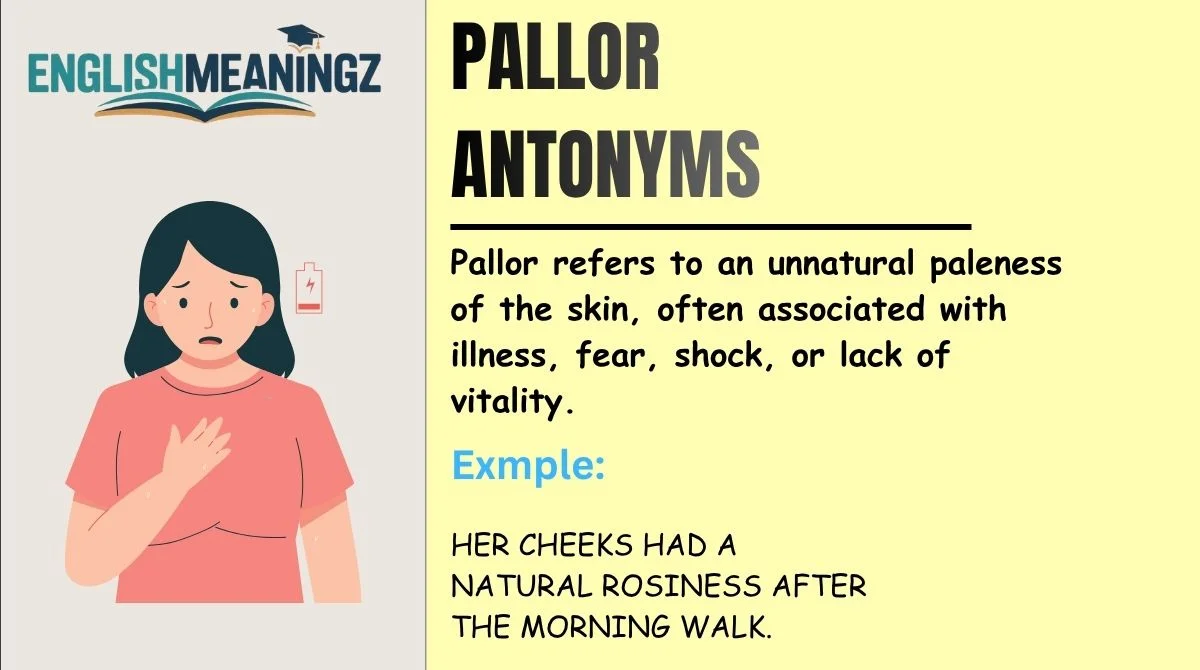
Pallor refers to an unnatural paleness of the skin, often associated with illness, fear, shock, or lack of vitality.
Tone Explanation
The word carries a negative and clinical tone. It often suggests weakness, fragility, or emotional distress.
Emotional or Action Intensity
Pallor is not just about physical appearance—it implies a deeper condition:
- Low energy
- Poor health
- Emotional disturbance (fear, anxiety)
Because of this layered meaning, its antonyms are not just “colorful” words—they often reflect health, vitality, and emotional strength.
15 Best Antonyms for “Pallor”
Rosiness
Meaning: A healthy pink glow in the skin
Tone: Emotional / Descriptive
Example: Her cheeks had a natural rosiness after the morning walk.
Why it’s an opposite: Pallor signals lifelessness, while rosiness reflects health and vitality.
Glow
Meaning: A soft, radiant brightness
Tone: Informal / Emotional
Example: His face had a confident glow during the presentation.
Why it’s an opposite: Glow implies energy and warmth, directly opposing dull paleness.
Radiance
Meaning: Brightness that seems to shine from within
Tone: Formal / Academic
Example: Her radiance made her stand out in the crowd.
Why it’s an opposite: Radiance suggests vibrancy and life, unlike pallor’s lifeless tone.
Vibrancy
Meaning: Full of energy and life
Tone: Academic
Example: The vibrancy of his appearance reflected his active lifestyle.
Why it’s an opposite: Pallor implies weakness, while vibrancy conveys strength and vitality.
Color
Meaning: Natural skin tone or liveliness
Tone: Neutral
Example: After recovery, color returned to his face.
Why it’s an opposite: Pallor removes color; this restores it.
Flush
Meaning: A sudden redness in the face
Tone: Informal / Emotional
Example: She had a slight flush after running upstairs.
Why it’s an opposite: Flush indicates blood flow and energy, unlike pale stillness.
Bloom
Meaning: Healthy and attractive appearance
Tone: Literary / Emotional
Example: The bloom on her face showed she was thriving.
Why it’s an opposite: Bloom reflects flourishing life, opposing dullness.
Freshness
Meaning: A lively and healthy look
Tone: Neutral
Example: His freshness made him look years younger.
Why it’s an opposite: Freshness implies renewal, not depletion.
Vitality
Meaning: Physical or mental energy
Tone: Academic
Example: Her vitality was evident in her glowing complexion.
Why it’s an opposite: Vitality contradicts the weakness implied by pallor.
Brilliance
Meaning: Exceptional brightness or vividness
Tone: Formal
Example: The brilliance of her expression captured everyone’s attention.
Why it’s an opposite: Brilliance replaces dullness with intensity.
Warmth
Meaning: A healthy, lively tone
Tone: Emotional
Example: His face had a natural warmth after exercise.
Why it’s an opposite: Pallor feels cold and lifeless; warmth suggests energy.
Healthiness
Meaning: State of being physically well
Tone: Academic
Example: Her healthiness showed in her glowing skin.
Why it’s an opposite: Pallor often signals illness, while healthiness signals well-being.
Liveliness
Meaning: Full of life and energy
Tone: Informal
Example: The liveliness in his expression was contagious.
Why it’s an opposite: Liveliness opposes the dull stillness of pallor.
Richness (of complexion)
Meaning: Deep and full natural tone
Tone: Formal
Example: The richness of his complexion reflected good health.
Why it’s an opposite: Richness adds depth, while pallor removes it.
Luminosity
Meaning: Soft glowing light
Tone: Academic / Formal
Example: Her skin had a natural luminosity.
Why it’s an opposite: Luminosity suggests brightness, unlike dull paleness.
Strong vs Mild Opposites
Not all antonyms carry the same intensity. Understanding this helps you choose the most precise word.
Mild Opposites
- Color
- Freshness
- Warmth
These simply indicate the absence of pallor without strong emotional impact.
Moderate Opposites
- Glow
- Flush
- Rosiness
- Liveliness
These suggest visible improvement and energy.
Strong Opposites
- Radiance
- Vitality
- Vibrancy
- Brilliance
- Luminosity
These go beyond contrast—they emphasize exceptional health and energy.
Context-Based Opposites
The best antonym depends on the situation.
Medical Context
- Use: Healthiness, Vitality
Example: The patient regained vitality after treatment.
Emotional Context
- Use: Glow, Radiance, Warmth
Example: Her face glowed with happiness.
Literary or Creative Writing
- Use: Bloom, Luminosity, Brilliance
Example: A bloom spread across her face.
Everyday Conversation
- Use: Color, Flush, Freshness
Example: You finally have color back in your face.
Common Mistakes When Using Opposites
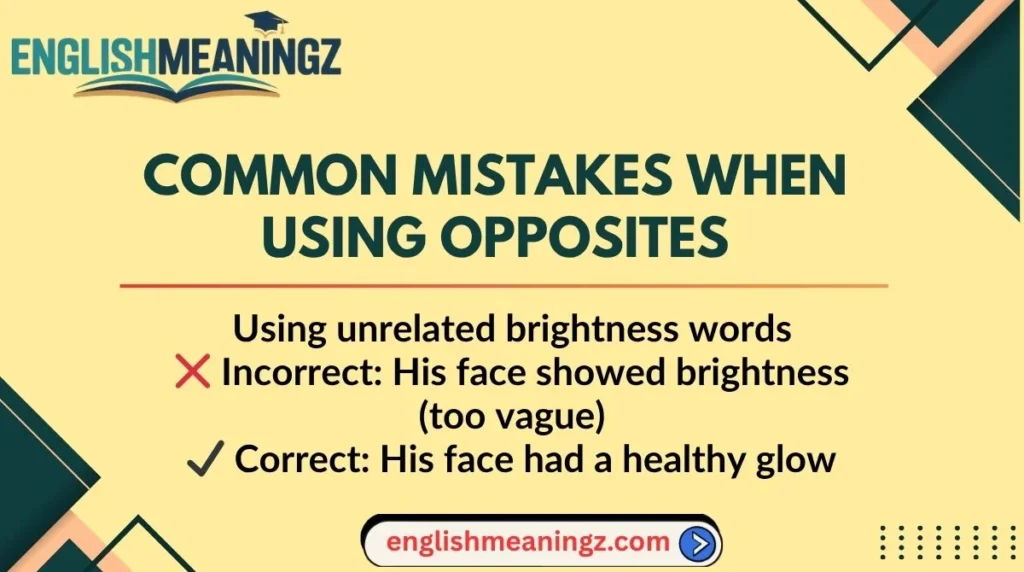
Using unrelated brightness words
❌ Incorrect: His face showed brightness (too vague)
✔ Correct: His face had a healthy glow
Confusing emotional and physical context
❌ Incorrect: Her vitality looked scared
✔ Correct: Her pallor showed fear
Overusing strong antonyms
❌ Incorrect: Every sentence uses “radiance”
✔ Correct: Mix mild and strong words naturally
Ignoring tone
❌ Incorrect: “Flush” in formal research writing
✔ Correct: Use “vitality” or “healthiness” in academic tone
Sentence Transformation Examples
Original → Improved with Antonyms
- His face showed pallor after the illness.
→ His face regained color after the illness. - She looked pale and weak.
→ She appeared full of vitality and strength. - The child’s pallor worried everyone.
→ The child’s freshness reassured everyone. - His pallor revealed fear.
→ A sudden flush revealed his emotion. - Her pale expression faded slowly.
→ A soft glow returned to her expression.
FAQs
What is the simplest antonym of pallor?
The simplest antonym is color, as pallor literally means lack of color.
Which antonym is best for academic writing?
Vitality and healthiness are most suitable due to their formal tone.
Can “glow” replace pallor in all contexts?
No, “glow” works best in emotional or descriptive contexts, not medical ones.
Is pallor always negative?
Yes, it usually indicates illness, fear, or weakness.
What is the strongest opposite of pallor?
Radiance or vibrancy, as they imply intense life and energy.
Are all antonyms related to skin color?
Not always—some relate to energy and emotional state, like vitality.
How can I remember these antonyms easily?
Group them by meaning:
- Health: vitality, healthiness
- Appearance: glow, radiance
- Emotion: warmth, liveliness
Conclusion
Mastering pallor antonyms is more than a vocabulary exercise—it’s a powerful way to improve how you express health, emotion, and visual imagery in writing.
By understanding the subtle differences between words like glow, vitality, and radiance, you can choose language that is precise, engaging, and context-appropriate.
Whether you’re writing academically, creatively, or professionally, using the right antonym transforms ordinary sentences into vivid, impactful communication.
The key is not just knowing these words—but knowing when and how to use them.