Understanding opposites is not just a basic language skill—it’s a powerful tool that elevates clarity, precision, and emotional depth in writing.
When you know how to use gradable antonyms effectively, your sentences become more expressive and nuanced rather than flat or overly simplistic.
In academic and professional communication, this skill becomes even more critical. Whether you are writing essays, reports, or business content, choosing the right opposite word helps you communicate contrast, argument strength, and tone with accuracy.
Gradable antonyms, in particular, allow you to express varying degrees instead of rigid black-and-white contrasts—making your writing more natural and human.
What Does “Gradable Antonyms” Mean?
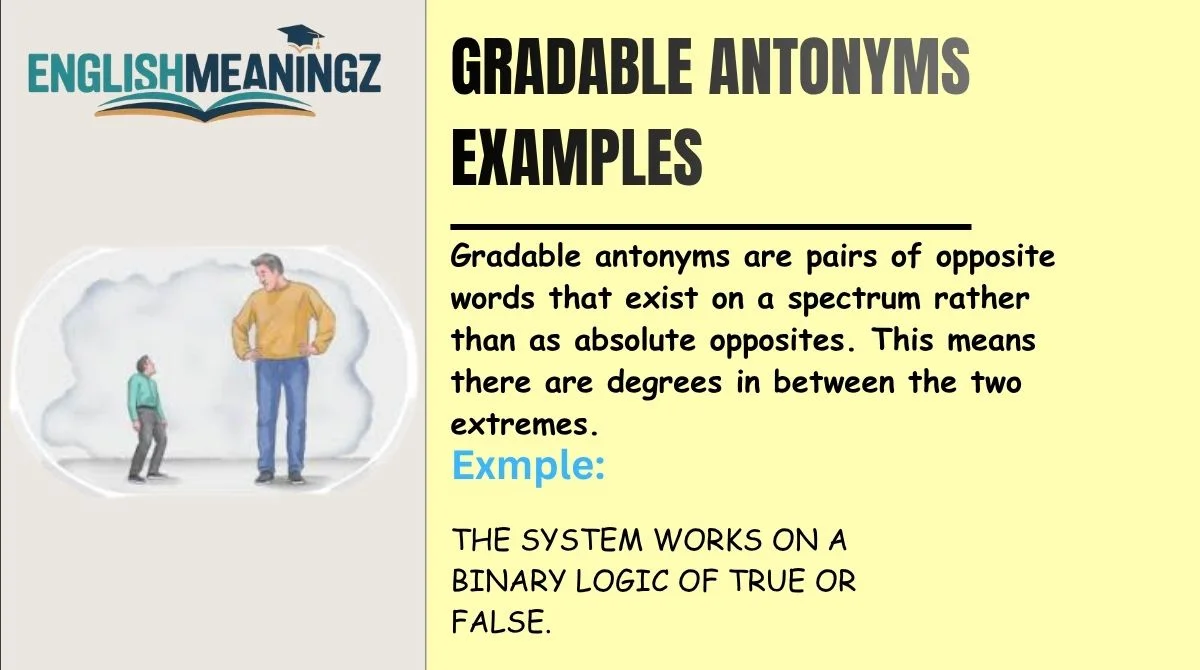
Gradable antonyms are pairs of opposite words that exist on a spectrum rather than as absolute opposites. This means there are degrees in between the two extremes.
For example, hot and cold are gradable antonyms because something can also be warm, cool, or lukewarm.
Tone Explanation
Gradable antonyms often carry flexible tones. Depending on the context, they can sound neutral, descriptive, emotional, or analytical. For instance, “happy” vs “sad” can be casual in conversation but also emotionally expressive in storytelling.
Emotional or Action Intensity
Unlike strict opposites (like dead/alive), gradable antonyms allow variation in intensity. You can modify them with words like:
- very
- slightly
- extremely
- somewhat
This makes them essential for precise communication.
15 Best Antonyms for “Gradable Antonyms”
Since “gradable antonyms” refers to flexible, degree-based opposites, its conceptual opposite is non-gradable (absolute) opposites. Below are 15 antonym pairs that illustrate this contrast clearly.
Absolute
Meaning: Complete and without degrees
Tone: Academic
Example: The result was absolute, leaving no room for variation.
Why it is opposite: Unlike gradable antonyms, absolute terms do not allow intermediate states.
Binary
Meaning: Divided into two fixed categories
Tone: Technical
Example: The system works on a binary logic of true or false.
Why it is opposite: Binary concepts eliminate the spectrum found in gradable opposites.
Fixed
Meaning: Not changeable or adjustable
Tone: Formal
Example: The rules are fixed and cannot be modified.
Why it is opposite: Gradable antonyms allow flexibility, while fixed terms do not.
Definite
Meaning: Clearly defined and certain
Tone: Formal
Example: There is a definite answer to this question.
Why it is opposite: Gradable antonyms involve ambiguity and degrees, unlike definite terms.
Rigid
Meaning: Stiff and unyielding
Tone: Neutral
Example: The structure is rigid and inflexible.
Why it is opposite: Gradable antonyms are flexible; rigid terms resist variation.
Unchangeable
Meaning: Impossible to alter
Tone: Formal
Example: Some laws are considered unchangeable.
Why it is opposite: Gradable opposites allow adjustment in intensity.
Strict
Meaning: Enforced without flexibility
Tone: Neutral
Example: The teacher follows strict grading criteria.
Why it is opposite: Gradable antonyms involve a range, not strict boundaries.
Exact
Meaning: Precise and accurate
Tone: Academic
Example: The measurement must be exact.
Why it is opposite: Gradable antonyms allow approximation, not exactness.
Clear-cut
Meaning: Obvious with no ambiguity
Tone: Informal
Example: The decision was clear-cut.
Why it is opposite: Gradable antonyms often involve gray areas.
Black-and-white
Meaning: Without shades of meaning
Tone: Informal
Example: The issue is not black-and-white.
Why it is opposite: Gradable antonyms thrive on shades and degrees.
Definitional
Meaning: Based strictly on definition
Tone: Academic
Example: The concept is definitional and cannot vary.
Why it is opposite: Gradable antonyms depend on interpretation and context.
Unambiguous
Meaning: Not open to multiple meanings
Tone: Formal
Example: The instructions are unambiguous.
Why it is opposite: Gradable antonyms often involve interpretation.
Categorical
Meaning: Without exception
Tone: Formal
Example: He gave a categorical denial.
Why it is opposite: Gradable antonyms allow exceptions and variation.
Final
Meaning: Conclusive and not subject to change
Tone: Neutral
Example: The decision is final.
Why it is opposite: Gradable antonyms are adjustable, not final.
Determinate
Meaning: Precisely defined
Tone: Academic
Example: The outcome is determinate.
Why it is opposite: Gradable antonyms involve degrees of uncertainty.
Strong vs Mild Opposites
Not all opposites carry the same intensity. Gradable antonyms exist on a scale, which allows you to choose the strength of contrast depending on your purpose.
For example:
- Strong contrast: freezing vs boiling
- Mild contrast: cool vs warm
This scale helps writers avoid exaggeration and instead choose precise language. In professional writing, mild opposites are often preferred because they sound more balanced and analytical. Strong opposites, on the other hand, are useful in persuasive or emotional contexts.
Context-Based Opposites
Opposites are not always fixed—they can change depending on context. These are known as situational antonyms.
For example:
- “fast” can be opposite of slow in speed
- but opposite of careful in behavior
Similarly:
- “light” can mean not heavy → opposite: heavy
- “light” can mean brightness → opposite: dark
This shows that understanding context is essential when using antonyms effectively.
Common Mistakes When Using Opposites
One of the most common mistakes is assuming every word has a single, direct opposite. This is not true, especially for gradable antonyms.
Misuse Example 1
Incorrect: The opposite of happy is angry
Correct: The closer opposite is sad
Misuse Example 2
Incorrect: Hot and freezing are direct opposites
Correct: Hot and cold are standard opposites; freezing is an extreme
Misuse Example 3
Incorrect: Using absolute terms in flexible contexts
Correct: Use gradable antonyms where nuance is needed
Another mistake is ignoring tone. For instance, using informal opposites in academic writing can weaken credibility.
Sentence Transformation Examples
Here are five examples of how sentences can be improved using antonyms:
- Original: The room was very hot.
Transformed: The room was slightly cold. - Original: She is extremely confident.
Transformed: She is somewhat uncertain. - Original: The results were positive.
Transformed: The results were negative. - Original: The task is easy.
Transformed: The task is difficult. - Original: His behavior was friendly.
Transformed: His behavior was unfriendly.
These transformations show how antonyms can shift meaning and tone instantly.
FAQs
What are gradable antonyms?
Gradable antonyms are opposite words that exist on a scale and allow degrees, such as hot and cold.
How are they different from non-gradable antonyms?
Non-gradable antonyms are absolute and do not allow degrees, like dead and alive.
Can gradable antonyms be modified?
Yes, they can be modified using intensifiers like very, slightly, or extremely.
Why are gradable antonyms important in writing?
They add precision, flexibility, and emotional nuance to your language.
Are all opposites gradable?
No, some opposites are absolute and cannot be graded.
How do I choose the right antonym?
Consider context, tone, and the level of intensity required.
Can one word have multiple opposites?
Yes, depending on context and meaning.
Conclusion
Mastering gradable antonyms is essential for anyone who wants to write with clarity and sophistication. Unlike rigid opposites, these word pairs offer flexibility, allowing you to express subtle differences in meaning and intensity.
By understanding their structure, context, and proper usage, you can significantly improve both your academic and professional communication.
Whether you are crafting essays, reports, or everyday content, the ability to choose the right opposite word will always set your writing apart.