Understanding opposites is one of the fastest ways to sharpen your language skills. When you learn antonyms, you don’t just expand your vocabulary—you deepen your control over tone, intent, and clarity.
Words exist in relationships, and knowing both sides of meaning allows you to express ideas with precision instead of relying on vague phrasing.
In academic and professional communication, this skill becomes even more critical.
Whether you’re writing essays, negotiating in business, or crafting persuasive content, the ability to replace a harsh or rigid term with a softer alternative can completely transform how your message is received.
That’s why mastering antonyms of strong words like ultimatum is essential for effective communication in 2026 and beyond.
What Does “Ultimatum” Mean?
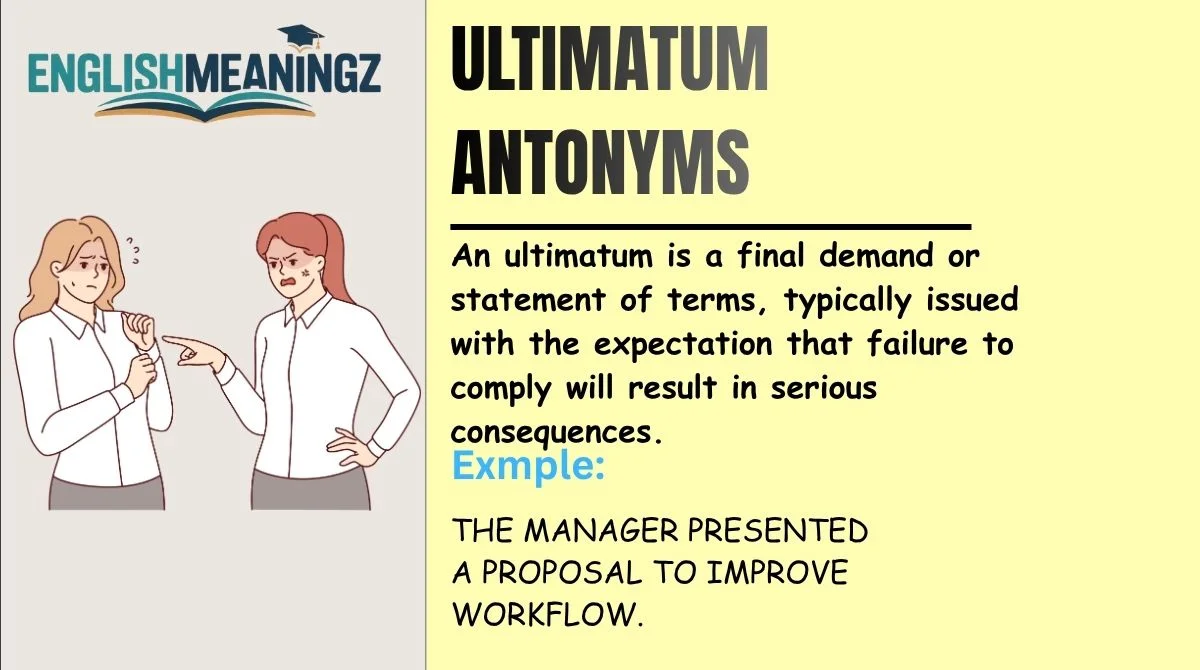
An ultimatum is a final demand or statement of terms, typically issued with the expectation that failure to comply will result in serious consequences. It leaves no room for negotiation or compromise.
Tone Explanation
The tone of “ultimatum” is strict, forceful, and authoritative. It often carries a sense of urgency and dominance, suggesting that one party holds power over another.
Emotional or Action Intensity
An ultimatum reflects high emotional intensity and decisive action. It signals the end of discussion and the beginning of consequences. Because of this, it can come across as aggressive, controlling, or even threatening in certain contexts.
15 Best Antonyms for “Ultimatum”
Suggestion
Meaning: A gentle proposal or idea offered for consideration
Tone: Informal / Neutral
Example: She made a suggestion instead of forcing a decision.
Why it’s opposite: Unlike an ultimatum, a suggestion invites flexibility and choice.
Proposal
Meaning: A formal plan or idea put forward for discussion
Tone: Formal / Professional
Example: The manager presented a proposal to improve workflow.
Why it’s opposite: A proposal opens dialogue rather than closing it.
Request
Meaning: A polite or formal appeal for something
Tone: Neutral / Polite
Example: He made a request for more time to complete the task.
Why it’s opposite: A request respects autonomy instead of imposing conditions.
Invitation
Meaning: A friendly offer to participate or engage
Tone: Warm / Social
Example: They sent an invitation to join the discussion.
Why it’s opposite: Invitations encourage voluntary action, unlike ultimatums.
Option
Meaning: A choice among alternatives
Tone: Neutral
Example: You have the option to accept or decline the offer.
Why it’s opposite: Options promote freedom, while ultimatums restrict it.
Recommendation
Meaning: Advice given based on judgment or expertise
Tone: Formal / Advisory
Example: The consultant gave a recommendation for better performance.
Why it’s opposite: Recommendations guide rather than demand.
Appeal
Meaning: A sincere request, often emotional or persuasive
Tone: Emotional / Formal
Example: She made an appeal for understanding.
Why it’s opposite: Appeals seek empathy, not compliance through pressure.
Negotiation
Meaning: A process of discussion to reach agreement
Tone: Professional
Example: The deal was finalized after hours of negotiation.
Why it’s opposite: Negotiation thrives on compromise, unlike ultimatums.
Compromise
Meaning: A mutual agreement where both sides concede
Tone: Neutral / Diplomatic
Example: They reached a compromise after discussing their differences.
Why it’s opposite: Compromise balances power instead of asserting it.
Discussion
Meaning: An open exchange of ideas
Tone: Neutral / Academic
Example: The topic requires further discussion before decisions are made.
Why it’s opposite: Discussion keeps communication open, unlike ultimatums.
Advice
Meaning: Guidance or suggestions offered to help
Tone: Informal / Supportive
Example: He gave helpful advice instead of forcing a choice.
Why it’s opposite: Advice supports decision-making without coercion.
Choice
Meaning: The act of selecting between alternatives
Tone: Neutral
Example: The final choice was left to the team.
Why it’s opposite: Choice emphasizes freedom rather than restriction.
Flexibility
Meaning: Willingness to adapt or change
Tone: Professional
Example: Flexibility in planning led to better outcomes.
Why it’s opposite: Flexibility allows adjustment, while ultimatums are rigid.
Offer
Meaning: A proposal presented for acceptance or rejection
Tone: Neutral / Business
Example: The company made an offer to settle the issue.
Why it’s opposite: Offers allow refusal without penalty.
Dialogue
Meaning: A conversation between two or more parties
Tone: Formal / Academic
Example: Constructive dialogue resolved the conflict.
Why it’s opposite: Dialogue fosters cooperation instead of control.
Strong vs Mild Opposites
Not all antonyms function at the same intensity level. Some directly counter the force of an ultimatum, while others soften the tone.
Strong opposites include words like negotiation, compromise, and dialogue. These actively replace the rigid structure of an ultimatum with collaborative processes.
Mild opposites include suggestion, advice, and recommendation. These reduce intensity but may not fully counter the authoritative nature of an ultimatum.
Understanding this scale helps you choose the right word depending on your intent. If you want to sound diplomatic, go for mild opposites. If you want to emphasize collaboration, use stronger alternatives.
Context-Based Opposites
Antonyms often depend on context rather than strict dictionary definitions.
- In business, “ultimatum” contrasts best with negotiation or proposal.
- In relationships, it contrasts with discussion or compromise.
- In academic writing, recommendation or analysis works better.
- In leadership, flexibility and dialogue are ideal opposites.
Choosing the right antonym requires understanding the situation, audience, and desired tone.
Common Mistakes When Using Opposites
1. Using weak antonyms in strong contexts
Incorrect: He gave an ultimatum, but later offered advice.
Problem: “Advice” is too mild to directly oppose “ultimatum.”
2. Confusing tone with meaning
Incorrect: “Request” is always the opposite of “ultimatum.”
Problem: In some contexts, a request can still carry pressure.
3. Ignoring context
Incorrect: Using “invitation” in a legal or formal setting.
Problem: The tone doesn’t match the situation.
4. Overusing the same antonym
Repeating words like “suggestion” reduces variety and clarity.
5. Mixing contradictory tones
Combining formal and informal antonyms in the same sentence can confuse readers.
Sentence Transformation Examples
1. Original: The manager issued an ultimatum to complete the task.
Rewritten: The manager opened a discussion to complete the task.
2. Original: She gave him an ultimatum about the relationship.
Rewritten: She proposed a compromise about the relationship.
3. Original: The company delivered an ultimatum to its employees.
Rewritten: The company presented a proposal to its employees.
4. Original: He used an ultimatum to force a decision.
Rewritten: He offered options to guide the decision.
5. Original: The teacher gave an ultimatum regarding deadlines.
Rewritten: The teacher made a request regarding deadlines.
FAQs
What is the simplest antonym of ultimatum?
The simplest antonym is suggestion, as it represents a flexible and non-forceful alternative.
Is “request” always an opposite of ultimatum?
Not always. While generally softer, a request can still carry authority depending on tone.
Which antonym is best for professional writing?
Proposal, negotiation, and recommendation are ideal for formal contexts.
Can “compromise” replace ultimatum in all cases?
No. Compromise implies mutual agreement, which may not fit every situation.
Why is understanding antonyms important?
It improves clarity, tone control, and communication effectiveness.
Are all antonyms exact opposites?
No. Many are context-based and vary in intensity.
How can I remember these antonyms easily?
Group them by tone: soft (suggestion), neutral (option), strong (negotiation).
Conclusion
Mastering antonyms of powerful words like ultimatum is more than a vocabulary exercise—it’s a communication upgrade.
By replacing rigid, forceful language with flexible and thoughtful alternatives, you can improve how your message is perceived in both personal and professional settings.
Whether you choose suggestion, proposal, or negotiation, each alternative gives you control over tone and intent.
In 2026, effective communication isn’t about sounding authoritative—it’s about being clear, adaptable, and persuasive. And knowing the right antonyms is a key step in that direction.