Understanding opposites is one of the fastest ways to sharpen your vocabulary and elevate your writing. When you learn antonyms—not just synonyms—you gain control over contrast, nuance, and clarity.
This allows you to express ideas more precisely, avoid repetition, and communicate with greater impact.
In academic and professional communication, clarity is everything. Whether you’re writing essays, reports, or business content, using the right opposite word can transform your message.
Instead of sounding vague or repetitive, your writing becomes intentional and exact.
This article focuses on “concussion antonyms”—words that convey the opposite meaning of concussion. You’ll not only learn 15 carefully selected antonyms, but also understand how and when to use them effectively.
What Does “Concussion” Mean?
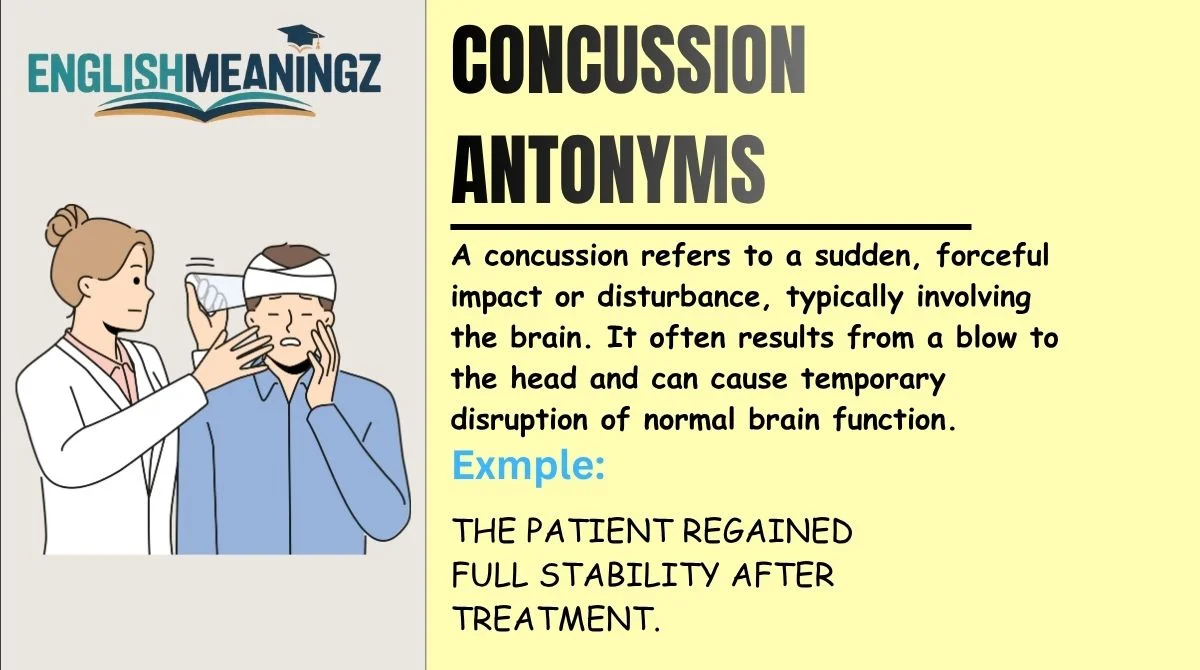
A concussion refers to a sudden, forceful impact or disturbance, typically involving the brain. It often results from a blow to the head and can cause temporary disruption of normal brain function.
Tone Explanation
The word carries a medical and serious tone, often used in formal, clinical, or safety-related contexts.
Emotional or Action Intensity
Concussion implies:
- High intensity
- Sudden disruption
- Physical trauma or shock
Because of this, its antonyms generally revolve around:
- Stability
- Calmness
- Protection
- Mental clarity
- Lack of impact
15 Best Antonyms for “Concussion”
Stability
Meaning: A state of balance and firmness
Tone: Formal / Academic
Example: The patient regained full stability after treatment.
Why it’s opposite: Concussion implies disruption, while stability represents steadiness and control.
Calmness
Meaning: A peaceful, undisturbed state
Tone: Emotional / Informal
Example: She maintained calmness even in stressful situations.
Why it’s opposite: Concussion involves shock and disturbance; calmness reflects the absence of both.
Protection
Meaning: The act of keeping someone safe from harm
Tone: Formal
Example: Helmets provide protection during sports.
Why it’s opposite: Concussion results from injury; protection prevents it.
Clarity
Meaning: Clear thinking or understanding
Tone: Academic
Example: After resting, he regained mental clarity.
Why it’s opposite: Concussion often causes confusion, while clarity is its mental opposite.
Harmony
Meaning: A state of agreement or peaceful coexistence
Tone: Emotional / Formal
Example: The team worked in harmony to complete the project.
Why it’s opposite: Concussion disrupts normal function; harmony maintains balance.
Safety
Meaning: Freedom from danger or risk
Tone: Formal
Example: Workplace safety is a top priority.
Why it’s opposite: Concussion is a harmful event; safety ensures no harm occurs.
Smoothness
Meaning: Evenness without disturbance
Tone: Informal
Example: The ride was marked by smoothness and comfort.
Why it’s opposite: Concussion suggests impact and disruption; smoothness implies continuity.
Peace
Meaning: Freedom from disturbance or conflict
Tone: Emotional
Example: He enjoys the peace of a quiet environment.
Why it’s opposite: Concussion is disruptive; peace is undisturbed.
Composure
Meaning: Calm self-control
Tone: Formal
Example: She handled the crisis with composure.
Why it’s opposite: Concussion creates chaos internally; composure reflects control.
Balance
Meaning: Physical or mental steadiness
Tone: Academic
Example: Yoga improves balance and coordination.
Why it’s opposite: Concussion often disrupts balance; this word restores the idea of equilibrium.
Wellness
Meaning: A state of good health
Tone: Formal
Example: Regular exercise promotes overall wellness.
Why it’s opposite: Concussion is an injury; wellness indicates health.
Tranquility
Meaning: Deep calm and serenity
Tone: Emotional / Formal
Example: The lake offered complete tranquility.
Why it’s opposite: Concussion involves sudden impact; tranquility reflects stillness.
Preservation
Meaning: Maintenance of something in its original state
Tone: Academic
Example: Proper care ensures the preservation of health.
Why it’s opposite: Concussion damages; preservation maintains.
Ease
Meaning: Comfort without difficulty or strain
Tone: Informal
Example: He completed the task with ease.
Why it’s opposite: Concussion implies strain and shock; ease removes both.
Normalcy
Meaning: The state of being normal
Tone: Formal
Example: She returned to normalcy after recovery.
Why it’s opposite: Concussion disrupts normal functioning; normalcy restores it.
Strong vs Mild Opposites
Not all antonyms carry the same level of contrast. Some are strong opposites, directly reversing the meaning, while others are mild opposites, offering contextual contrast.
Strong Opposites
- Stability
- Safety
- Clarity
- Wellness
These directly counter the core effects of concussion: instability, danger, confusion, and injury.
Mild Opposites
- Calmness
- Ease
- Harmony
- Peace
These don’t directly negate the medical condition but oppose its emotional or situational effects.
Intensity Scale Insight
Think of it like a spectrum:
Concussion (high disruption) → instability → imbalance → discomfort → calm → peace → tranquility (low disturbance)
Understanding this scale helps you choose the right antonym based on context.
Context-Based Opposites
Antonyms change depending on how “concussion” is used.
Medical Context
- Opposites: wellness, health, recovery
- Example: “The athlete showed no signs of concussion and remained in perfect health.”
Emotional Context
- Opposites: calmness, peace, composure
- Example: “Instead of panic, she responded with calmness.”
Physical Movement Context
- Opposites: smoothness, balance
- Example: “The motion was smooth, with no sudden impact.”
Safety Context
- Opposites: protection, safety
- Example: “Proper gear ensures protection from injury.”
Common Mistakes When Using Opposites
Using unrelated words
Incorrect: Concussion → happiness
Correct: Use words related to stability or safety.
Ignoring tone
Incorrect: Using informal words in academic writing
Correct: Choose “stability” instead of “chillness” in formal contexts.
Confusing synonyms with antonyms
Incorrect: Concussion → injury
Correct: That’s a synonym, not an opposite.
Overgeneralizing
Incorrect: Using “peace” in a strictly medical report
Correct: Use “wellness” or “stability” instead.
Sentence Transformation Examples
Original → With Antonym
- The player suffered a concussion during the match.
→ The player remained in perfect health and stability during the match. - The accident caused a severe concussion.
→ The situation ensured complete safety and protection. - He experienced confusion after the concussion.
→ He maintained full clarity throughout the event. - The impact led to a concussion.
→ The movement was handled with smoothness and balance. - The injury disrupted his normal life.
→ He continued his life with complete normalcy and ease.
FAQs
What is the exact opposite of concussion?
There is no single exact opposite, but “stability,” “wellness,” and “clarity” are the closest depending on context.
Are concussion antonyms always medical?
No. Some relate to emotional or physical states, such as calmness or balance.
Can “peace” be used as an antonym?
Yes, but only in emotional or situational contexts, not strict medical writing.
Which antonym is best for academic writing?
“Stability,” “clarity,” and “wellness” are most appropriate in formal contexts.
Why are there multiple antonyms?
Because “concussion” has multiple dimensions—physical, mental, and emotional.
Is “safety” a direct antonym?
Yes, in contexts where concussion is viewed as a preventable injury.
How do I choose the right antonym?
Focus on context: medical, emotional, or situational.
Conclusion
Mastering concussion antonyms gives you more than vocabulary—it gives you precision. Instead of repeating ideas or using vague language, you can express exact contrasts that enhance clarity and professionalism.
From strong opposites like stability and wellness to softer contrasts like calmness and peace, each word serves a unique purpose. The key is understanding context, tone, and intensity.
If you apply these strategically, your writing will become sharper, more engaging, and far more effective in 2026 and beyond.