A rich vocabulary is one of the strongest indicators of effective writing. Whether someone is preparing academic essays, publishing blog articles, or writing professional reports, the ability to use varied vocabulary significantly improves clarity and impact.
One common way to strengthen writing is by replacing repetitive words with accurate synonyms.
Using synonyms strategically enhances readability, demonstrates linguistic competence, and often leads to higher writing scores in academic assessments.
Examiners in standardized tests such as IELTS and university-level writing assignments typically reward lexical variety because it shows mastery of language.
The word “disposition” appears frequently in academic writing, psychology, law, and everyday communication. However, repeating the same word repeatedly can weaken the quality of a text. Learning its synonyms allows writers to express subtle variations in meaning while maintaining precision.
Students benefit from synonym usage in essays and research papers. Bloggers rely on vocabulary diversity for search engine optimization and reader engagement.
Professionals in fields like psychology, law, and management use nuanced vocabulary to communicate complex ideas clearly.
This comprehensive guide explores 24 synonyms of “disposition,” explains their meanings, and demonstrates how to use them correctly in different contexts. It also highlights common mistakes, provides academic examples, and offers practical exercises to strengthen vocabulary skills.
Definition and Core Meaning of “Disposition”
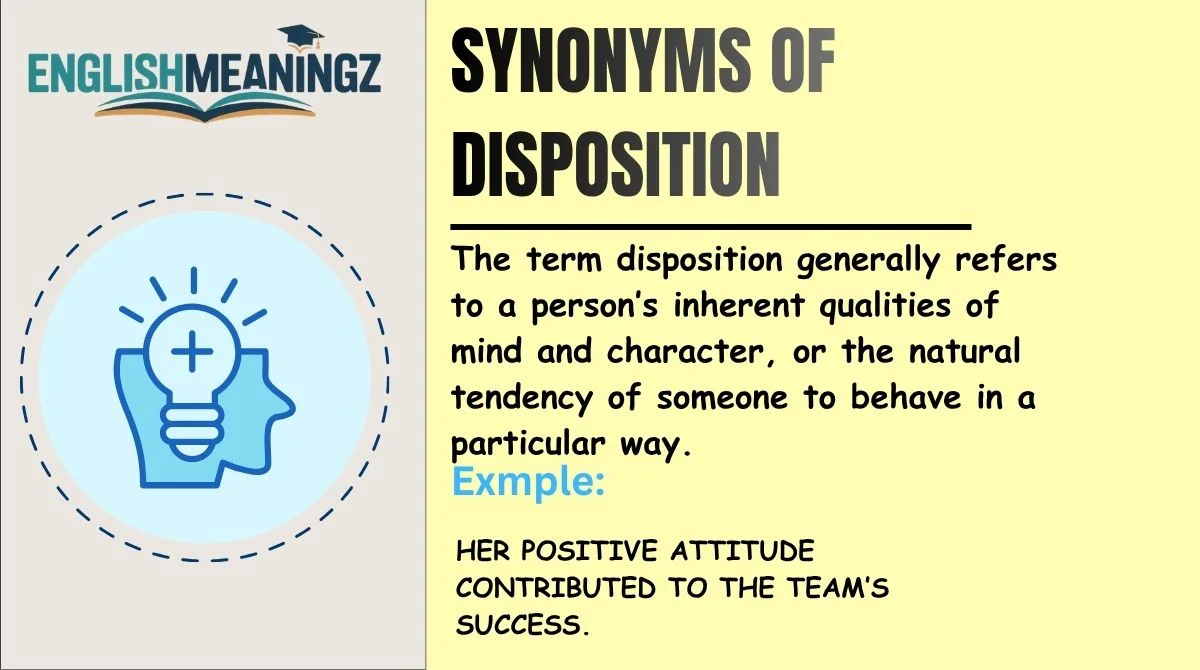
The term disposition generally refers to a person’s inherent qualities of mind and character, or the natural tendency of someone to behave in a particular way.
In everyday language, disposition often describes someone’s temperament, attitude, or personality traits. For example, a person might be described as having a cheerful disposition or a calm disposition.
In more specialized fields, the word carries additional meanings:
Psychology:
Disposition refers to a person’s stable personality traits or behavioral tendencies.
Law:
Disposition can refer to the final settlement or resolution of a legal case.
Medicine:
In medical contexts, disposition sometimes indicates a patient’s post-treatment status or care plan.
Despite these contextual variations, the central idea remains the same: a tendency, character, or arrangement that determines how something behaves or is handled.
Understanding this core meaning helps writers choose the most accurate synonym depending on the situation.
24 Synonyms Grouped by Context
General Use
Temperament
Meaning: A person’s natural emotional makeup or mood pattern.
Context Explanation:
Temperament is commonly used in psychology and everyday descriptions of personality.
Example Sentence:
Her calm temperament helped her manage stressful situations effectively.
Character
Meaning: The combination of qualities that define a person’s moral and psychological traits.
Context Explanation:
Character often emphasizes ethical or moral aspects of personality.
Example Sentence:
His strong character made him a respected leader in the community.
Nature
Meaning: The inherent qualities that define how someone typically behaves.
Context Explanation:
Nature often describes someone’s instinctive personality.
Example Sentence:
It was in her generous nature to help people in need.
Personality
Meaning: The set of traits that influence how a person thinks, feels, and behaves.
Context Explanation:
Personality is widely used in psychology and everyday conversation.
Example Sentence:
His friendly personality made him popular among colleagues.
Attitude
Meaning: A person’s mental outlook or perspective toward situations.
Context Explanation:
Attitude focuses more on mindset than long-term personality traits.
Example Sentence:
Her positive attitude contributed to the team’s success.
Temper
Meaning: A person’s tendency to become angry or emotionally reactive.
Context Explanation:
Temper describes emotional responses, particularly anger.
Example Sentence:
His quick temper sometimes created tension in meetings.
Formal & Academic Writing
Inclination
Meaning: A natural tendency to behave or think in a particular way.
Context Explanation:
Inclination is frequently used in academic and formal writing.
Example Sentence:
Researchers observed a strong inclination toward cooperative behavior.
Propensity
Meaning: A strong natural tendency toward a specific behavior.
Context Explanation:
Propensity often appears in academic research and psychology.
Example Sentence:
The study examined the propensity for risk-taking among adolescents.
Predisposition
Meaning: A tendency to develop certain behaviors or conditions.
Context Explanation:
Common in psychology and medical research.
Example Sentence:
Genetic factors may create a predisposition to anxiety disorders.
Tendency
Meaning: A pattern of behavior that occurs regularly.
Context Explanation:
Used widely in research papers and analytical writing.
Example Sentence:
The data revealed a tendency toward cautious decision-making.
Orientation
Meaning: A person’s general outlook or approach toward something.
Context Explanation:
Often used in academic discussions of ideology or perspective.
Example Sentence:
His research reflects a strong environmental orientation.
Outlook
Meaning: A person’s general perspective on life or situations.
Context Explanation:
Outlook emphasizes mental perspective.
Example Sentence:
A positive outlook can improve resilience during challenges.
Informal Usage
Mindset
Meaning: A habitual way of thinking.
Context Explanation:
Mindset is widely used in motivational and self-development contexts.
Example Sentence:
Developing a growth mindset improves learning outcomes.
Mood
Meaning: A temporary emotional state.
Context Explanation:
Unlike disposition, mood changes frequently.
Example Sentence:
Her cheerful mood brightened the entire office.
Spirit
Meaning: A person’s enthusiasm, courage, or emotional energy.
Context Explanation:
Spirit emphasizes positivity and motivation.
Example Sentence:
The team’s competitive spirit drove them to victory.
Way
Meaning: A typical manner of behaving.
Context Explanation:
Way is an informal substitute in casual conversation.
Example Sentence:
His quiet way of speaking reflected his thoughtful personality.
Style
Meaning: A characteristic manner of acting or performing tasks.
Context Explanation:
Often used to describe behavioral approaches.
Example Sentence:
Her leadership style encourages collaboration.
Technical or Subject-Specific Use
Disposition (Legal Sense Alternative: Settlement)
Meaning: The final decision or resolution of a legal matter.
Context Explanation:
Used frequently in legal documentation.
Example Sentence:
The court reached a settlement after months of negotiation.
Resolution
Meaning: The formal conclusion of a dispute or issue.
Context Explanation:
Common in law and organizational decision-making.
Example Sentence:
The resolution of the conflict restored workplace harmony.
Arrangement
Meaning: An organized structure or plan.
Context Explanation:
Often used when discussing organizational systems.
Example Sentence:
The arrangement of responsibilities improved efficiency.
Configuration
Meaning: The structural setup or organization of elements.
Context Explanation:
Common in technical and engineering contexts.
Example Sentence:
The configuration of the system determines its performance.
Structure
Meaning: The organized pattern of components.
Context Explanation:
Used in academic disciplines including sociology and architecture.
Example Sentence:
The structure of the organization influences its culture.
Composition
Meaning: The combination of elements forming a whole.
Context Explanation:
Often used in chemistry, art, and writing.
Example Sentence:
The composition of the team balanced experience and innovation.
Framework
Meaning: A conceptual structure guiding analysis or understanding.
Context Explanation:
Common in academic research.
Example Sentence:
The theoretical framework explained the behavioral patterns observed.
Word Intensity & Tone Comparison Table
| Word | Formal Level | Emotional Strength | Typical Context |
|---|---|---|---|
| Temperament | Medium | Moderate | Personality discussion |
| Character | Formal | Strong | Moral evaluation |
| Attitude | Neutral | Moderate | Workplace or social behavior |
| Inclination | Formal | Mild | Academic writing |
| Propensity | Very Formal | Neutral | Research papers |
| Predisposition | Technical | Mild | Medical and psychology |
| Mindset | Informal | Moderate | Self-development |
| Outlook | Neutral | Mild | Personal perspective |
| Temper | Informal | Strong | Emotional behavior |
| Orientation | Formal | Neutral | Academic contexts |
Common Mistakes When Using These Synonyms
Mistake 1: Replacing Words Without Considering Context
Incorrect:
He has a cheerful framework.
Correct:
He has a cheerful disposition.
Explanation:
Framework refers to structure, not personality.
Mistake 2: Confusing Temporary States With Permanent Traits
Incorrect:
Her happy mood describes her personality.
Correct:
Her happy temperament describes her personality.
Explanation:
Mood is temporary, while temperament is stable.
Mistake 3: Using Informal Words in Academic Writing
Incorrect:
The participants showed a positive mindset toward the task.
Correct:
The participants showed a positive inclination toward the task.
Synonyms in Academic Writing
Example Paragraph 1
Individual behavior is often influenced by underlying personality traits. Researchers have long studied how temperament and predisposition shape decision-making processes. For instance, individuals with a cautious temperament may exhibit a stronger inclination toward risk avoidance. These psychological tendencies significantly affect professional performance and social interactions.
Example Paragraph 2
Educational psychology frequently examines the relationship between mindset and academic achievement. Students who maintain a growth-oriented outlook tend to demonstrate persistence when facing challenges. Such attitudes contribute to long-term academic success and intellectual development.
IELTS & Exam Writing Tips
Avoid Repetition
In exam essays, repeating the same word weakens vocabulary scores. Instead of repeating “disposition,” alternate with:
- temperament
- inclination
- tendency
- outlook
Example:
Weak sentence:
His disposition affects his work performance, and his disposition also influences teamwork.
Improved sentence:
His disposition affects his work performance, and his temperament also influences teamwork.
When NOT to Replace the Word
Sometimes synonyms do not fit perfectly.
Example:
Legal context:
The court announced the disposition of the case.
Here, replacing the word with “temperament” or “attitude” would be incorrect.
Always check whether the synonym matches the specific meaning required in context.
Similar Words vs True Synonyms
Many words appear similar to disposition but carry slightly different meanings.
Temperament vs Personality
Temperament refers to emotional tendencies, while personality includes broader psychological traits.
Attitude vs Disposition
Attitude describes a viewpoint toward something, whereas disposition refers to overall behavioral tendencies.
Mood vs Disposition
Mood is temporary; disposition is long-term.
Understanding these distinctions ensures accurate word choice in academic writing.
Practice Sentences
Choose the most appropriate synonym.
- Her calm ______ helped resolve the conflict.
- The study examined students’ ______ toward collaborative learning.
- His aggressive ______ sometimes caused disagreements.
- Genetic factors may influence a person’s ______ to certain diseases.
- The manager’s leadership ______ encouraged innovation.
Answers:
- temperament
- inclination
- temper
- predisposition
- style
FAQs
What is the best synonym for disposition?
The best synonym depends on context. Common alternatives include temperament, character, attitude, and inclination.
Is temperament the same as disposition?
Temperament is very close in meaning, but it usually focuses more on emotional behavior.
Which synonym is best for academic writing?
Formal synonyms such as inclination, propensity, predisposition, and tendency are preferred in academic writing.
Can mood replace disposition?
No. Mood is temporary, while disposition refers to long-term personality traits.
Why is using synonyms important in writing?
Using synonyms prevents repetition, improves vocabulary scores, and enhances clarity in academic and professional communication.
Conclusion
Expanding vocabulary is an essential step toward becoming a skilled writer. Understanding the various synonyms of “disposition” allows writers to express personality traits, behavioral tendencies, and structural arrangements with greater precision.
Students preparing for exams benefit from improved lexical diversity, while bloggers and professionals produce clearer and more engaging content.
By learning when and how to use alternatives such as temperament, inclination, mindset, and predisposition, writers can strengthen both academic and professional communication.
Consistent practice, careful attention to context, and awareness of subtle differences between synonyms will gradually build a stronger vocabulary and more effective writing style.