Understanding opposites is one of the most effective ways to sharpen your language skills.
When you learn antonyms, you don’t just expand your vocabulary—you deepen your ability to express contrast, precision, and nuance.
This is especially valuable in academic writing, professional communication, and even creative expression.
In writing, contrast creates clarity. When you can confidently switch between a word and its opposite, your arguments become more persuasive, your storytelling more engaging, and your communication more impactful.
Mastering antonyms of sophisticated words like sojourn helps you move beyond basic language and into a more refined, articulate style.
What Does “Sojourn” Mean?
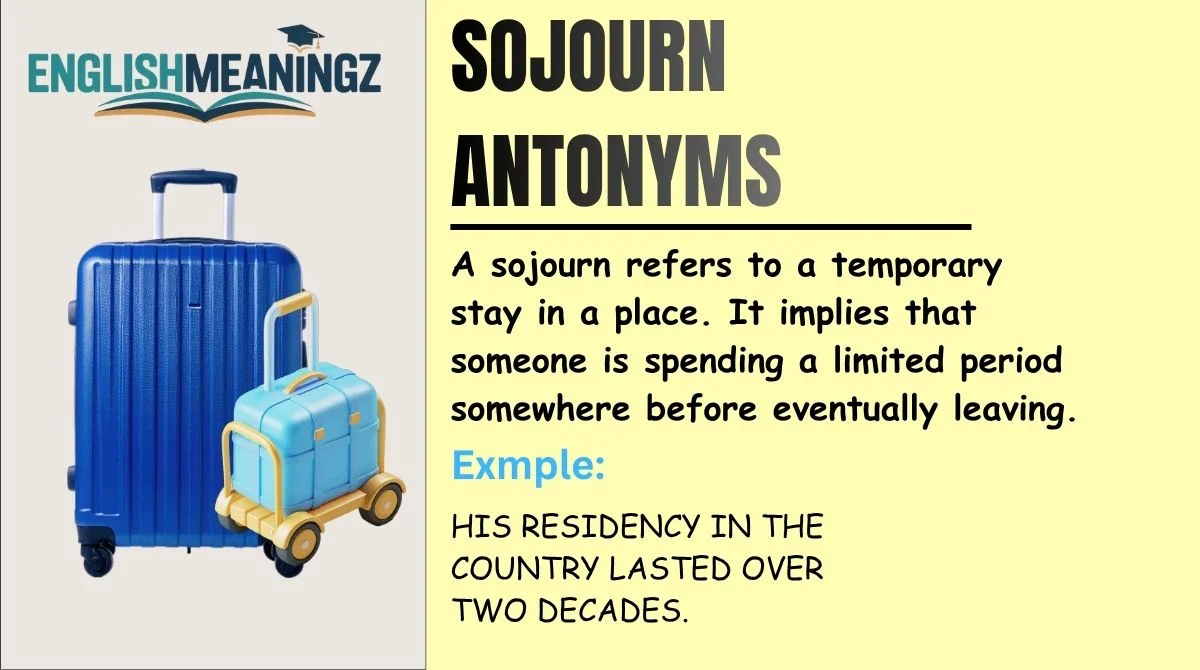
A sojourn refers to a temporary stay in a place. It implies that someone is spending a limited period somewhere before eventually leaving. The word is often used in formal or literary contexts and carries a slightly elegant tone.
Tone Explanation:
“Sojourn” is typically formal and somewhat poetic. It suggests intention and awareness of time—this is not a random visit, but a purposeful, temporary stay.
Emotional or Action Intensity:
The word conveys calmness and temporariness. It does not imply urgency or permanence. Instead, it reflects a gentle pause in movement—like a traveler resting before continuing their journey.
13 Best Antonyms for “Sojourn”
Permanent Residence
Meaning: Living in a place indefinitely
Tone: Formal / Academic
Example: She chose permanent residence in the city after years of travel.
Why it’s opposite: A sojourn is temporary, while permanent residence implies no intention of leaving.
Settlement
Meaning: Establishing a stable home
Tone: Formal
Example: The family’s settlement in the countryside marked the end of their wandering life.
Why it’s opposite: Settlement emphasizes stability and long-term commitment, unlike a brief stay.
Residency
Meaning: Official or long-term living in a place
Tone: Formal / Academic
Example: His residency in the country lasted over two decades.
Why it’s opposite: Residency indicates extended duration, contrasting with the temporary nature of a sojourn.
Permanence
Meaning: The state of lasting forever or indefinitely
Tone: Academic
Example: The monument symbolizes permanence and legacy.
Why it’s opposite: Sojourn implies impermanence, while permanence suggests no end.
Stability
Meaning: Consistency and lack of movement
Tone: Neutral / Academic
Example: She valued stability over constant travel.
Why it’s opposite: A sojourn involves movement and transition; stability reflects staying put.
Rootedness
Meaning: Being firmly established in one place
Tone: Emotional / Literary
Example: His sense of rootedness kept him from moving abroad.
Why it’s opposite: Rootedness suggests deep attachment to one place, unlike a temporary stay.
Fixity
Meaning: The quality of being fixed or unchanging
Tone: Formal
Example: The fixity of his lifestyle contrasted with her adventurous spirit.
Why it’s opposite: Sojourn implies movement; fixity implies no change or relocation.
Continuity
Meaning: Ongoing, uninterrupted presence
Tone: Academic
Example: The continuity of her presence reassured the team.
Why it’s opposite: A sojourn is a break in continuity, not a continuation.
Long-term Stay
Meaning: Extended duration in one place
Tone: Neutral
Example: His long-term stay turned into a permanent move.
Why it’s opposite: Unlike a short, temporary stay, this suggests duration and commitment.
Establishment
Meaning: Setting up a base or foundation
Tone: Formal
Example: The establishment of their home marked a new chapter.
Why it’s opposite: Establishment implies permanence, whereas sojourn is temporary.
Endurance
Meaning: The ability to last over time
Tone: Academic / Emotional
Example: Their relationship showed endurance through hardships.
Why it’s opposite: Sojourn suggests a limited timeframe; endurance implies longevity.
Anchoring
Meaning: Securing firmly in one place
Tone: Emotional / Metaphorical
Example: Family provided emotional anchoring in uncertain times.
Why it’s opposite: Anchoring contrasts with the transient nature of a sojourn.
Permanency
Meaning: Lasting or intended to last indefinitely
Tone: Formal
Example: The job offered a sense of permanency he had never experienced before.
Why it’s opposite: Permanency directly opposes the temporary essence of a sojourn.
Strong vs Mild Opposites
Not all antonyms carry the same intensity. Some completely oppose the idea of a sojourn, while others offer a softer contrast.
Strong Opposites:
Words like permanence, permanent residence, and settlement directly contradict the temporary nature of a sojourn. These indicate a complete shift from short-term to indefinite duration.
Mild Opposites:
Words like stability or continuity suggest reduced movement but do not always guarantee permanence. They provide contrast without being absolute opposites.
Understanding this intensity scale helps you choose the right word based on context. Strong antonyms work best in formal arguments, while mild ones suit nuanced writing.
Context-Based Opposites
Antonyms often depend on context rather than strict dictionary definitions.
- In travel context, “sojourn” may be opposed by settlement or permanent residence.
- In emotional context, it might contrast with rootedness or anchoring.
- In professional context, long-term placement or residency may serve as antonyms.
This flexibility highlights the importance of understanding meaning beyond memorization. Always consider the situation before selecting an antonym.
Common Mistakes When Using Opposites
Mistake 1: Using unrelated words
Incorrect: He ended his sojourn with a vacation.
Correct: He ended his sojourn by settling permanently.
Mistake 2: Ignoring tone
Using informal words like “stay forever” in academic writing weakens clarity. Prefer permanence or residency instead.
Mistake 3: Confusing duration with action
“Sojourn” refers to duration, not activity. Its opposite should also relate to duration, not actions like “travel” or “leave.”
Mistake 4: Overgeneralizing antonyms
Not every long stay is a true opposite. The key contrast is temporary vs lasting.
Sentence Transformation Examples
Original: She enjoyed her sojourn in Paris.
Rewritten: She chose permanent residence in Paris.
Original: His sojourn in the village was brief.
Rewritten: His settlement in the village lasted a lifetime.
Original: The sojourn gave him time to reflect.
Rewritten: His long-term residency allowed continuous reflection.
Original: They planned a short sojourn abroad.
Rewritten: They planned a permanent relocation abroad.
Original: Her sojourn ended after a month.
Rewritten: Her permanency in the city extended indefinitely.
FAQs
What is the simplest antonym of “sojourn”?
The simplest antonym is permanent residence, as it directly contrasts temporary stay with long-term living.
Is “home” an antonym of “sojourn”?
Not exactly. “Home” is a place, while “sojourn” describes a duration. However, in context, it can suggest permanence.
Can “settlement” be used in formal writing?
Yes, it is highly appropriate in academic and professional contexts.
Are all antonyms of “sojourn” related to time?
Yes, most opposites focus on duration—temporary versus permanent.
Is “residency” stronger than “stay”?
Yes, “residency” implies formality and longer duration, making it a stronger antonym.
Can antonyms change based on context?
Absolutely. The best opposite depends on how “sojourn” is used in a sentence.
Why is learning antonyms important?
It improves clarity, enhances expression, and strengthens both written and spoken communication.
Conclusion
Mastering antonyms of sophisticated words like sojourn is more than a vocabulary exercise—it’s a powerful tool for clear and effective communication.
By understanding the contrast between temporary and permanent states, you gain the ability to express ideas with precision and confidence.
Whether you’re writing academically, professionally, or creatively, choosing the right opposite word can transform your message.
Focus on context, tone, and intensity, and you’ll elevate your language to a much higher level.