Understanding opposites is one of the fastest ways to sharpen your vocabulary and elevate your writing. When you know not only what a word means—but also what it does not mean—you gain precision, flexibility, and control over your expression.
This is especially important in academic, business, and professional communication, where subtle differences in word choice can completely change meaning.
Learning antonyms of commonly used words like contract allows you to write more clearly, avoid repetition, and communicate nuanced ideas.
Whether you’re writing essays, reports, emails, or creative content, having a strong grasp of opposites improves both clarity and impact.
In this guide, you’ll explore the best antonyms of “contract,” understand their tones and contexts, and learn how to use them effectively.
What Does “Contract” Mean?
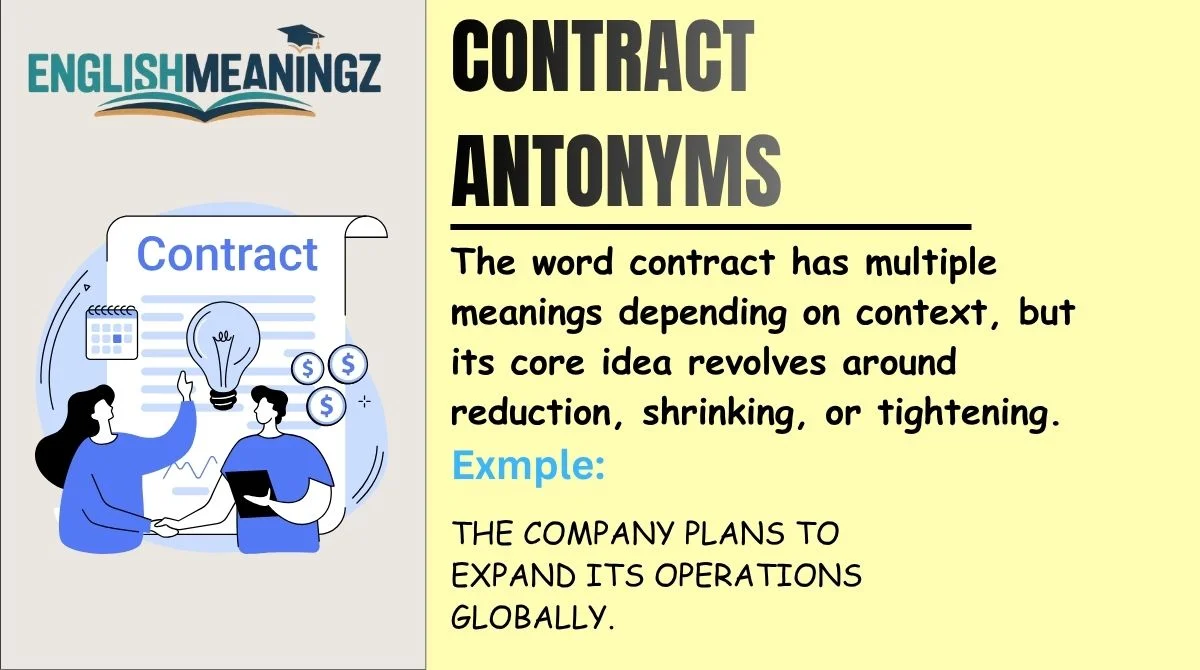
The word contract has multiple meanings depending on context, but its core idea revolves around reduction, shrinking, or tightening.
Core Definition
To contract means:
- To become smaller in size, volume, or scope
- To shrink, compress, or draw together
Tone Explanation
The tone of contract is generally neutral to formal. It is commonly used in:
- Scientific writing (e.g., muscles contract)
- Business or economics (e.g., market contraction)
- Everyday language (e.g., cold weather causes materials to contract)
Emotional or Action Intensity
The word implies a controlled or natural reduction, not necessarily sudden or extreme. It often suggests:
- Gradual shrinking
- Physical tightening
- Decrease in scale or extent
13 Best Antonyms for “Contract”
Below are powerful opposites of contract, each explained with meaning, tone, examples, and reasoning.
Expand
Meaning: To increase in size, volume, or scope
Tone: Neutral / Academic
Example: The company plans to expand its operations globally.
Why It’s Opposite: Expansion directly contrasts shrinking, representing growth instead of reduction.
Enlarge
Meaning: To make something bigger
Tone: Neutral
Example: She enlarged the image to see the details clearly.
Why It’s Opposite: Enlargement reverses contraction by increasing physical dimensions.
Stretch
Meaning: To extend or lengthen
Tone: Informal / Neutral
Example: The fabric stretches easily when pulled.
Why It’s Opposite: Stretching increases length, opposing the tightening effect of contraction.
Inflate
Meaning: To fill with air or increase in size
Tone: Neutral / Scientific
Example: The balloon inflates rapidly when air is pumped in.
Why It’s Opposite: Inflation causes expansion, directly opposing contraction.
Grow
Meaning: To increase naturally over time
Tone: Neutral
Example: The population continues to grow each year.
Why It’s Opposite: Growth implies expansion rather than reduction.
Extend
Meaning: To lengthen or widen
Tone: Formal
Example: The road extends beyond the hills.
Why It’s Opposite: Extension increases reach or length, opposing contraction.
Spread
Meaning: To cover a wider area
Tone: Neutral
Example: The news spread quickly across the city.
Why It’s Opposite: Spreading increases coverage, unlike contracting which reduces it.
Broaden
Meaning: To widen in scope or understanding
Tone: Academic
Example: The course helped broaden her perspective.
Why It’s Opposite: Broadening expands scope, the opposite of narrowing or contracting.
Amplify
Meaning: To increase intensity or volume
Tone: Formal / Academic
Example: The speaker used a microphone to amplify his voice.
Why It’s Opposite: Amplification increases strength or magnitude, unlike contraction.
Dilate
Meaning: To expand or open wider
Tone: Scientific
Example: The pupils dilate in low light.
Why It’s Opposite: Dilation is a direct physical opposite of contraction.
Widen
Meaning: To make something broader
Tone: Neutral
Example: The gap between them widened over time.
Why It’s Opposite: Widening increases space, opposite of shrinking.
Prolong
Meaning: To extend in duration
Tone: Formal
Example: The meeting was prolonged due to discussions.
Why It’s Opposite: While contraction reduces, prolonging increases duration.
Escalate
Meaning: To increase in intensity or scale
Tone: Formal / Professional
Example: The conflict escalated quickly.
Why It’s Opposite: Escalation moves upward in intensity, unlike contraction which reduces.
Strong vs Mild Opposites
Not all antonyms carry the same intensity. Some are strong opposites, while others are more subtle.
Strong Opposites
These directly reverse contraction:
- Expand
- Inflate
- Dilate
- Enlarge
They indicate clear physical or measurable growth.
Mild Opposites
These imply gradual or contextual increase:
- Grow
- Broaden
- Extend
- Spread
They are useful in abstract or metaphorical contexts.
Intensity Scale Example
- Contract → Slight increase → Grow → Expand → Inflate
Understanding this scale helps you choose the right antonym depending on context.
Context-Based Opposites
The best antonym depends heavily on how contract is used.
Physical Context
- Contract (muscles) → Dilate / Expand
Business Context
- Contract (economy) → Grow / Expand
Emotional Context
- Contract (fear tightening chest) → Relax / Open
Spatial Context
- Contract (space shrinking) → Widen / Spread
Choosing the wrong antonym can make your sentence sound unnatural or incorrect.
Common Mistakes When Using Opposites
Using Incorrect Context
❌ The balloon grew (less precise)
✔ The balloon inflated
Mixing Physical and Abstract Meanings
❌ His ideas inflated (awkward)
✔ His ideas expanded
Overusing Generic Opposites
❌ The company got bigger
✔ The company expanded
Ignoring Tone
❌ The pupils grew (scientifically weak)
✔ The pupils dilated
Using Near-Opposites Incorrectly
❌ The situation spread instead of contract
✔ The situation escalated
Sentence Transformation Examples
Here are five examples showing how antonyms improve clarity:
Example 1
Original: The material contracts in cold weather.
Rewritten: The material expands in warm conditions.
Example 2
Original: The company contracted during the recession.
Rewritten: The company expanded after the recovery.
Example 3
Original: His muscles contracted tightly.
Rewritten: His muscles relaxed and expanded.
Example 4
Original: The space seemed to contract.
Rewritten: The space appeared to widen.
Example 5
Original: The project scope contracted.
Rewritten: The project scope broadened.
FAQs
What is the simplest antonym of contract?
The simplest and most common antonym is expand, as it directly represents the opposite action.
Are all antonyms of contract physical?
No, many are abstract, such as broaden or escalate, depending on context.
Can “grow” always replace contract?
Not always. “Grow” works in general contexts but may lack precision in scientific or technical usage.
What is the scientific opposite of contract?
In scientific contexts, dilate or expand are the most accurate opposites.
Is “inflate” always an antonym of contract?
Only in contexts involving air, pressure, or size increase—not abstract situations.
Why is context important when choosing antonyms?
Because the meaning of contract changes depending on usage, and the opposite must match that specific meaning.
How can I improve my vocabulary with antonyms?
Practice rewriting sentences, learn words in context, and group antonyms by intensity and usage.
Conclusion
Mastering antonyms of contract is more than just memorizing words—it’s about understanding how language works in different contexts.
From precise scientific terms like dilate to broader expressions like expand and grow, each opposite adds a new layer of clarity and sophistication to your writing.
When you choose the right antonym, you don’t just avoid repetition—you communicate with purpose, accuracy, and impact.
Keep practicing, focus on context, and your vocabulary will naturally become sharper and more versatile.