Understanding opposites is one of the fastest ways to sharpen your writing. When you know not just what a word means—but also what it doesn’t mean—you gain precision, control, and flexibility.
This is especially important for high-level communication, where subtle differences in tone can influence how your message is received.
In academic and professional settings, vocabulary depth signals clarity of thought. Using accurate antonyms allows you to contrast ideas, critique performance, and present balanced arguments.
Instead of sounding vague or repetitive, your writing becomes more analytical, persuasive, and impactful.
This guide explores 15 carefully selected antonyms of “exemplary,” each explained with clarity, tone guidance, and real-world usage.
What Does “Exemplary” Mean?
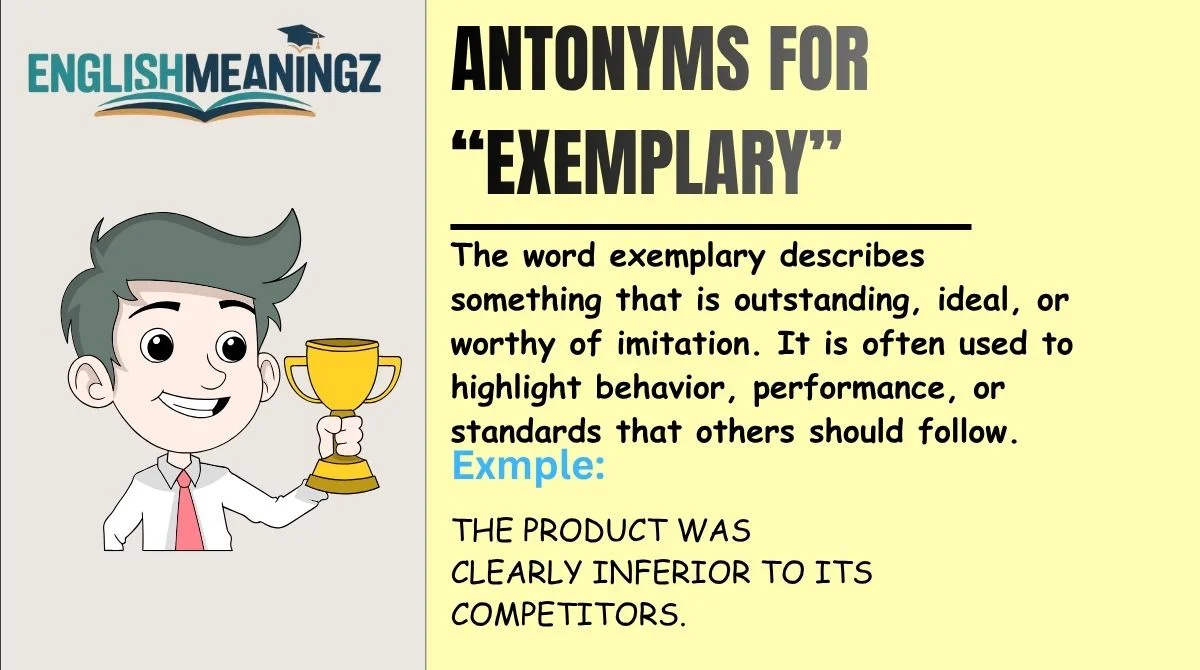
The word exemplary describes something that is outstanding, ideal, or worthy of imitation. It is often used to highlight behavior, performance, or standards that others should follow.
Tone Explanation:
“Exemplary” carries a highly positive and often formal tone. It is commonly used in professional evaluations, academic writing, and official recognition.
Emotional or Action Intensity:
This word represents the highest level of quality or conduct. It implies not just being good, but being a model of excellence.
15 Best Antonyms for “Exemplary”
1. Inferior
Meaning: Lower in quality or value
Tone: Formal
Example: The product was clearly inferior to its competitors.
Why Opposite: “Exemplary” suggests top-tier quality, while “inferior” implies below standard.
2. Mediocre
Meaning: Average, not impressive
Tone: Neutral / Academic
Example: His performance was mediocre despite high expectations.
Why Opposite: Exemplary stands out; mediocre blends in without distinction.
3. Poor
Meaning: Lacking quality or effectiveness
Tone: Neutral
Example: The report received poor feedback from the supervisor.
Why Opposite: Exemplary work exceeds standards; poor work fails to meet them.
4. Inadequate
Meaning: Not sufficient or acceptable
Tone: Formal / Academic
Example: The explanation was inadequate for a scientific paper.
Why Opposite: Exemplary work is complete and thorough; inadequate work falls short.
5. Deficient
Meaning: Missing essential qualities
Tone: Formal
Example: The system is deficient in security features.
Why Opposite: Exemplary implies completeness; deficient indicates lack.
6. Substandard
Meaning: Below the accepted level
Tone: Formal
Example: Substandard materials led to structural issues.
Why Opposite: Exemplary exceeds standards; substandard fails to meet them.
7. Flawed
Meaning: Containing mistakes or weaknesses
Tone: Neutral
Example: The argument was flawed and lacked evidence.
Why Opposite: Exemplary work is nearly flawless, while flawed work contains errors.
8. Unremarkable
Meaning: Not noteworthy or special
Tone: Neutral
Example: The presentation was unremarkable and quickly forgotten.
Why Opposite: Exemplary stands out; unremarkable fades into the background.
9. Bad
Meaning: Of low quality or poor standard
Tone: Informal
Example: That was a bad decision for the company.
Why Opposite: Exemplary is highly positive; bad is broadly negative.
10. Faulty
Meaning: Containing defects or errors
Tone: Formal
Example: The machine stopped due to faulty wiring.
Why Opposite: Exemplary implies perfection; faulty suggests malfunction.
11. Ineffective
Meaning: Not producing desired results
Tone: Academic / Formal
Example: The strategy proved ineffective in achieving goals.
Why Opposite: Exemplary achieves results efficiently; ineffective does not.
12. Disappointing
Meaning: Failing to meet expectations
Tone: Emotional
Example: The outcome was disappointing after months of effort.
Why Opposite: Exemplary exceeds expectations; falls below them.
13. Unsatisfactory
Meaning: Not acceptable or adequate
Tone: Formal
Example: The results were unsatisfactory for c.
Why Opposite: Exemplary meets the standards; does not.
14. Negligent
Meaning: Careless or lacking responsibility
Tone: Formal / Legal
Example: The staff was negligent in handling safety procedures.
Why Opposite: Exemplary behavior is responsible and careful; negligent behavior is careless.
15. Shoddy
Meaning: Poorly made or done carelessly
Tone: Informal
Example: The construction work was shoddy and unsafe.
Why Opposite: Exemplary reflects craftsmanship; shoddy reflects carelessness.
Strong vs Mild Opposites
Not all antonyms carry the same intensity. Understanding this difference helps you choose the right word for the context.
Strong Opposites:
Words like negligent, shoddy, faulty, and inferior express a clear and often harsh contrast. These are suitable for critical evaluations or strong opinions.
Mild Opposites:
Words like mediocre, unremarkable, and ineffective are softer. They suggest a lack of excellence without being overly negative.
Intensity Scale Insight:
- Exemplary → Outstanding
- Mediocre → Average
- Poor → Below Average
- Shoddy / Negligent → Critically Bad
Choosing the right level of intensity ensures your message is accurate and appropriate.
Context-Based Opposites
Antonyms are not always fixed—they can change depending on the situation.
- In academic writing, “inadequate” or “unsatisfactory” may be better than “bad.”
- In business communication, “substandard” or “ineffective” sounds more professional.
- In casual speech, “poor” or “bad” may suffice.
For example:
- “Exemplary leadership” → “Ineffective leadership” (professional context)
- “Exemplary behavior” → “Negligent behavior” (ethical context)
Understanding context ensures precision and avoids awkward phrasing.
Common Mistakes When Using Opposites
1. Using overly harsh words unnecessarily
Incorrect: The presentation was negligent.
Correct: The presentation was mediocre.
Why: “Negligent” implies carelessness, not just average performance.
2. Confusing tone levels
Incorrect: The report was bad (in formal writing).
Correct: The report was unsatisfactory.
Why: Formal contexts require appropriate vocabulary.
3. Misjudging intensity
Incorrect: The system is shoddy (for minor flaws).
Correct: The system is flawed.
Why: “Shoddy” suggests severe issues.
4. Using antonyms without context
Incorrect: The teacher was ineffective (without explanation).
Correct: The teacher was ineffective in explaining complex topics.
Why: Clarity strengthens communication.
Sentence Transformation Examples
1. Original: Her performance was exemplary.
Rewritten: Her performance was mediocre.
2. Original: The team delivered exemplary results.
Rewritten: The team delivered unsatisfactory results.
3. Original: He showed exemplary leadership skills.
Rewritten: He demonstrated ineffective leadership skills.
4. Original: The project execution was exemplary.
Rewritten: The project execution was flawed.
5. Original: Their service is exemplary.
Rewritten: Their service is disappointing.
FAQs
What is the simplest antonym of “exemplary”?
The simplest antonym is “poor,” as it directly contrasts high quality with low quality.
Which antonym is best for academic writing?
“Inadequate” and “unsatisfactory” are ideal due to their formal tone.
Is “mediocre” a strong opposite?
No, it is a mild antonym that indicates average quality rather than failure.
Can “bad” replace all antonyms of exemplary?
No, “bad” is too general and informal for precise communication.
What is the strongest antonym in this list?
“Negligent” and “shoddy” are among the strongest due to their critical tone.
Are antonyms always exact opposites?
Not always. Many are context-dependent and vary in intensity.
Why should I learn multiple antonyms?
It improves vocabulary flexibility, tone control, and writing precision.
Conclusion
Mastering antonyms of “exemplary” gives you a powerful advantage in communication. Instead of relying on vague or repetitive language, you can express precise levels of quality, criticism, and evaluation.
Whether you are writing academically, professionally, or creatively, understanding these opposites allows you to control tone, sharpen arguments, and communicate with confidence.
The key is not just memorizing words—but understanding their intensity, context, and nuance.
With the 15 antonyms covered here, you now have a versatile toolkit to elevate your vocabulary in 2026 and beyond.