Strong writing is not only about what you say—it’s about how precisely you say it. One of the most effective ways to elevate your language is by mastering opposites.
Understanding antonyms allows you to control tone, emphasize contrast, and communicate ideas with clarity and impact.
In both academic and professional communication, the ability to replace a word like multitude with its exact opposite can dramatically shift meaning.
Whether you’re crafting essays, reports, or persuasive content, knowing the right antonym ensures your message is accurate, concise, and powerful.
What Does “Multitude” Mean?
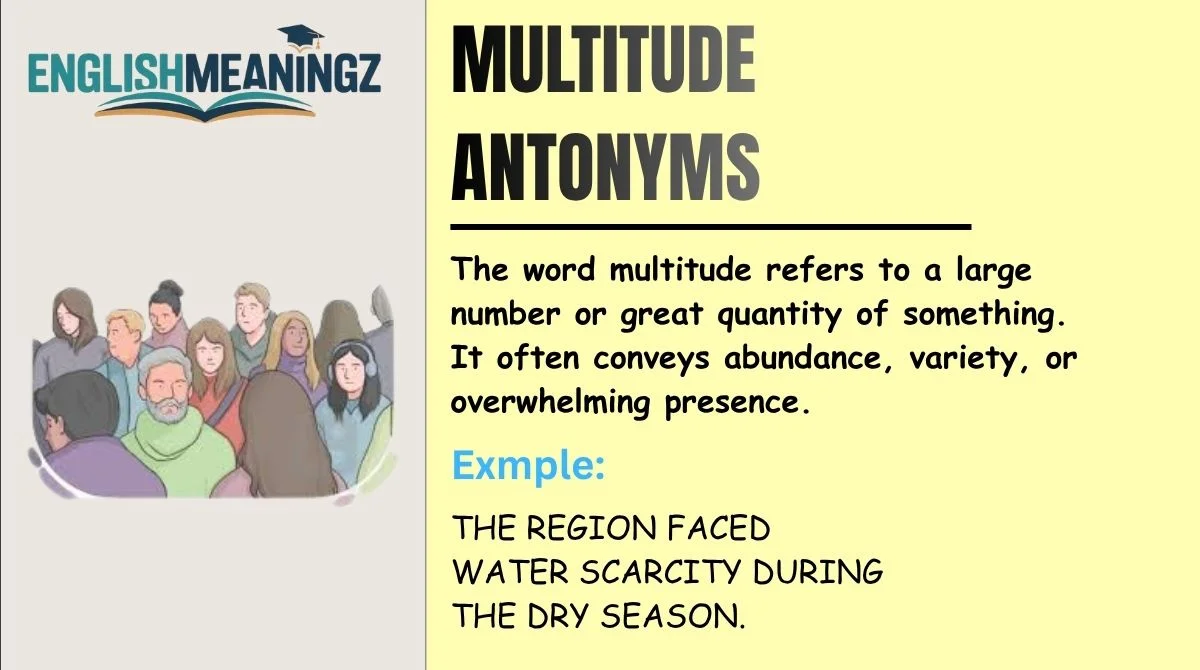
The word multitude refers to a large number or great quantity of something. It often conveys abundance, variety, or overwhelming presence.
Tone Explanation:
“Multitude” carries a slightly formal tone and is commonly used in academic, literary, or professional contexts.
Emotional or Intensity Insight:
It suggests excess, abundance, or overflow. The word implies not just “many,” but so many that they are difficult to count or manage.
15 Best Antonyms for “Multitude”
Scarcity
Meaning: A very limited supply
Tone: Formal / Academic
Example: The region faced water scarcity during the dry season.
Why it’s opposite: It directly contrasts abundance with shortage.
Few
Meaning: A small number
Tone: Neutral
Example: Only a few students attended the lecture.
Why it’s opposite: Reduces quantity from many to minimal.
Lack
Meaning: Absence or deficiency
Tone: Formal
Example: There is a lack of resources in rural schools.
Why it’s opposite: Highlights insufficiency instead of plenty.
Shortage
Meaning: Not enough supply
Tone: Formal
Example: The company experienced a shortage of materials.
Why it’s opposite: Opposes large quantity with inadequate amount.
Limited
Meaning: Restricted in amount
Tone: Neutral
Example: Seating is limited for the event.
Why it’s opposite: Suggests constraint rather than abundance.
Minimal
Meaning: Barely sufficient
Tone: Academic
Example: The damage was minimal after the storm.
Why it’s opposite: Indicates the smallest possible amount.
Deficiency
Meaning: Inadequacy or insufficiency
Tone: Academic
Example: A deficiency in nutrients can cause health issues.
Why it’s opposite: Signals absence where there should be plenty.
Rare
Meaning: Not common or frequent
Tone: Neutral
Example: Such talent is rare in young athletes.
Why it’s opposite: Opposes frequency and abundance.
Sparse
Meaning: Thinly distributed or scattered
Tone: Descriptive / Formal
Example: The desert had sparse vegetation.
Why it’s opposite: Contrasts density with thinness.
Insufficient
Meaning: Not enough to meet needs
Tone: Formal
Example: The evidence was insufficient to support the claim.
Why it’s opposite: Replaces plenty with inadequacy.
Meager
Meaning: Very small or inadequate
Tone: Slightly emotional
Example: He earned a meager salary.
Why it’s opposite: Emphasizes disappointing smallness.
Single
Meaning: Only one
Tone: Neutral
Example: A single error changed the outcome.
Why it’s opposite: Moves from many to just one.
Isolated
Meaning: Occurring alone
Tone: Formal
Example: The issue was an isolated incident.
Why it’s opposite: Opposes collective presence with singularity.
Dearth
Meaning: Extreme scarcity
Tone: Academic
Example: There is a dearth of reliable data.
Why it’s opposite: Strong opposite emphasizing lack.
Trickle
Meaning: A very small flow or amount
Tone: Informal / Descriptive
Example: Only a trickle of visitors came to the museum.
Why it’s opposite: Contrasts overwhelming quantity with barely any.
Strong vs Mild Opposites
Not all antonyms carry the same intensity. Some express a complete absence, while others suggest a reduction in quantity.
Strong opposites:
- Depletion-level words like dearth, scarcity, and deficiency
- These imply serious lack or critical shortage
Mild opposites:
- Words like few, limited, and minimal
- These suggest reduction but not complete absence
Insight:
Choosing between strong and mild antonyms depends on context. Academic writing often favors precision, while creative writing may use stronger contrasts for emphasis.
Context-Based Opposites
Antonyms are not always fixed—they depend on usage.
- In business writing, “multitude” may be opposed by limited resources
- In scientific contexts, it might be replaced with insufficient data
- In casual conversation, “a multitude of options” becomes just a few choices
Key Insight:
The best antonym is the one that fits the situation, tone, and purpose.
Common Mistakes When Using Opposites
1. Using weak opposites
Incorrect: A multitude of ideas → some ideas
Better: A multitude of ideas → a few ideas
2. Ignoring tone mismatch
Incorrect: Multitude → tiny bit (too informal)
Better: Multitude → minimal amount
3. Confusing rarity with absence
Incorrect: Multitude → rare (not always exact)
Better: Use scarcity or lack for clearer contrast
4. Overgeneralizing antonyms
Not every opposite works in every sentence.
Sentence Transformation Examples
Original: The company has a multitude of clients.
Rewritten: The company has a limited number of clients.
Original: She presented a multitude of arguments.
Rewritten: She presented only a few arguments.
Original: The forest contains a multitude of species.
Rewritten: The forest has sparse species diversity.
Original: There are a multitude of opportunities available.
Rewritten: There are minimal opportunities available.
Original: The report includes a multitude of errors.
Rewritten: The report includes only a single error.
FAQs
What is the closest antonym of “multitude”?
The closest antonyms are scarcity and few, depending on context.
Is “few” always the best opposite?
No. It works in general contexts, but academic writing may require insufficient or limited.
Can “single” be an antonym of multitude?
Yes, when emphasizing contrast between many and one.
What is a strong opposite of multitude?
Words like dearth and scarcity provide stronger contrast.
Are antonyms always exact opposites?
Not always. Many are context-based rather than absolute.
How do I choose the right antonym?
Consider tone, intensity, and the sentence purpose.
Why is learning antonyms important?
It improves clarity, enhances contrast, and strengthens communication.
Conclusion
Mastering antonyms of multitude gives you precise control over language.
Whether you’re writing academically, professionally, or creatively, knowing how to shift from abundance to scarcity allows you to express ideas with clarity and authority.
The right opposite word doesn’t just change meaning—it transforms the impact of your message.