Understanding opposites is one of the fastest ways to sharpen your writing. When you know not just what a word means but also what it doesn’t mean, you gain precision, clarity, and stylistic control.
This is especially useful for academic essays, professional reports, and persuasive content where nuance matters.
Antonyms help you avoid repetition, strengthen arguments, and present contrasts effectively. In academic and professional communication, the ability to switch between a concept and its opposite allows you to explain ideas more completely and demonstrate deeper linguistic awareness.
In this guide, we’ll explore 19 powerful antonyms of “milieu”, along with meanings, tone, examples, and contextual explanations.
What Does “Milieu” Mean?
Milieu refers to the environment, setting, or social context in which something exists or develops. It often describes the cultural, social, or physical surroundings influencing a person or event.
Tone Explanation
The word “milieu” is typically formal and academic. It appears frequently in scholarly writing, literature, and intellectual discussions rather than casual conversation.
Emotional or Action Intensity
“Milieu” carries a neutral tone but implies subtle influence. It doesn’t suggest action directly; instead, it reflects a background force shaping behavior, identity, or outcomes.
19 Best Antonyms for “Milieu”
Isolation
Meaning: A state of being separated from surroundings or society
Tone: Emotional / Formal
Example: He lived in complete isolation, far removed from any social influence.
Why it’s an opposite: “Milieu” implies connection to surroundings, while isolation removes that connection.
Detachment
Meaning: Lack of emotional or physical connection
Tone: Academic
Example: Her detachment from the workplace culture was evident.
Why it’s an opposite: Milieu suggests immersion; detachment suggests disconnection.
Separation
Meaning: The act of being set apart
Tone: Formal
Example: The separation from his cultural roots affected his identity.
Why it’s an opposite: Milieu integrates; separation divides.
Alienation
Meaning: Feeling estranged or excluded
Tone: Emotional
Example: He experienced alienation in a society that didn’t accept him.
Why it’s an opposite: Milieu nurtures belonging; alienation removes it.
Vacuum
Meaning: An absence of surrounding influence
Tone: Academic
Example: Ideas cannot develop in a vacuum.
Why it’s an opposite: Milieu provides context; a vacuum lacks it entirely.
Disconnection
Meaning: Lack of link or interaction
Tone: Neutral
Example: There was a clear disconnection between him and his environment.
Why it’s an opposite: Milieu implies interaction; disconnection denies it.
Independence
Meaning: Freedom from external influence
Tone: Formal
Example: She built her identity with complete independence from societal norms.
Why it’s an opposite: Milieu shapes; independence resists shaping.
Solitude
Meaning: Being alone
Tone: Emotional
Example: He preferred solitude over social environments.
Why it’s an opposite: Milieu involves surroundings; solitude removes them.
Exclusion
Meaning: Being left out
Tone: Formal
Example: Social exclusion limited his opportunities.
Why it’s an opposite: Milieu includes; exclusion denies participation.
Disengagement
Meaning: Withdrawal from involvement
Tone: Academic
Example: Disengagement from the cultural scene reduced his influence.
Why it’s an opposite: Milieu requires engagement; disengagement rejects it.
Rootlessness
Meaning: Lack of connection to a place or culture
Tone: Emotional
Example: His constant travel led to a sense of rootlessness.
Why it’s an opposite: Milieu provides grounding; rootlessness removes it.
Estrangement
Meaning: Emotional distance or separation
Tone: Formal
Example: Estrangement from society shaped his worldview.
Why it’s an opposite: Milieu connects individuals; estrangement distances them.
Void
Meaning: Empty space lacking influence
Tone: Academic
Example: Creativity struggles in a void of inspiration.
Why it’s an opposite: Milieu offers richness; void implies emptiness.
Displacement
Meaning: Being removed from a familiar environment
Tone: Formal
Example: Displacement disrupted his sense of identity.
Why it’s an opposite: Milieu anchors; displacement uproots.
Withdrawal
Meaning: Pulling away from surroundings
Tone: Emotional
Example: His withdrawal from social circles was noticeable.
Why it’s an opposite: Milieu involves presence; withdrawal removes it.
Autonomy
Meaning: Self-governance without external influence
Tone: Academic
Example: The project was completed with full autonomy.
Why it’s an opposite: Milieu influences; autonomy resists influence.
Detachment from Context
Meaning: Lack of situational connection
Tone: Academic
Example: The argument suffered from detachment from context.
Why it’s an opposite: Milieu provides context; this removes it.
Nonconformity
Meaning: Refusal to adapt to social surroundings
Tone: Formal
Example: His nonconformity set him apart from the group.
Why it’s an opposite: Milieu shapes conformity; nonconformity resists it.
Isolationism
Meaning: Policy or state of avoiding external influence
Tone: Academic
Example: Isolationism limited cultural exchange.
Why it’s an opposite: Milieu thrives on interaction; isolationism avoids it.
Strong vs Mild Opposites
Not all antonyms carry the same intensity. Some strongly oppose “milieu,” while others offer a softer contrast.
Strong Opposites:
Words like vacuum, void, isolation, and alienation represent complete absence of environment or influence. These are powerful contrasts and often used in academic or philosophical writing.
Mild Opposites:
Terms like detachment, independence, and disengagement suggest partial separation rather than total absence. They are more flexible and commonly used in everyday writing.
Key Insight:
Choose stronger antonyms when emphasizing contrast and weaker ones when showing subtle differences.
Context-Based Opposites
Antonyms depend heavily on context. “Milieu” can mean social, cultural, or physical environment, so its opposite changes accordingly.
- Social context: Alienation, exclusion
- Physical environment: Vacuum, void
- Cultural setting: Rootlessness, displacement
- Psychological connection: Detachment, disengagement
Example:
- In sociology → “alienation” works best
- In science → “vacuum” is more accurate
Common Mistakes When Using Opposites
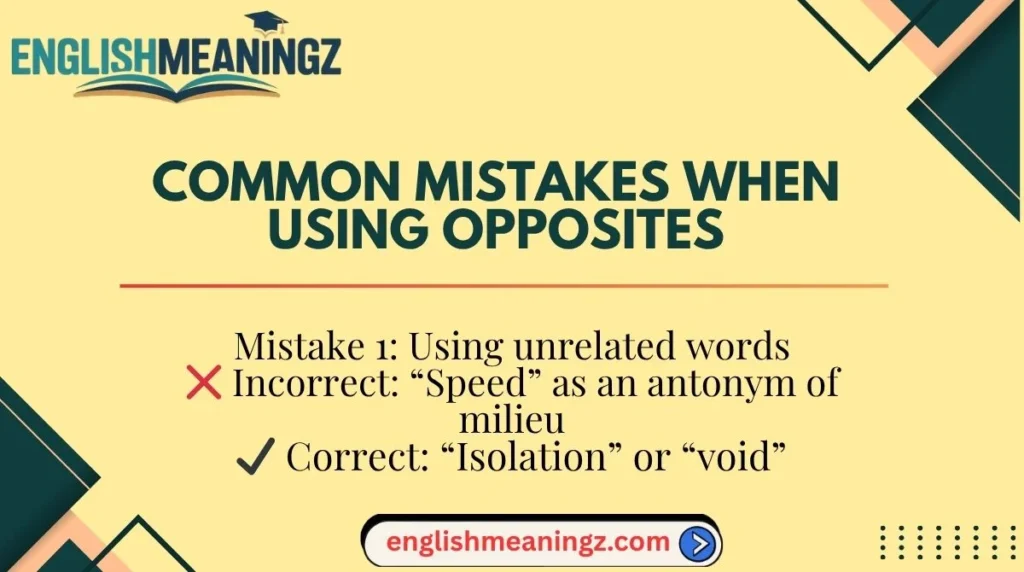
Mistake 1: Using unrelated words
❌ Incorrect: “Speed” as an antonym of milieu
✔ Correct: “Isolation” or “void”
Mistake 2: Ignoring tone
❌ Using “alone” in academic writing
✔ Use “solitude” or “isolation”
Mistake 3: Overusing one antonym
❌ Repeating “isolation” everywhere
✔ Rotate with synonyms like “detachment” or “alienation”
Mistake 4: Context mismatch
❌ Using “vacuum” in emotional writing
✔ Use “alienation” instead
Sentence Transformation Examples
Original → Rewritten
Original: She thrived in a creative milieu.
Rewritten: She struggled in complete isolation.
Original: His success was shaped by his academic milieu.
Rewritten: His success developed independently of any environment.
Original: The cultural milieu influenced his art.
Rewritten: His art emerged from a void of cultural influence.
Original: He adapted quickly to his new milieu.
Rewritten: He remained detached from his surroundings.
Original: The social milieu encouraged collaboration.
Rewritten: Social alienation discouraged collaboration.
FAQs
What is the simplest antonym of milieu?
“Isolation” is the most straightforward and commonly used opposite.
Is “vacuum” a correct antonym of milieu?
Yes, especially in academic or scientific contexts where absence of environment is implied.
Can “independence” be an antonym of milieu?
Yes, when referring to freedom from environmental influence.
Which antonym is best for emotional writing?
“Alienation” or “estrangement” works best due to their emotional depth.
Are all antonyms of milieu negative?
Most carry a negative or neutral tone, as they imply lack of connection or context.
Can I use “solitude” as an antonym?
Yes, particularly in informal or literary contexts.
Why is context important when choosing antonyms?
Because “milieu” can refer to different types of environments, and the opposite must match that specific meaning.
Conclusion
Mastering antonyms like those of “milieu” significantly enhances your writing precision. Instead of relying on a single concept, you gain the ability to express contrast, depth, and nuance.
Whether you’re writing academically, professionally, or creatively, these opposites help you communicate more effectively.
By understanding both strong and mild antonyms, as well as context-based usage, you can choose the most accurate word every time. This not only improves clarity but also strengthens your authority as a writer.