Understanding opposites is one of the fastest ways to elevate your writing from basic to sophisticated. When you know not just what a word means—but also what it does not mean—you gain sharper control over tone, clarity, and expression.
This is especially valuable for writers, students, and professionals who want to communicate with precision.
Opposites, or antonyms, help create contrast, emphasize ideas, and avoid repetition. In academic and professional communication, they allow you to present balanced arguments, refine meaning, and articulate subtle differences.
If you rely on a narrow vocabulary, your writing can feel flat. But when you actively use antonyms, your language becomes dynamic and impactful.
In this guide, we explore the keyword “periscope antonyms”—breaking down the meaning of periscope and presenting 17 strong opposites with clear explanations and examples.
What Does “Periscope” Mean?
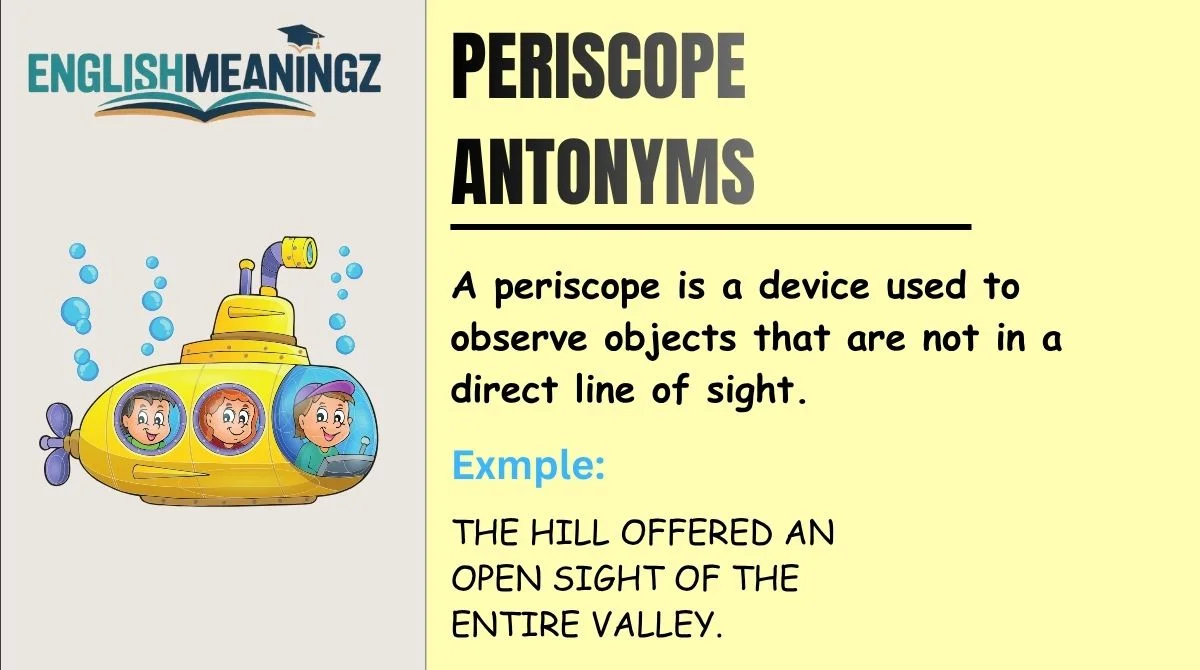
A periscope is a device used to observe objects that are not in a direct line of sight. It is commonly associated with submarines, allowing users to see above the water while remaining hidden below.
Core Definition
A periscope enables indirect viewing, typically from a concealed or protected position.
Tone Explanation
The word carries a technical and observational tone. It is often used in scientific, military, or metaphorical contexts.
Emotional or Action Intensity
Periscope implies:
- Distance from the subject
- Indirect awareness
- Controlled or limited visibility
Because of this, its antonyms generally relate to:
- Direct observation
- Full exposure
- Open visibility
17 Best Antonyms for “Periscope”
Direct View
Meaning: Seeing something without any obstruction
Tone: Neutral / Academic
Example: She had a direct view of the stage from her seat.
Why it’s an opposite: A periscope enables indirect vision, while direct view removes all barriers.
Open Sight
Meaning: Clear and unobstructed line of sight
Tone: Formal
Example: The hill offered an open sight of the entire valley.
Why it’s an opposite: Periscopes are used when sight is blocked; open sight means nothing is hidden.
Exposure
Meaning: Being fully visible or uncovered
Tone: Formal / Academic
Example: The exposure of the structure made it vulnerable.
Why it’s an opposite: A periscope hides the observer, while exposure reveals everything.
Transparency
Meaning: Complete clarity and visibility
Tone: Academic
Example: Transparency in communication builds trust.
Why it’s an opposite: Periscopes limit visibility; transparency enhances it.
Visibility
Meaning: The state of being easily seen
Tone: Neutral
Example: Fog reduced visibility on the road.
Why it’s an opposite: A periscope compensates for poor visibility; this word represents the opposite condition.
Open Observation
Meaning: Watching something without concealment
Tone: Formal
Example: The experiment was conducted under open observation.
Why it’s an opposite: Periscopes allow hidden observation; this implies full openness.
Clear View
Meaning: An unobstructed perspective
Tone: Informal / Neutral
Example: From the balcony, we had a clear view of the ocean.
Why it’s an opposite: Periscopes are used when clarity is not naturally available.
Full Exposure
Meaning: Total visibility without protection
Tone: Formal
Example: The soldiers were in full exposure during the operation.
Why it’s an opposite: A periscope protects and hides; this removes protection.
Face-to-Face View
Meaning: Direct visual interaction
Tone: Informal
Example: The meeting allowed a face-to-face view of the client.
Why it’s an opposite: Periscopes create distance; this removes it entirely.
Uncovered Perspective
Meaning: A viewpoint without barriers
Tone: Academic
Example: The report offered an uncovered perspective on the issue.
Why it’s an opposite: Periscopes operate under concealment; this suggests openness.
Plain Sight
Meaning: Easily visible without effort
Tone: Informal
Example: The keys were hidden in plain sight.
Why it’s an opposite: Periscopes reveal hidden things; plain sight removes the need for tools.
Open Display
Meaning: Something shown publicly
Tone: Formal
Example: The artwork was placed on open display.
Why it’s an opposite: Periscopes are about hidden observation; this is about public visibility.
Surface Viewing
Meaning: Observing from an exposed position
Tone: Neutral
Example: Surface viewing gave a better understanding of the terrain.
Why it’s an opposite: A periscope is used below the surface; this occurs above it.
Immediate Observation
Meaning: Seeing something instantly without tools
Tone: Academic
Example: Immediate observation revealed the flaw.
Why it’s an opposite: Periscopes delay and mediate viewing; this removes mediation.
Open Perspective
Meaning: A broad and unobstructed viewpoint
Tone: Formal
Example: The discussion encouraged an open perspective.
Why it’s an opposite: Periscopes restrict angles; this expands them.
Revealed View
Meaning: A view that is fully uncovered
Tone: Neutral
Example: The curtain lifted to reveal the view.
Why it’s an opposite: Periscopes hide and reveal indirectly; this is direct revelation.
Direct Observation
Meaning: Watching something firsthand
Tone: Academic
Example: The scientist relied on direct observation.
Why it’s an opposite: A periscope introduces distance and tools; this eliminates both.
Strong vs Mild Opposites
Not all antonyms carry the same intensity. Some are strong opposites, completely reversing the concept of a periscope, while others are mild opposites, offering partial contrast.
Strong Opposites
- Exposure
- Full Exposure
- Direct Observation
- Plain Sight
These words eliminate all elements of concealment and indirect viewing.
Mild Opposites
- Clear View
- Visibility
- Open Perspective
These reduce the need for a periscope but do not completely negate its concept.
Understanding this intensity scale helps you choose the most precise word for your context.
Context-Based Opposites
Antonyms can change depending on how periscope is used.
Physical Context
If referring to the device:
- Opposite: Direct view, surface viewing
Metaphorical Context
If referring to indirect awareness:
- Opposite: Transparency, openness
Strategic Context
If implying hidden observation:
- Opposite: Exposure, open display
Choosing the right antonym depends entirely on context—not just dictionary meaning.
Common Mistakes When Using Opposites
Using unrelated words
❌ Incorrect: “Blindness” as an antonym
✔ Correct: “Direct observation”
Blindness removes sight entirely, while periscope still involves seeing.
Confusing intensity
❌ Incorrect: Using “clear view” when “full exposure” is needed
✔ Correct: Match intensity with context
Ignoring context
❌ Incorrect: Using “transparency” in a physical setting
✔ Correct: Use “direct view” for physical situations
Overgeneralization
❌ Incorrect: Treating all antonyms as interchangeable
✔ Correct: Each antonym carries a specific nuance
Sentence Transformation Examples
Original → With Antonym
- He used a periscope to observe the enemy.
→ He relied on direct observation to see the enemy. - The submarine depended on its periscope.
→ The crew operated in full exposure above the surface. - She viewed the situation like a periscope observer.
→ She approached the situation with complete transparency. - The device allowed hidden viewing.
→ The scene was visible in plain sight. - The periscope provided limited perspective.
→ The hill offered an open perspective.
FAQs
What is the simplest antonym of periscope?
The simplest antonym is direct view, as it removes the need for indirect observation.
Are periscope antonyms always about visibility?
Mostly yes, but they can also relate to openness, exposure, and transparency.
Can “transparency” be an antonym of periscope?
Yes, especially in metaphorical contexts involving clarity and openness.
Is “blindness” an antonym of periscope?
No, because a periscope still enables vision, while blindness removes it.
Why are there multiple antonyms for one word?
Because meaning changes based on context, tone, and usage.
Which antonym is strongest?
“Full exposure” and “direct observation” are among the strongest opposites.
How can I remember antonyms effectively?
Use them in sentences and compare their intensity and context regularly.
Conclusion
Mastering antonyms like those of periscope is not just about expanding vocabulary—it’s about gaining precision and control in communication.
Whether you’re writing academically, professionally, or creatively, knowing how to contrast ideas effectively can transform your language.
The 17 antonyms explored here give you a wide range of options—from subtle contrasts like clear view to strong opposites like full exposure. By understanding context, tone, and intensity, you can select the most accurate word every time.
Develop this habit consistently, and your writing will become clearer, sharper, and far more impactful.